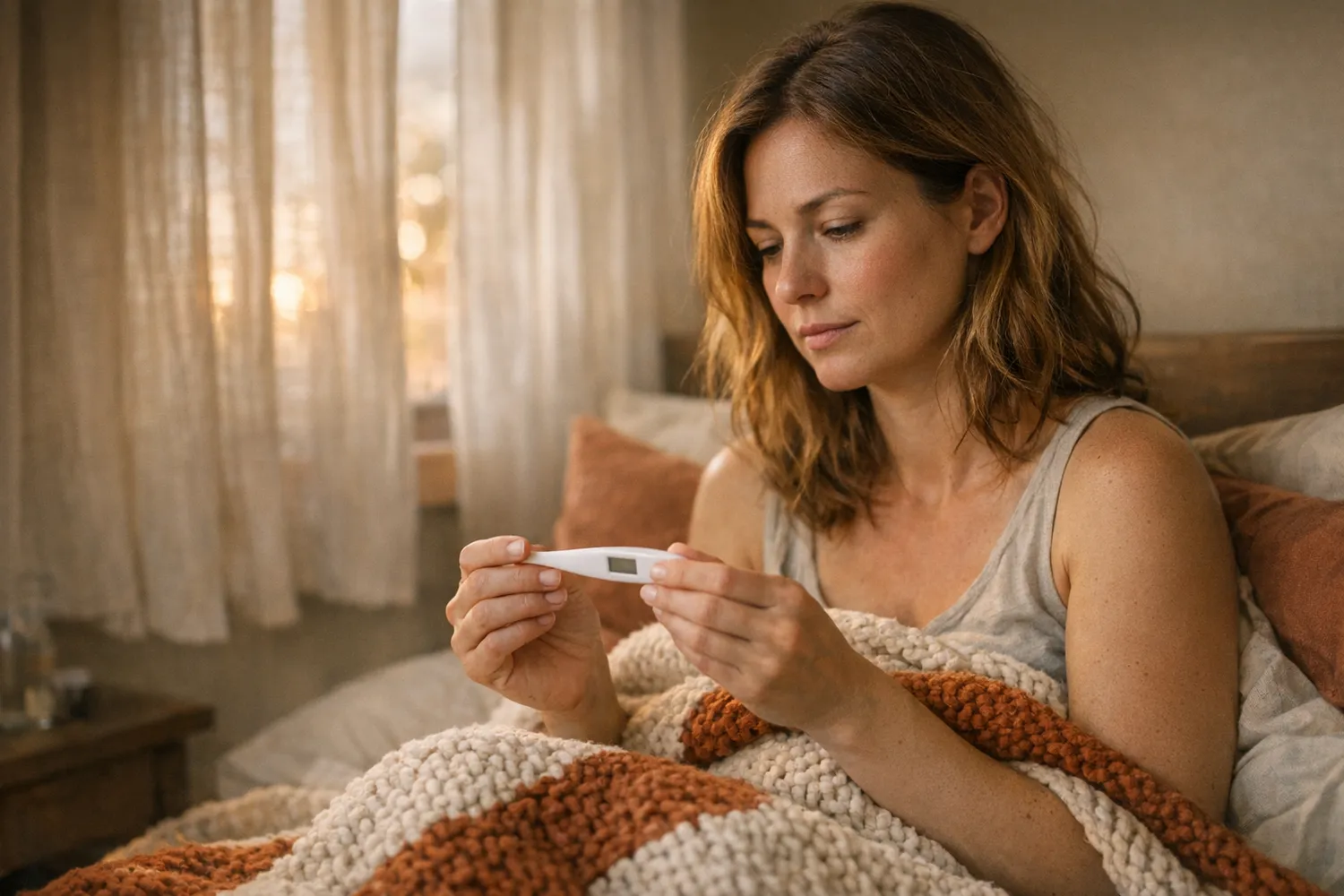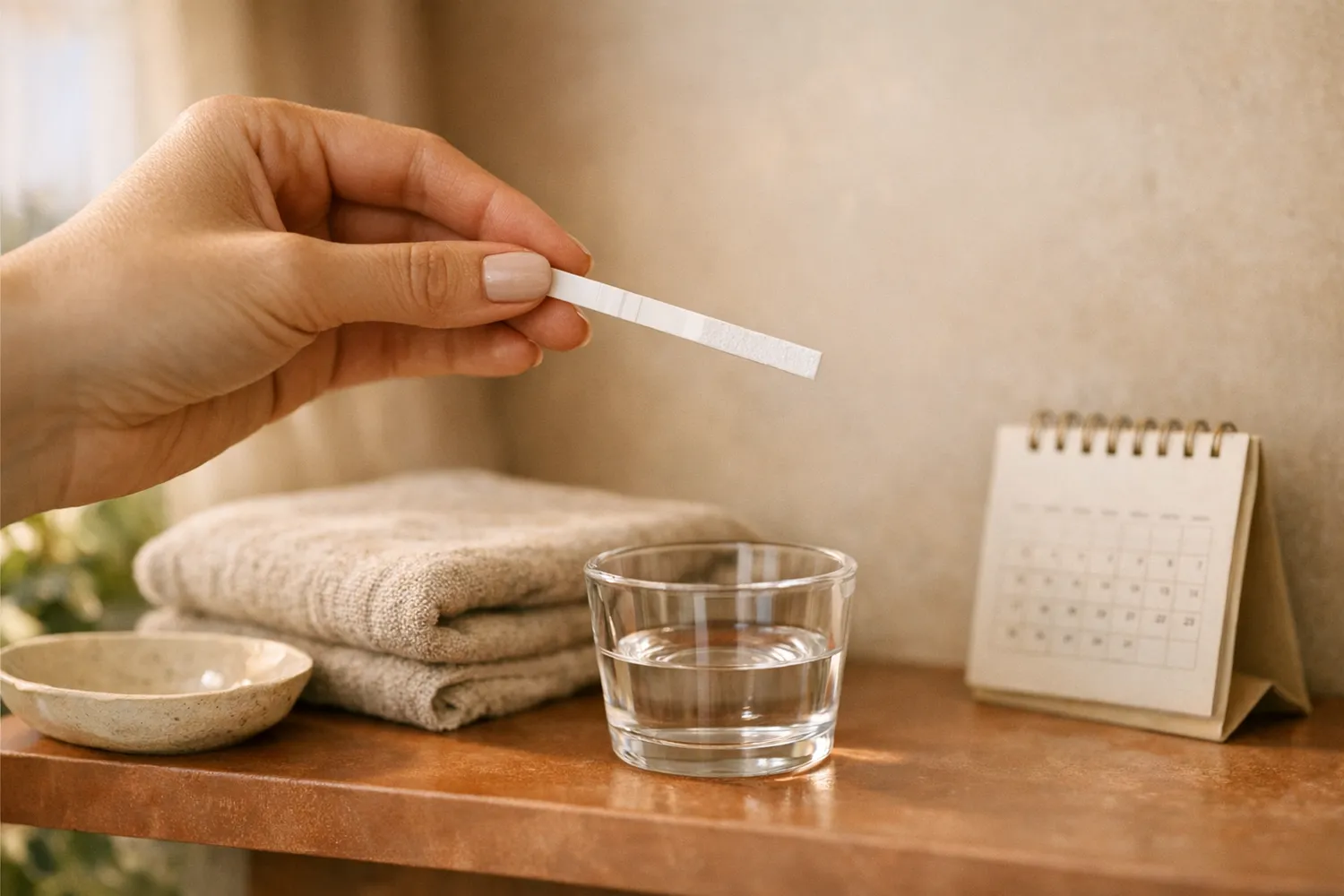
You cannot see ovulation itself. But you can recognize it by changes in the days before and after: discharge becomes clearer and stretchier, an LH test turns positive, sometimes there is a pulling pain on one side of the lower abdomen, and only afterward does your morning temperature rise. Only some of these signs are reliable enough to pinpoint your fertile days.
Many symptoms around the middle of the cycle are harmless. Still, you should know a few warning signs, because endometriosis, an ovarian cyst, or an ectopic pregnancy can feel similar to ovulation pain.
Data box: Ovulation symptoms in numbers
Mittelschmerz: possibly affects more than 40% of women of reproductive age (Brott and Le 2023) and lasts from a few minutes to 1 or 2 days (NHS 2026).
Ovulation bleeding: In a US study of 250 women with regular cycles, 4.8% had bleeding in the middle of the cycle, affecting 2.8% of cycles (Dasharathy 2012).
LH test: After a positive test, ovulation usually follows within 24 to 36 hours (MedlinePlus 2025).
Temperature: rises only after ovulation, by about 0.2°C (familienplanung.de 2026).
Ovulation symptoms and signs at a glance
The British professional society for sexual and reproductive health (FSRH) distinguishes between signs that can be observed or measured and subjective symptoms. The observable signs include cervical mucus, basal body temperature, the cervix, and hormone tests. It names abdominal pain, a feeling of heaviness in the abdomen, breast changes, bleeding between periods, back pain, skin changes, and fluctuations in sex drive and mood as the least reliable signs: they vary widely and should not be used to determine the fertile window (FSRH 2015).
| Sign | When in the cycle | How reliable | How to check |
|---|---|---|---|
| Cervical mucus becomes clear, slippery, and stretchy like raw egg white | in the days before ovulation, most clearly shortly before (FSRH 2015) | good sign of the most fertile days, but in one study it matched ultrasound in only 48% (cited in FSRH 2015) | feel at the vaginal opening, look at toilet paper or underwear |
| LH surge | 1 to 2 days before ovulation (ASRM 2021) | shows the surge reliably, false positive in about 7% of cycles (ASRM 2022) | ovulation test with urine |
| Temperature rise | after ovulation (FSRH 2015) | shows ovulation only in hindsight, not reliable for confirming it (NICE NG257) | basal thermometer in the morning before getting up |
| Mittelschmerz | around ovulation, more often shortly before (Brott and Le 2023) | unreliable, many women do not feel it (FSRH 2015) | watch for a pulling or stabbing pain on one side of the lower abdomen |
| Spotting in the middle of the cycle | around ovulation | rare, 2.8% of cycles (Dasharathy 2012), unreliable (FSRH 2015) | panty liner, note it in your cycle chart |
| Cervix higher, soft, and slightly open | during the fertile time (FSRH 2015, familienplanung.de 2026) | supplementary: matched mucus and temperature in two small studies (FSRH 2015) | feel it with a finger in the vagina |
| Higher sex drive | on the fertile days (Bullivant 2004) | weak, subjective sign (FSRH 2015) | note it in your cycle chart |
| Breast tenderness | up to 2 weeks before the period (NHS 2023) | not a sign of when ovulation happens | note it in your cycle chart |
| Feeling of heaviness in the abdomen, back pain, skin, mood | varies | least reliable (FSRH 2015) | note it in your cycle chart |
What follows from this? For timing, two signs are especially useful because they announce ovulation in advance: cervical mucus and the LH test. Temperature then shows you whether and when it happened. Everything else can be a clue if you notice it again and again at the same point in your cycle over several cycles. It cannot replace the two main signs.
Mittelschmerz: ovulation pain
The name, German for “middle pain,” comes from the timing: the pain occurs in the middle of the cycle, about 14 days before the next period. It usually lasts only a short time and is harmless (NHS 2026).
How common is mittelschmerz?
According to a medical review, mittelschmerz possibly affects more than 40% of women of reproductive age, and in these women it occurs almost every month. It usually begins only a few years after the first period, once cycles with ovulation become the rule (Brott and Le 2023). Cleveland Clinic gives a figure of up to 40% (Cleveland Clinic 2023). We have not found a large population study on how common it is, so the figures are estimates.
What does mittelschmerz feel like, and how long does it last?
Some women describe a dull ache, others a sudden, sharp, stabbing pain (NHS 2026). The intensity ranges from a slight twinge to very severe pain (Brott and Le 2023). Sometimes there is also light bleeding, discharge, or lower back pain, and with severe pain, nausea as well (NHS 2026, Cleveland Clinic 2023).
It lasts from a few minutes to 1 or 2 days (NHS 2026). Usually it is a few hours, but it can last up to 48 hours (Cleveland Clinic 2023).
Right or left: which side?
Mittelschmerz always affects only one side of the lower abdomen and can switch sides from cycle to cycle, depending on which ovary releases the egg (NHS 2026). It is usually felt near the ovary in which the follicle is maturing (Brott and Le 2023). Some women, however, feel it on the same side every month, regardless of which ovary is active (Cleveland Clinic 2023).
What causes the pain?
This has not been fully explained. The pain coincides with the peak of the hormone LH, a time when the follicle has grown but has not yet ruptured. Brott and Le therefore consider it unlikely that the stretching of the follicle alone causes the pain. Their explanation: through prostaglandins, the LH surge makes smooth muscle cells around the follicle contract (Brott and Le 2023). Cleveland Clinic, on the other hand, names the stretching and rupture of the follicle as the cause (Cleveland Clinic 2023).
An ultrasound study found some free fluid in the pelvis in the middle of the cycle in 40% of all cycles, and in as many as two thirds of the cycles with pain. The authors see this as confirmation that ovulation slightly injures the tissue (Hann 1979).
What helps with ovulation pain?
If the pain is not severe, a warm bath or a painkiller such as paracetamol (acetaminophen) or ibuprofen is often enough, according to the NHS. For frequent symptoms, your doctor may recommend hormonal contraception such as the pill or a contraceptive implant so that ovulation does not happen at all (NHS 2026). If you are trying to conceive, that is not an option.
If you are worried that ibuprofen might interfere with ovulation: in a small study of 12 women, the participants took 800 mg of ibuprofen three times a day for ten days once the follicle had reached 16 mm, and a placebo in another cycle. In 5 of 11 women who could be evaluated, follicle rupture was delayed by 2 or more days, in 3 of them in the ibuprofen cycle. Ibuprofen did not change the progesterone level in the second half of the cycle. The authors consider this reassuring (Uhler 2001). The dose was far higher than a single tablet taken as needed.
Mittelschmerz as a sign of your fertile days
Because the pain usually occurs before the follicle ruptures (Brott and Le 2023), it often falls in the most fertile time. The chance of pregnancy is highest with sex in the 2 days before ovulation (ASRM 2022). If you feel it, sex on that day and the next is well timed.
You should not rely on it, though. The FSRH counts abdominal pain among the least reliable signs because such symptoms vary widely (FSRH 2015). The pain also gives you hardly any advance notice: the fertile time begins as early as 5 days before ovulation (Wilcox 1995). It becomes useful when you check it against cervical mucus or an LH test.
When should you get ovulation pain checked?
See a doctor about the pain if any of these points apply:
- The pain is severe and painkillers do not help (NHS 2026, Cleveland Clinic 2023).
- It keeps coming back (NHS 2026) or stays severe for longer than a day (Cleveland Clinic 2023).
- You have a fever above 38°C (Cleveland Clinic 2023).
- You have pain when urinating, severe nausea, vomiting, or red, burning skin over the painful area (Cleveland Clinic 2023).
- You have heavy bleeding between periods (Cleveland Clinic 2023).
- You have missed a period or you could be pregnant. In that case, the NHS advises an urgent doctor’s appointment (NHS 2026, NHS 2024).
- The pain starts suddenly and severely. According to the NHS, this also needs to be checked urgently (NHS 2023).
Mittelschmerz or something else?
Similar pain can be caused by endometriosis, ovarian cysts, chlamydia, scar tissue after surgery such as a cesarean section, or an ectopic pregnancy (NHS 2026). Cleveland Clinic also names appendicitis, ovarian torsion, and inflammation in the pelvis (Cleveland Clinic 2023).
| Cause | What points to it | Source |
|---|---|---|
| Mittelschmerz | middle of the cycle, one side, minutes to 1 or 2 days, comes and goes with the cycle | NHS 2026 |
| Endometriosis | lower abdominal pain that lasts a long time; period pain that limits your daily life; deep pain during or after sex; cyclical symptoms during bowel movements or urination | NICE NG73 |
| Ovarian cyst | usually no symptoms; if it is large, bursts, or twists: pelvic pain, pain during sex, bloating, feeling full quickly; sudden, severe pain needs to be checked urgently | NHS 2023 |
| Ectopic pregnancy | only if you could be pregnant, usually between the 4th and 12th weeks of pregnancy: one-sided pain low in the abdomen, irregular bleeding or dark brown, watery discharge, pain in the tip of the shoulder | NHS 2022 |
If your symptoms occur not only in the middle of the cycle but also around your period or during sex, bring this up with your gynecologist. A pain and symptom diary makes the conversation easier (NICE NG73). How endometriosis affects fertility and which treatment is recommended if you are trying to conceive is covered in the guide Endometriosis and fertility.
The most common ovarian cysts are called functional cysts. They form as part of the normal cycle and are usually harmless and short-lived (NHS 2023).
With an ectopic pregnancy, the fallopian tube can rupture. Signs are sudden, very severe abdominal pain, dizziness or fainting, and nausea. In that case, call emergency services immediately (NHS 2022).
Ovulation bleeding: spotting in the middle of the cycle
Light bleeding around ovulation is possible but rare. In the BioCycle Study of the US National Institutes of Health (NIH), the daily bleeding diaries of 250 women with regular cycles were analyzed, 470 cycles in total. Of these women, 12 (4.8%) had bleeding in the middle of the cycle, affecting 13 cycles (2.8%). The bleeding lasted 1 or 2 days, usually just one. Of the 12 women, 11 had it only once, and none of them had a cycle without ovulation (Dasharathy 2012).
The study did not clarify where the bleeding comes from. Women with bleeding in the middle of the cycle had higher LH levels around ovulation and more progesterone in the second half of the cycle, and estrogen showed a similar tendency. With only 12 women affected, however, the differences are uncertain (Dasharathy 2012).
Ovulation bleeding or bleeding between periods?
You cannot tell the difference from the bleeding alone. It points to ovulation bleeding if it stays light, is over after 1 to 2 days, and falls exactly in the middle of the cycle, for example together with stretchy cervical mucus, a positive LH test, or mittelschmerz.
Even so, the NHS advises having any bleeding between periods or after sex checked by a doctor. It can also be caused by hormonal contraception, polyps or fibroids in the uterus, or chlamydia (NHS 2024). It becomes urgent if you have missed a period and have unusual bleeding and abdominal pain (NHS 2024).
Discharge during ovulation
More discharge in the middle of the cycle is normal. According to the NHS, around ovulation it is often clearer and wetter and more noticeable (NHS 2024). The reason is cervical mucus: after your period, the vaginal opening usually feels dry for a few days. As estrogen rises, the mucus first becomes sticky and whitish, then increasingly slippery, wet, clear, and stretchy like raw egg white. After ovulation, under the influence of progesterone, it becomes thick and sticky again (FSRH 2015).
Discharge that is clear or white, thick and sticky, or slippery and wet, without a strong smell, is normal. A fishy smell, crumbly white discharge like cottage cheese, greenish, yellow, or frothy discharge, and itching or burning can point to an infection. In that case, have it checked by a doctor (NHS 2024).
How to observe the mucus, which stages there are, and what it means after ovulation is covered in the guide Cervical mucus.
Measurable signs: LH test and temperature
LH surge: the signal before ovulation
Shortly before ovulation, luteinizing hormone (LH) rises sharply. An ovulation test detects this surge in urine. After a positive result, ovulation usually follows within 24 to 36 hours, but not in all women (MedlinePlus 2025). According to ASRM, it can happen at any point in the 2 days after that, and false positive results occur in about 7% of cycles (ASRM 2022).
Which cycle day to start testing on and how to read the result is explained in the guide Ovulation test. What the hormone level in the blood tells you is covered under LH levels.
Temperature shift: confirmation afterward
After ovulation, the corpus luteum, which forms from the ruptured follicle, produces the hormone progesterone. Progesterone raises basal body temperature, and it stays elevated until the next period (FSRH 2015). The rise is only about 0.2°C (familienplanung.de 2026).
That is why the temperature rises only once ovulation is over. In a small study of 24 cycles, the rise came on average 2.4 to 4.1 days after the LH peak in the blood, depending on the evaluation method (Prior 1990). More than 2 days after the rise, the chance of conception was negligible in an older study (cited in FSRH 2015). So the temperature shows you that the fertile time is over. According to NICE, it should not be used to confirm ovulation in a fertility evaluation because it does not show it reliably (NICE NG257).
How to measure correctly and read the chart is explained in the guide Measuring basal body temperature.
What does ovulation feel like?
For many women, it does not feel like anything. Those who notice something usually describe a pulling or stabbing pain on one side of the lower abdomen that lasts from minutes to 1 or 2 days (NHS 2026). Often there is also a wet, slippery feeling at the vaginal opening because the cervical mucus becomes thinner and clearer (FSRH 2015).
Sex drive can change too. In one study, women had sex more often in the days before and on the day of the LH surge, specifically when they themselves took the initiative. In a second analysis within the same paper, a six-day rise began 3 days before the LH surge, together with stronger desire (Bullivant 2004). Among 68 women with an IUD or sterilization, sex on the 6 fertile days was 24% more frequent than on the other days without bleeding (Wilcox 2004).
Breast tenderness is less likely to be one of the signs. Cyclical breast pain begins up to 2 weeks before the period, gets stronger, and disappears when the bleeding ends (NHS 2023). So it falls mainly in the second half of the cycle.
Ovulation without noticeable signs: normal
Not feeling your ovulation does not mean it is not happening. If you have regular monthly cycles, you are very likely ovulating (NICE NG257). In most women who ovulate, the period comes regularly every 21 to 35 days (ASRM 2021). So mittelschmerz is not a prerequisite for ovulation.
Signs that you are not ovulating
A single missing sign says little. These observations point to cycles without ovulation:
- Your cycles are repeatedly shorter than 21 or longer than 35 days, or you have fewer than 8 periods a year. According to the German guideline, infrequent or absent egg maturation is then considered present (AWMF 2026). With polyendocrine metabolic ovarian syndrome (PMOS, formerly PCOS), cycles typically lengthen to more than 35 days (AWMF 2026). Which treatment helps in that case is covered in the guide Getting pregnant with PCOS.
- Your period does not come. Ovulation disorders usually show up as clearly changed bleeding, periods that are too infrequent, or periods that stop altogether (ASRM 2021).
- Your basal body temperature stays flat over several cycles. Cycles without ovulation usually have a monophasic chart. However, some women who ovulate do not have a clearly biphasic chart (ASRM 2021).
- Your LH test does not turn positive in 3 cycles in a row, even though you started in time. According to the manufacturer, a single cycle without a surge is not unusual, and after 3 cycles in a row it recommends a medical evaluation (Clearblue Advanced 2020).
Even with a regular cycle, ovulation occasionally does not occur, in 1% to 14% of cycles according to ASRM (ASRM 2021). Whether ovulation has taken place is checked by your gynecologist with a blood progesterone test about a week before your expected period, on day 21 of a 28-day cycle (ASRM 2021, NICE NG257). A level above 3 ng/ml indicates recent ovulation (ASRM 2021).
When to get a fertility evaluation?
More than 80% of couples get pregnant within a year if the woman is under 40 and they have regular sex without contraception (NICE NG257). The German-language guideline (Germany, Austria, and Switzerland) recommends an evaluation after 12 months without a pregnancy, after 6 months for women over 35, and immediately at a fertility clinic for women over 40 (AWMF 015-085, 2026). ASRM advises an evaluation without a waiting period for irregular, infrequent, or absent periods, bleeding between periods, and known or suspected endometriosis (ASRM 2021).
Which tests are then due for both of you and what health insurance covers is explained in the Infertility guide.
How long do ovulation and the fertile window last?
For your chances, the rupture of the follicle itself matters less than the time during which the egg can be fertilized afterward: about 24 hours (familienplanung.de 2026). The data on this are thin, and an older analysis arrived at about 17 hours on average (cited in FSRH 2015). Sperm can survive up to 5 days in the cervix and uterus (familienplanung.de 2026).
This gives the fertile window: 6 days that end with the day of ovulation. In the Wilcox study of 221 women, pregnancies occurred only after sex during this time. The probability of conception was 10% with sex 5 days before ovulation and 33% with sex on the day of ovulation (Wilcox 1995). The chances for each day and by age are shown in the Ovulation Calculator.
What the signs mean for timing
| What you notice | Where you are in the cycle | What it means for you both |
|---|---|---|
| Mucus becomes moist, then slippery and stretchy | the fertile window is beginning (FSRH 2015) | from now on, regular sex |
| Last day with slippery, stretchy mucus | usually the day closest to ovulation; you can only be sure of it the following day (FSRH 2015) | in studies, sex on this day had the highest chance, about 38%, and 15% to 20% on the day before or after (ASRM 2022) |
| Positive LH test | ovulation usually within 24 to 36 hours (MedlinePlus 2025) | sex on the same day and the next |
| Mittelschmerz | ovulation probably close (Brott and Le 2023) | sex on the same day and the next, check against mucus or an LH test |
| Temperature has risen | ovulation is over (FSRH 2015) | the most fertile time of this cycle is usually over |
You do not have to hit the exact day. According to NICE, sex every 2 to 3 days is enough to make the most of your chances (NICE NG257). ASRM suggests sex every 1 to 2 days in the fertile window and considers 2 to 3 times a week almost as effective (ASRM 2022). The signs help you not to miss these days, especially if your cycle varies.
When your fertile days fall by calculation is shown in the Ovulation Calculator. When your period comes after ovulation is covered in the Period Calculator. How hormones and cycle phases work together is explained in the guide Menstrual cycle.
Frequently asked questions
Can you feel ovulation?
Some women can, many cannot. The most common sign is a one-sided pulling or stabbing pain in the lower abdomen, mittelschmerz. It possibly affects more than 40% of women of reproductive age (Brott and Le 2023). Many also notice a wet, slippery feeling caused by cervical mucus (FSRH 2015). If you feel nothing, you are still very likely ovulating if your cycle is regular (NICE NG257).
How long does ovulation pain last?
From a few minutes to 1 or 2 days (NHS 2026), usually a few hours (Cleveland Clinic 2023). If severe pain lasts longer than a day, comes back in most months, or painkillers do not help, get it checked (Cleveland Clinic 2023).
Does mittelschmerz come before or after ovulation?
Usually shortly before. It coincides with the LH peak, when the follicle has grown but not yet ruptured (Brott and Le 2023). The rupture of the follicle itself can also hurt (Cleveland Clinic 2023). As a sign of your most fertile days, it is only useful together with cervical mucus or an LH test.
Is bleeding during ovulation normal?
It happens, but it is rare: in a US study, 4.8% of women with regular cycles had bleeding in the middle of the cycle, usually for only one day (Dasharathy 2012). Because bleeding between periods can also be caused by polyps, fibroids, or chlamydia, the NHS advises getting it checked by a doctor (NHS 2024).
Can I take painkillers for mittelschmerz if we are trying to get pregnant?
The NHS names paracetamol or ibuprofen as an option (NHS 2026). In a small study with high-dose ibuprofen over 10 days, follicle rupture was delayed by 2 or more days in 3 of 11 women while taking ibuprofen and in 2 while taking a placebo, and the progesterone level stayed the same. The authors consider this reassuring (Uhler 2001). If you regularly need painkillers, bring it up at your fertility appointment.
How can I tell that I am not ovulating?
Signs include cycles that are repeatedly shorter than 21 or longer than 35 days, fewer than 8 periods a year (AWMF 2026), absent periods, or a temperature chart that stays flat over several cycles (ASRM 2021). A blood progesterone level about a week before your expected period shows whether ovulation has taken place (ASRM 2021, NICE NG257).
What does ovulation discharge look like?
Clear, wet, and slippery, often stretchy like raw egg white, and usually more than at other times (NHS 2024, FSRH 2015). If it smells fishy, is crumbly, greenish, yellow, or frothy, or if it itches, an infection may be behind it (NHS 2024). More on this in the guide Cervical mucus.
Sources
Guidelines and professional societies
- FSRH Clinical Guidance: Fertility Awareness Methods, Faculty of Sexual & Reproductive Healthcare (now CoSRH), 2015
- Practice Committee of ASRM: Optimizing natural fertility, a committee opinion, Fertil Steril 2022;117:53-63, ASRM, 2022
- Practice Committee of ASRM: Fertility evaluation of infertile women, a committee opinion, Fertil Steril 2021;116:1255-65, ASRM, 2021
- NICE NG257: Fertility problems, assessment and treatment, chapter Investigation of fertility problems and management strategies, NICE, 31 March 2026
- NICE NG257: chapter Initial advice to people concerned about delays in conception, NICE, 31 March 2026
- NICE NG73: Endometriosis, diagnosis and management, recommendations 1.3.1 and 1.3.3, NICE, 2017, last updated 11 November 2024
- Diagnostics and therapy before medically assisted reproduction treatment, S2k guideline AWMF 015-085, version 2.0, DGGG, OEGGG, and SGGG, as of April 2026, recommendation 3.1.E1
- Patient guideline: diagnosis and treatment of polyendocrine metabolic ovarian syndrome (PMOS, formerly PCOS), AWMF register no. 089-004, AWMF, as of June 2026
Reviews and studies
- Brott NR, Le JK: Mittelschmerz, StatPearls, StatPearls Publishing, 2023
- Hann LE, Hall DA, Black EB, Ferrucci JT: Mittelschmerz, sonographic demonstration, JAMA 1979;241(25):2731-2
- Dasharathy SS et al.: Menstrual bleeding patterns among regularly menstruating women, Am J Epidemiol 2012;175(6):536-45
- Uhler ML, Hsu JW, Fisher SG, Zinaman MJ: The effect of nonsteroidal anti-inflammatory drugs on ovulation, a prospective, randomized clinical trial, Fertil Steril 2001;76(5):957-61
- Wilcox AJ, Weinberg CR, Baird DD: Timing of sexual intercourse in relation to ovulation, N Engl J Med 1995;333(23):1517-21
- Wilcox AJ et al.: On the frequency of intercourse around ovulation, evidence for biological influences, Hum Reprod 2004;19(7):1539-43
- Bullivant SB et al.: Women's sexual experience during the menstrual cycle, identification of the sexual phase by noninvasive measurement of luteinizing hormone, J Sex Res 2004;41(1):82-93
- Prior JC, Vigna YM, Schulzer M, Hall JE, Bonen A: Determination of luteal phase length by quantitative basal temperature methods, validation against the midcycle LH peak, Clin Invest Med 1990;13(3):123-31
Consumer health information
- Ovulation pain, NHS, last reviewed 17 July 2026
- Vaginal discharge, NHS, last reviewed 15 February 2024
- Vaginal bleeding between periods or after sex, NHS, last reviewed 13 August 2024
- Ovarian cyst, NHS, last reviewed 21 June 2023
- Ectopic pregnancy, symptoms, NHS, last reviewed 23 August 2022
- Breast pain, NHS, last reviewed 3 May 2023
- Ovulation Pain (Mittelschmerz), Cleveland Clinic, 9 February 2023
- LH urine test (home test), MedlinePlus, U.S. National Library of Medicine, review 22 May 2025
- Getting pregnant: ovulation and the fertile days, familienplanung.de (Federal Institute for Public Health), 7 January 2026
Manufacturer information