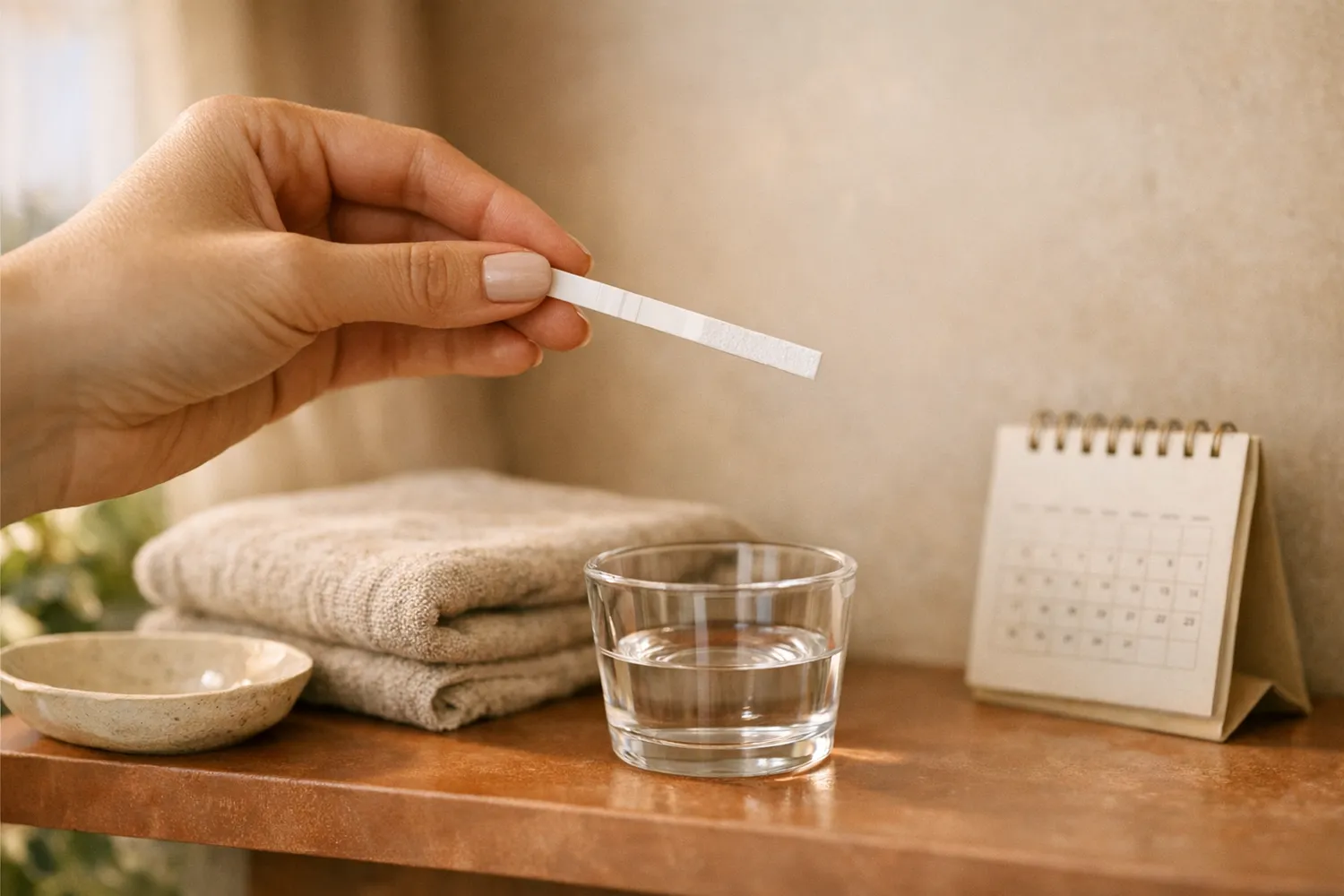
An ovulation test shows you when luteinizing hormone (LH) rises in your urine. This surge comes shortly before ovulation. That is exactly what makes the LH test so useful when you are trying to get pregnant: instead of estimating ovulation by the calendar, you can see in the current cycle when it is about to happen.
For this purpose, it is well studied. According to the Cochrane review, timed sex after a urine ovulation test probably leads to a birth more often than sex without predicting ovulation. This applies to women under 40 who have been trying for less than 12 months. However, the studies on this tested only products from the brands Clearblue and Clearplan and were funded or supported by the manufacturer (Cochrane 2023).
In everyday life, the questions are about details: Which day do I start? Morning or evening? Is the line already positive? And when is the best moment for sex afterward? You will find the answers here, along with a comparison of test strips, digital tests, and tests with estrogen, the cost per cycle, and the situations in which results can be misleading.
Data box: What happens after a positive LH test
In a study of 26 normally fertile women who tested in the evening, the follicle ruptured on ultrasound an average of 20 hours after the positive urine test (95% confidence interval 14 to 26 hours). In 73% of cases this happened within 24 hours, in 92% within 48 hours (Miller and Soules 1996).
How an ovulation test (LH test) works
Shortly before ovulation, LH rises sharply, and this surge can be detected in urine. An ovulation test is a rapid test (lateral flow immunoassay): it does not show how much LH is in the urine, only whether a certain threshold has been exceeded (Mivolis 2025).
This threshold is not uniform. Commercially available tests respond at roughly 20 to 50 mIU/ml, and there is no consensus among manufacturers on which value is right (Leiva 2017). A test strip from a drugstore, for example, responds at 30 mIU/ml or above, and two digital tests at 40 mIU/ml or above (Mivolis 2025, Clearblue Digital 2018, Clearblue Advanced 2020).
Several studies have measured how much time lies between the LH surge and ovulation:
| Study | How measured | Result |
|---|---|---|
| WHO 1980 | 107 women, LH in blood, ovulation determined directly during abdominal surgery | Ovulation a median of 32 hours after the start of the LH surge and 16.5 hours after the peak |
| Miller and Soules 1996 | 26 normally fertile women, evening urine test, ultrasound | Urine test positive an average of 2 hours after the blood LH peak, ovulation an average of 20 hours after the positive test |
| Johnson 2015 (sponsored by SPD, the Clearblue manufacturer) | 40 women aged 18 to 40, urine samples, ultrasound | LH surge in urine always before ovulation, an average of 0.81 days (about 19 hours) earlier |
What matters is the start of the surge, not the peak. When the peak is measured depends on the measurement method, and it can even fall after ovulation (Johnson 2015). In blood as well, ovulation occurred in 90% of women between about 3 hours before and 36 hours after the LH peak (WHO 1980). For you, the first positive test is therefore what counts.
What the LH level in blood tells you is explained in the guide LH levels.
Why an ovulation test shows more than a calendar
Ovulation falls on day 14 less often than many people think. In one study, 34% of women believed they had a 28-day cycle, but in fact only 15% did. Among 949 women whose urinary LH surge was measured, even with a 28-day cycle, cycle day 16 was the most common day of ovulation, and even that applied in only 21% of cases. Cycle apps that calculate by the calendar predicted the day of ovulation correctly in at most 21% of cases (Johnson 2018, two authors work for the Clearblue manufacturer SPD).
In addition, in a study of 221 women, the fertile window fell entirely between cycle days 10 and 17 in only about 30% (Wilcox 2000). In an app data analysis of 612,613 cycles, the first half of the cycle up to ovulation lasted 16.9 days on average, and in 95% it was between 10 and 30 days (Bull 2019, funded by the app provider).
A calendar estimates, an ovulation test measures. The calendar still has its uses: our Ovulation Calculator shows you which day you can start testing and, if you like, adds the date to your calendar.
Ovulation test: when to take it and from which cycle day?
Cycle day 1 is the first day of your period. You start testing 3 to 5 days before the expected ovulation, so with a 28-day cycle on cycle day 11 (MedlinePlus 2025). For LH-only tests, the instructions for use work with a simple formula: cycle length minus 17 (Clearblue Digital 2018 for 22 to 40 days, Mivolis 2025 for cycles of 24 days or longer).
| Cycle length | Tests from | Ovulation expected |
|---|---|---|
| 21 days | Cycle day 5 | around cycle day 7 |
| 22 days | Cycle day 5 | around cycle day 8 |
| 23 days | Cycle day 6 | around cycle day 9 |
| 24 days | Cycle day 7 | around cycle day 10 |
| 25 days | Cycle day 8 | around cycle day 11 |
| 26 days | Cycle day 9 | around cycle day 12 |
| 27 days | Cycle day 10 | around cycle day 13 |
| 28 days | Cycle day 11 | around cycle day 14 |
| 29 days | Cycle day 12 | around cycle day 15 |
| 30 days | Cycle day 13 | around cycle day 16 |
| 31 days | Cycle day 14 | around cycle day 17 |
| 32 days | Cycle day 15 | around cycle day 18 |
| 33 days | Cycle day 16 | around cycle day 19 |
| 34 days | Cycle day 17 | around cycle day 20 |
| 35 days | Cycle day 18 | around cycle day 21 |
Calculated with a 14-day second half of the cycle. If your cycle varies, the shortest cycle of the past few months counts. For your own data with a calendar and reminder: Ovulation Calculator.
For very short and very long cycles, the information differs slightly:
- 21 days or shorter: from cycle day 5 (Clearblue Digital 2018). For 21 to 23 days, Mivolis gives cycle day 6 to 7.
- Over 40 days: 17 days before the expected period (Clearblue Digital 2018).
- Under 21 or over 38 days: Mivolis advises talking with a doctor first. MedlinePlus recommends this in general for a cycle length that differs from 28 days.
- Tests with estrogen: They start earlier because they also capture days before the LH surge. With a 28-day cycle, such a test starts on cycle day 8, and with 41 days or more, 20 days before the expected period, so roughly at cycle length minus 20 (Clearblue Advanced 2020). The table above does not apply to these tests.
If your cycle varies: If the length varies by more than 3 days, base your timing on the shortest cycle of the last 6 months. One pack may then not be enough to capture the surge (Clearblue Digital 2018). With an irregular cycle, the surge may not be captured at all (MedlinePlus 2025).
How long should you test? Once a day until the test is positive. According to Mivolis, about 90% of women who ovulate and have a regular cycle see an LH surge within 8 to 10 test days. In a research analysis with ultrasound, an early start from cycle day 7 with a threshold of 25 to 30 mIU/ml predicted ovulation best (Leiva 2017).
Time of day and first morning urine: when to test?
Here the instructions for use contradict one another. We did not find a guideline or comparative study on the best time of day. So follow the instructions for your test:
| Test type (example) | Time of day | First morning urine | Before testing |
|---|---|---|---|
| Test strip, LH only (Mivolis) | about the same time every day, recommended between 10 a.m. and 8 p.m. | no, it is more concentrated and can give false positive results | if possible, do not drink anything for about 2 hours beforehand |
| Digital test, LH only (Clearblue Digital) | any time of day possible, but about the same time every day | not specified | do not urinate for at least 4 hours beforehand |
| Digital test with LH and estrogen (Clearblue Advanced Digital, German name “fortschrittlich & digital”) | morning | yes, first urine after the longest period of sleep | once a day until high fertility is displayed |
Why the difference? In most women, the LH surge begins between midnight and 8 a.m. (Cahill 1998, 155 LH surges in 35 women with infertility before IVF in a natural cycle). It shows up in urine somewhat later than in blood (Miller and Soules 1996). At the same time, first morning urine is more concentrated (Mivolis 2025). According to our research, no study has compared which time of day ends up detecting more surges correctly.
For every test: do not drink large amounts beforehand (MedlinePlus 2025), and test at about the same time every day.
Reading your ovulation test: how to interpret the result
Test strips
On a test strip you see two lines: the control line (C) and the test line (T). The result is positive only when the test line is as dark as or darker than the control line. Then the LH level is elevated, and according to the manufacturer, ovulation is likely within the next 24 to 36 hours (Mivolis 2025). A test line that is lighter than the control line is not a positive result.
The reading time differs by product, for example 3 minutes for Mivolis and 10 minutes for cyclotest (Mivolis 2025, cyclotest). Stick to it exactly.
A US study shows how easy it is to misjudge a reading: in more than 7% of tissue samples from the uterine lining, taken 7 to 13 days after a self-read positive LH test, there was no evidence that ovulation had occurred. The authors interpret this as false positive tests caused by misreading (McGovern 2004).
Digital tests
Digital tests take the interpreting of lines off your hands. An LH-only test shows the surge as a symbol on the display (Clearblue Digital 2018). Tests with estrogen have two stages: a flashing smiley face stands for high fertility (estrogen is rising), a solid smiley face for peak fertility (LH surge). The solid smiley face stays on for 48 hours (Clearblue, German package insert for Advanced Digital).
Several positive days in a row
LH does not rise the same way in all women. In an observational study of 43 women, the surge began within one day in 42.9% and gradually over 2 to 6 days in 57.1% (cited in Su 2017). Several positive tests in a row are therefore nothing unusual. For planning, the first positive day is what counts.
| Result | What it means | What you can do |
|---|---|---|
| Test line lighter than control line | no LH surge detected | keep testing the next day at the same time |
| Test line as dark as or darker, solid smiley face or LH symbol | LH surge, ovulation usually within the next 24 to 36 hours | sex on the same day and the next day |
| Flashing smiley face (tests with estrogen only) | estrogen is rising, high fertility according to the manufacturer | sex makes sense from now on, keep testing until the solid smiley face appears |
| Positive for several days | a gradual LH surge is possible | count from the first positive day |
| Never positive in the whole cycle | surge missed or no ovulation | see If the test never turns positive |
Ovulation test positive: when is ovulation?
After a positive test, ovulation usually follows within 24 to 36 hours, but not in all women (MedlinePlus 2025). The studies agree on the order of magnitude, but the range is wide:
- According to ASRM, ovulation can occur at any point within the 2 days after the LH surge (ASRM 2022).
- Measured in blood, it fell between 16 and 48 hours after the first clear LH surge in 90% of women (WHO 1980).
- In 101 women with infertility whose untreated cycles were monitored by ultrasound, the urinary LH surge matched the ultrasound in 98 of 101 cases. The time interval to ovulation varied widely, however (Guermandi 2001).
A positive test therefore announces ovulation, but not to the hour.
Positive does not mean ovulation is certain
An ovulation test shows the LH surge, not ovulation itself. According to ASRM, the result is false positive in about 7% of cycles (ASRM 2022). In addition, there is LUF syndrome (luteinized unruptured follicle): there is a normal LH surge, corpus luteum function, and a period, but the egg is not released. This has been described in 10.7% of cycles of normally fertile women (Su 2017).
Whether ovulation has taken place is checked in the fertility evaluation, according to NICE, by measuring progesterone in the blood in the middle of the second half of the cycle (NICE NG257). However, this value does not reveal a LUF cycle, because the corpus luteum is working even then (Su 2017). Whether the follicle has actually ruptured is shown by ultrasound, against which ESHRE also measured the LH tests in its analysis (ESHRE 2023).
When is the best time for sex?
In the well-known Wilcox study of 221 women and 625 cycles, pregnancies occurred only after sex within a 6-day period that ends on the day of ovulation: the 5 days before and the day of ovulation itself. Even five days before ovulation, the probability of conception was 10% (Wilcox 1995). Another analysis summarized by ASRM found the highest chance on the day before ovulation, and on the day of ovulation itself it was already declining (ASRM 2022).
What does this mean for you?
- The day of the first positive test and the day after are the most important days, because ovulation usually follows 24 to 36 hours later.
- The days before count, too. In the Wilcox study, pregnancies occurred even after sex five days before ovulation.
- Regularly, not by stopwatch. ASRM advises using ovulation tests to guide the timing of frequent sex. They are not meant to replace the approach of “sex every 1 to 2 days in the fertile window.” Sex 2 to 3 times per week is almost equally effective according to ASRM, and couples should not limit how often they have sex (ASRM 2022). NICE mentions sex every 2 to 3 days (NICE NG257).
- Do not stop after the positive test. An LH test alone should not be used to define the end of the fertile window (Leiva 2017).
The chance per cycle was similar with daily sex, sex every second day, and even sex every third day in the fertile window. It was lowest when there was sex only once in the fertile window (ASRM 2022). Betting everything on a single day therefore gains little.
Sex planned strictly by the test can, according to ASRM, increase stress and lower sexual satisfaction and frequency (ASRM 2022). Whether ovulation tests actually change stress is unclear: there is only one study on this, with 77 participants and very low-certainty evidence (Cochrane 2023). If you use lubricant, the guide Fertility friendly lubricant explains what matters.
How reliable is an ovulation test?
The answer depends on which question you ask.
Does the test detect the surge in the cycle? Yes, very reliably. In ESHRE’s evidence review, urinary LH measurements agreed with ultrasound 98 to 100% of the time, and accuracy was 97%. Basal body temperature and progesterone in the second half of the cycle reached about 70 to 80% (ESHRE 2023).
Does the positive day hit exactly the day before ovulation? That succeeds much less often. In an analysis of 107 women and 283 cycles monitored by ultrasound, thresholds of 20 to 30 mIU/ml with daily testing from day 7 to 20 reached only about 35% sensitivity for ovulation within 24 hours; 35 mIU/ml reached 24%, and 40 mIU/ml reached 19% (Leiva 2017). The study analyzed LH concentrations from laboratory analyses, did not test commercially available tests, and was partly funded by the diagnostics manufacturer Quidel.
According to the manufacturer, some digital tests adapt their evaluation to your personal hormone pattern (Clearblue, German product page for Advanced Digital). According to our research, no independent study has examined whether this makes them predict ovulation more accurately.
What does “over 99% accurate” mean? These manufacturer claims refer to detecting the LH surge in the lab, not to ovulation and not to pregnancy (Clearblue Digital 2018). For Mivolis, the stated over 99.9% is based on an internal comparison of 300 urine samples with another commercially available LH test, not with actual ovulation (Mivolis 2025).
Test strips, digital test, or test with estrogen?
All three types detect LH in urine. They differ in how you read the result, whether estrogen is also measured, and what they cost.
| Test strip (LH only) | Digital test (LH only) | Digital test with estrogen (E3G) | |
|---|---|---|---|
| Measures | LH | LH | LH and estrogen |
| Result | two lines, read it yourself | symbol on the display | two stages: high and peak fertility |
| LH detection threshold (examples) | 25 to 30 mIU/ml (Mivolis, cyclotest, Ovy) | 40 mIU/ml (Clearblue Digital) | 40 mIU/ml (Clearblue Advanced) |
| Start of testing with a 28-day cycle | cycle day 11 | cycle day 11 | cycle day 8 |
| First morning urine | no (Mivolis, Ovy) | not specified | yes |
Test strips are the cheapest option. You interpret the lines yourself, and it is possible to misread them (McGovern 2004).
Digital tests take the reading off your hands. Whether they predict ovulation better than strips is an open question: we did not find an independent direct comparison with ultrasound.
Tests with estrogen (E3G) also show the rise in estrogen and thereby mark days before the LH surge as high fertility (Clearblue Advanced 2020). According to the manufacturer, in its own study of 87 women, 4 or more fertile days were detected in 80% of cycles. In about 8% of cycles, the test does not display peak fertility, according to the manufacturer (Clearblue, German product page for Advanced Digital).
On pregnancies, the studies available for tests with estrogen come mainly from the manufacturer’s side; the results are in the section on the evidence from studies (Johnson 2020, funded by SPD, the Clearblue manufacturer). We did not find an independent study that directly compares tests with estrogen against LH-only tests.
What does an ovulation test cost per cycle?
This section applies to Germany only.
The costs differ many times over. Our example calculation uses prices from October 4, 2026 (shop price or manufacturer’s suggested retail price):
| Option | Example product and price | Per cycle | First year |
|---|---|---|---|
| LH test strips | Drugstore house brand Mivolis, 10 tests for €5.95 | €3.57 for 6 tests | €46 |
| Digital test with LH and estrogen | Clearblue Advanced Digital (German name “fortschrittlich & digital”), 30 tests for €49.99 | €13.33 for 8 tests (about €1.67 per test) | €173 |
| Hormone monitor with test sticks (LH and estrogen) | Clearblue Advanced Fertility Monitor, €139.99 plus €81.50 for 30 test sticks | €27.17 for 10 tests | €493 |
| Hormone monitor with numerical values (LH, E3G, PdG, FSH) | Mira Ultra4, kit €266.95 with 20 sticks, English-language shop | €106.95 for 20 sticks | €1,550 |
The first year includes the purchase and ongoing costs at constant use. How many tests you really need depends on your cycle length and on when the surge occurs, because you test daily until the result is positive. With a varying cycle, one pack may not be enough (Clearblue Digital 2018). According to the manufacturer, you can use leftover sticks of the digital test in the next cycle with the same holder.
How hormone monitors, temperature sensors, and cycle apps work and which studies exist on them is covered in our fertility tracker comparison.
Using an ovulation test correctly: common mistakes
- Started too late. If you calculate with the average length when your cycle is short or varies, you can easily miss the surge. Use the shortest cycle of the last few months (Clearblue Digital 2018).
- Used the wrong urine. First morning urine with strips that exclude it can give a false positive (Mivolis 2025). Tests with estrogen, by contrast, explicitly require it (Clearblue Advanced 2020).
- Drank a lot beforehand. Avoid large amounts of fluid before the test (MedlinePlus 2025).
- Went to the bathroom shortly before. With the LH-only digital test, you should not urinate for at least 4 hours beforehand (Clearblue Digital 2018).
- Counted a faint line as positive. Only a test line that is at least as dark as the control line is positive (Mivolis 2025).
- Waited for the peak. What matters is the first positive test, not the darkest (Johnson 2015).
- Sex only once. A single time in the fertile window gives the lowest chance; more frequent sex in the fertile window makes more sense (ASRM 2022).
- Used the test for contraception. The manufacturers expressly rule this out in their instructions for use (Clearblue, Mivolis).
Wrong results: PCOS, menopause, hCG, and clomiphene
Some situations distort the result or make it hard to interpret. The information comes mostly from instructions for use and partly contradicts itself. We did not find studies on how often wrong results occur in these situations.
| Situation | What the sources say |
|---|---|
| PCOS (new name: PMOS) | Manufacturers warn of misleading results (Clearblue Digital 2018, Clearblue Advanced 2020). MedlinePlus lists elevated LH in the blood with PCOS. |
| No ovulation | MedlinePlus lists elevated LH with some forms of absent ovulation. With an underactive pituitary gland, on the other hand, LH can be too low. |
| Menopause | Manufacturers warn of misleading results after the onset of menopause (Clearblue Digital 2018). MedlinePlus lists elevated LH during and after menopause. We did not find a study on test accuracy in perimenopause, the time before menopause. |
| Pregnancy, including recently ended | can lead to misleading results (Clearblue Digital 2018) |
| hCG trigger shot, medications containing LH or hCG | can cause misleading results according to the manufacturer (Clearblue Advanced 2020) |
| Clomiphene | Information is contradictory: no effect on the result, but an effect on cycle length and thus on when to start testing (Clearblue Digital 2018); misleading estrogen display, LH display not affected (Clearblue Advanced 2020); can raise LH (MedlinePlus 2025) |
| Birth control pill, hormone replacement therapy | Estrogens, progesterone, and testosterone can lower LH (MedlinePlus 2025) |
| Antibiotics containing tetracyclines | can cause misleading results according to the manufacturer (Clearblue Advanced 2020) |
| Impaired liver or kidney function | according to the manufacturer, a possible reason for misleading results (Clearblue Advanced 2020) |
If you take clomiphene or have ovulation triggered with an injection, talk with your doctor’s office about whether and when ovulation tests make sense in your treatment cycle.
Ovulation test with PCOS
The German guideline on PMOS (formerly PCOS) considers infrequent or absent egg maturation to be present when cycles are repeatedly shorter than 21 days or longer than 35 days, or when there are fewer than 8 cycles per year (AWMF 2026). Ovulation tests are then difficult for two reasons: manufacturers warn of misleading results with PCOS, and with an irregular cycle the surge may not be captured at all (MedlinePlus 2025). We did not find a study on the hit rate of LH tests in PCOS.
Rather than testing pack after pack, a medical evaluation is the better route here. Which treatments are available is covered in the guide Getting pregnant with PCOS.
If the test never turns positive
A cycle with no positive test at all has two possible explanations: you missed the surge, for example because you started too late, or ovulation did not occur in this cycle. According to the manufacturer, a cycle without an LH surge is not unusual. After 3 cycles in a row without a surge, the manufacturer recommends a medical evaluation (Clearblue Advanced 2020).
If you have regular monthly cycles, ovulation very probably occurs, according to NICE (NICE NG257). Whether it should be confirmed anyway is viewed differently by the guidelines: in the fertility evaluation, NICE recommends a progesterone measurement in the middle of the second half of the cycle even then, whereas ESHRE does not consider this routinely necessary with a regular cycle (NICE NG257, ESHRE 2023).
Do ovulation tests work? What the studies show
Personal accounts online are individual cases. Studies in which couples were randomly assigned to groups are more reliable. The 2023 Cochrane review analyzed 7 randomized studies with 2,464 women or couples, 4 of them on urine ovulation tests and 3 on cycle observation without a test (Cochrane 2023).
Data box: Timed sex after an ovulation test (Cochrane 2023)
Births: Where 16 of 100 women had a baby without predicting ovulation, with a urine ovulation test it would be 16 to 28 of 100 (relative risk 1.36; 95% confidence interval 1.02 to 1.81; 1 study, 844 women, moderate-certainty evidence).
Pregnancies: 18 of 100 become 20 to 28 of 100 (relative risk 1.28; 1.09 to 1.50; 4 studies, 2,202 women, moderate-certainty evidence).
This applies to women under 40 who have been trying for less than 12 months. For basal body temperature, cervical mucus, calendar, or apps without a urine test, an effect on the live birth rate is uncertain (relative risk 0.95; 0.76 to 1.20; 2 studies, 157 women, low-certainty evidence).
For context: the statement on births rests on a single study, the Johnson study funded by SPD, the Clearblue manufacturer, which used an app-connected test for LH and estrogen (pregnancies published in 2020, births in 2022). The other three studies on urine tests also tested Clearblue or Clearplan products and were funded by the manufacturer or supported with devices. Cochrane therefore downgraded the evidence because of the risk of bias. The review does not include a randomized study with LH test strips from other manufacturers, such as from a drugstore (Cochrane 2023).
| Study | Who and what | Result | Note |
|---|---|---|---|
| Johnson 2020 | 844 women, app-connected test system for LH and estrogen versus no test | pregnant after 1 cycle 25.4% versus 14.7%, after 2 cycles 36.2% versus 28.6% | funded by the manufacturer SPD; the births from the same study were reported later, in 2022 (Johnson 2022) |
| Robinson 2007 | 653 women, Clearblue Easy Fertility Monitor (predecessor of today’s Advanced monitor, LH and estrogen) versus no monitor | pregnant after 2 cycles 22.7% versus 14.4% | pregnancies self-reported by diary, funded by Unipath, then the Clearblue manufacturer (according to Cochrane 2023) |
| Gnoth 2003 | 346 women in Germany, timed sex after natural family planning (NFP) | pregnant after 1, 3, 6, and 12 cycles: 38, 68, 81, and 92% | reference value, no control group |
The numbers also show that even with good timing, it usually takes several cycles. According to NICE, over 80% of couples become pregnant within a year if the woman is under 40 and the couple has regular sex without contraception. Of the rest, about half become pregnant in the second year (NICE NG257).
Ovulation test, basal body temperature, or app?
Basal body temperature rises through progesterone only after ovulation, so temperature-based methods detect it in hindsight (Bull 2019). An ovulation test, by contrast, announces it beforehand. In an analysis by the app provider Natural Cycles, there were on average 1.9 days between the first positive LH test and the ovulation day estimated from temperature (Berglund Scherwitzl 2015, written by the manufacturer).
To confirm ovulation in a fertility evaluation, NICE advises against temperature charts because they do not reliably predict ovulation (NICE NG257). Cochrane found a probable benefit for the live birth rate only for urine ovulation tests, not for cycle observation without a urine test (Cochrane 2023).
Combining can still be helpful: the test shows you beforehand when the time has come, and the chart shows you in hindsight when the temperature rose. How to measure correctly and read the chart is explained in the guide How to measure basal body temperature.
If you record over several cycles when the test was positive and when your period came, you also get a feel for the length of the second half of your cycle. What a short second half of the cycle means is explained in the guide Luteal phase defect.
When to get a medical evaluation?
An ovulation test measures only LH. It says nothing about the fallopian tubes, sperm, or ovarian reserve; other tests clarify those. Which tests those are and what they cost is covered in the guide Fertility test for women.
Cochrane has shown the probable benefit of the tests only for women under 40 in the first 12 months (Cochrane 2023). If you are older or have been trying for longer, you should not rely on tests alone. You should have it checked by a doctor:
- if you see no LH surge for 3 cycles in a row (manufacturer recommendation, Clearblue Advanced 2020),
- if your cycles are repeatedly shorter than 21 or longer than 35 days or you have fewer than 8 periods a year, because then, according to the German guideline, infrequent or absent egg maturation is considered present (AWMF 2026),
- if you are 35 or older and have been trying without success for 6 months (ASRM 2022), and if you are over 40, directly at a fertility clinic without a waiting period (joint guideline of Germany, Austria, and Switzerland, 2026),
- if a cause is known or suspected: in that case, NICE says a referral for specialist fertility advice should be offered at the first contact with a doctor, and likewise from age 36 (NICE NG257),
- otherwise after 12 months without pregnancy despite regular sex (NICE NG257, ASRM 2022).
The time frames by age and what an evaluation of both partners includes are described in the guide to infertility. You can find fertility clinics near you in our clinic directory.
Frequently asked questions
How long after a positive ovulation test does ovulation occur?
Usually within 24 to 36 hours, but not in all women (MedlinePlus 2025). In an ultrasound study, ovulation occurred an average of 20 hours after the positive test, and within 48 hours in 92% of cases (Miller and Soules 1996). According to ASRM, it can occur at any point within 2 days after the LH surge.
When should you have sex after a positive ovulation test?
Mainly on the day of the first positive test and the day after, because ovulation usually follows 24 to 36 hours later, and the chance is highest on the day before ovulation (MedlinePlus 2025, ASRM 2022). The days before count, too: in the Wilcox study, pregnancies occurred even after sex five days before ovulation (Wilcox 1995). Do not stop after the positive test; ASRM advises sex every 1 to 2 days in the fertile window (ASRM 2022).
What is the best time of day for an ovulation test?
It depends on the test. Mivolis and Ovy exclude first morning urine and name 10 a.m. to 8 p.m., while tests with estrogen require the first urine after sleeping. Test at about the same time every day and do not drink much beforehand (Mivolis 2025, Ovy, Clearblue Advanced 2020, MedlinePlus 2025).
Why is my ovulation test positive for several days?
Because in many women, LH does not rise all at once but over several days. In a study of 43 women, the surge was gradual over 2 to 6 days in 57.1% (cited in Su 2017). For timing, the first positive day counts (Johnson 2015). With PCOS, manufacturers also warn of misleading results.
What does it mean if the ovulation test never turns positive?
Either you missed the surge, for example by starting too late, or ovulation did not occur in this cycle. According to the manufacturer, a single cycle without a surge is not unusual; after 3 cycles in a row, a medical evaluation is recommended (Clearblue Advanced 2020).
Is a digital ovulation test more accurate than test strips?
That has not been shown. A digital ovulation test takes the interpreting of lines off your hands, but we did not find an independent direct comparison with ultrasound. The claim of “over 99%” refers, for the manufacturers we examined, to the laboratory detection of LH, not to ovulation (Clearblue Digital 2018, Mivolis 2025).
Does an ovulation test work with PCOS?
Possibly not reliably. Manufacturers warn of misleading results with PCOS, and with an irregular cycle the LH surge may not be captured at all (Clearblue Digital 2018, MedlinePlus 2025). We did not find a study on the hit rate with PCOS. If cycles are repeatedly shorter than 21 or longer than 35 days, a medical evaluation is the better route (AWMF 2026).
Can an ovulation test show a pregnancy?
It is not designed for that. Its intended purpose is predicting ovulation, and according to the manufacturer, an existing or recently ended pregnancy can lead to misleading results (Clearblue Digital 2018). A pregnancy test shows whether you are pregnant.
Sources
Guidelines and reviews
- Gibbons T, Reavey J, Georgiou EX, Becker CM: Timed intercourse for couples trying to conceive, Cochrane Database Syst Rev 2023, CD011345.pub3
- Practice Committee of ASRM and SREI: Optimizing natural fertility, a committee opinion, Fertil Steril 2022;117:53-63, ASRM, 2022
- ESHRE Guideline Group on Unexplained Infertility: Evidence-based guideline, unexplained infertility, ESHRE, 2023
- NICE NG257: Fertility problems, assessment and treatment, chapter Initial advice to people concerned about delays in conception, NICE, 2026
- NICE NG257: chapter Investigation of fertility problems and management strategies, NICE, 2026
- NICE NG257: chapter Defining infertility and initial assessment, NICE, 2026
- Diagnosis and treatment before medically assisted reproduction treatment, S2k guideline AWMF 015-085, version 2.0, DGGG, OEGGG, and SGGG, as of April 2026
- Patient guideline: diagnosis and treatment of polyendocrine metabolic ovarian syndrome (PMOS, formerly PCOS), AWMF register no. 089-004, AWMF, as of June 2026
- Su HW et al.: Detection of ovulation, a review of currently available methods, Bioeng Transl Med 2017
Studies
- WHO Task Force on Methods for the Determination of the Fertile Period: Temporal relationships between ovulation and defined changes in the concentration of plasma estradiol-17 beta, luteinizing hormone, follicle-stimulating hormone, and progesterone, Am J Obstet Gynecol 1980
- Miller PB, Soules MR: The usefulness of a urinary LH kit for ovulation prediction during menstrual cycles of normal women, Obstet Gynecol 1996
- Johnson S et al.: Development of the first urinary reproductive hormone ranges referenced to independently determined ovulation day, Clin Chem Lab Med 2015, study sponsored by SPD, the Clearblue manufacturer
- Leiva RA et al.: Urinary Luteinizing Hormone Tests, Which Concentration Threshold Best Predicts Ovulation?, Front Public Health 2017, partly funded by the diagnostics manufacturer Quidel
- Guermandi E et al.: Reliability of ovulation tests in infertile women, Obstet Gynecol 2001
- McGovern PG et al. (NICHD Reproductive Medicine Network): Absence of secretory endometrium after false-positive home urine luteinizing hormone testing, Fertil Steril 2004
- Cahill DJ et al.: Onset of the preovulatory luteinizing hormone surge, diurnal timing and critical follicular prerequisites, Fertil Steril 1998
- Wilcox AJ, Weinberg CR, Baird DD: Timing of sexual intercourse in relation to ovulation, N Engl J Med 1995
- Wilcox AJ, Dunson D, Baird DD: The timing of the fertile window in the menstrual cycle, day specific estimates from a prospective study, BMJ 2000
- Johnson S, Marriott L, Zinaman M: Can apps and calendar methods predict ovulation with accuracy?, Curr Med Res Opin 2018, some authors at the manufacturer SPD
- Bull JR et al.: Real-world menstrual cycle characteristics of more than 600,000 menstrual cycles, npj Digital Medicine 2019, funded by the app provider
- Berglund Scherwitzl E, Lindén Hirschberg A, Scherwitzl R: Identification and prediction of the fertile window using NaturalCycles, Eur J Contracept Reprod Health Care 2015, written by the manufacturer
- Johnson S, Stanford JB, Warren G et al.: Increased Likelihood of Pregnancy Using an App-Connected Ovulation Test System, a Randomized Controlled Trial, J Womens Health 2020, funded by SPD
- Johnson S, Bond S, Grace B, Marriott L: Increased Chance of Live Birth Following Use of Connected Ovulation Test System, Womens Health Rep 2022, funded by SPD
- Robinson JE, Wakelin M, Ellis JE: Increased pregnancy rate with use of the Clearblue Easy Fertility Monitor, Fertil Steril 2007, funded by Unipath (Clearblue)
- Gnoth C et al.: Time to pregnancy, results of the German prospective study and impact on the management of infertility, Hum Reprod 2003
Consumer health information
- LH urine test (home test), MedlinePlus, U.S. National Library of Medicine, review May 22, 2025
- Luteinizing hormone (LH) blood test, MedlinePlus, U.S. National Library of Medicine, review August 18, 2025
Instructions for use and manufacturer information
- Clearblue DIGITAL Ovulation Test, package insert, US version P/N 504351-11, SPD Swiss Precision Diagnostics, 2018
- Clearblue Advanced Digital Ovulation Test, package insert, US version 506039-10, SPD Swiss Precision Diagnostics, 2020
- Clearblue Advanced Digital Ovulation Test (German version “Fortschrittlich & Digital”), package insert 2300606.01, SPD Swiss Precision Diagnostics, May 2020
- Clearblue Advanced Digital Ovulation Test (German version “Fortschrittlich & Digital”), product page, SPD Swiss Precision Diagnostics, accessed October 4, 2026
- Mivolis Ovulation Test, instructions for self-use Rev. 03, dm-drogerie markt and Hangzhou AllTest Biotech, 2025
- cyclotest LH tests, product page, UEBE Medical, accessed October 4, 2026
- Ovy ovulation test strips, product page, Ovy, accessed October 4, 2026
Prices (as of October 4, 2026)
- Mivolis ovulation test sticks, dm-drogerie markt, 2026
- Clearblue Advanced Digital Ovulation Test (German version “Fortschrittlich & Digital”), 30 pieces, MSRP according to medpex, 2026
- Clearblue Advanced Fertility Monitor, SPD Swiss Precision Diagnostics, 2026
- Mira Hormone Monitor Ultra4 Kit, Mira, 2026