
This page covers Germany, Austria, and Switzerland.
Sperm donation is no longer a niche topic. For a long time, donor sperm was used almost exclusively by heterosexual couples facing male infertility. Today it is just as often used by single women who want to become mothers on their own and by female couples who want a child. All of them face a decision that carries medical, legal, and emotional weight.
Medically, treatment with donor sperm is called donor insemination, also known as heterologous insemination. In a fertility clinic, the sperm of a screened donor is used in an IUI, IVF, or ICSI procedure. This guide explains the process step by step, the routes for single women and female couples, the legal situation in Germany, Austria, and Switzerland, the costs, and what to look for when choosing a sperm bank. We keep it factual, without sugarcoating and without unnecessary drama.
One thing up front, because it matters to us: Fertilio does not broker donor sperm and does not recommend any particular sperm bank. We provide information on the law, selection criteria, and publicly listed prices. You can find fertility clinics that offer treatment with donor sperm in our clinic directory.
Sperm donation at a glance
- Germany: allowed for couples, female couples, and single women. No law defines who may be treated. Whether a clinic or sperm bank treats you is its own decision.
- Austria: only within a marriage, registered partnership, or cohabiting partnership. Female couples are permitted (according to the wording of the law, in a registered partnership or cohabiting partnership). Single women are excluded.
- Switzerland: only for married couples, and since July 1, 2022 also for married female couples.
- The child's rights: The child can find out the donor's identity. In Germany via the Sperm Donor Registry (Samenspenderregister) at the Federal Institute for Drugs and Medical Devices (BfArM), where from age 16 only the child can make the request; in Austria from age 14, and in Switzerland from age 18.
- Paternity: If the sperm comes from a sperm bank and conception is medically assisted in a clinic, the donor cannot be legally determined to be the father in Germany (§ 1600d para. 4 of the German Civil Code, BGB). This protection does not apply to a private donation.
- Costs: Statutory health insurance funds in Germany pay nothing for donor sperm. According to familienplanung.de, a sperm sample costs €700 to over €1,000, plus shipping.
- Chances: In Germany in 2024, 16.0% of inseminations with donor sperm led to a clinical pregnancy (German IVF Registry, Deutsches IVF-Register, D.I.R.).
What is sperm donation?
In a sperm donation, a healthy man provides his sperm so that another person or a couple can have a child. In Germany, Austria, and Switzerland, this runs through sperm banks and authorized fertility clinics. They select the donors, screen them, freeze the samples, and hand them over to the treating clinic. You can find an overview in our directory of sperm banks.
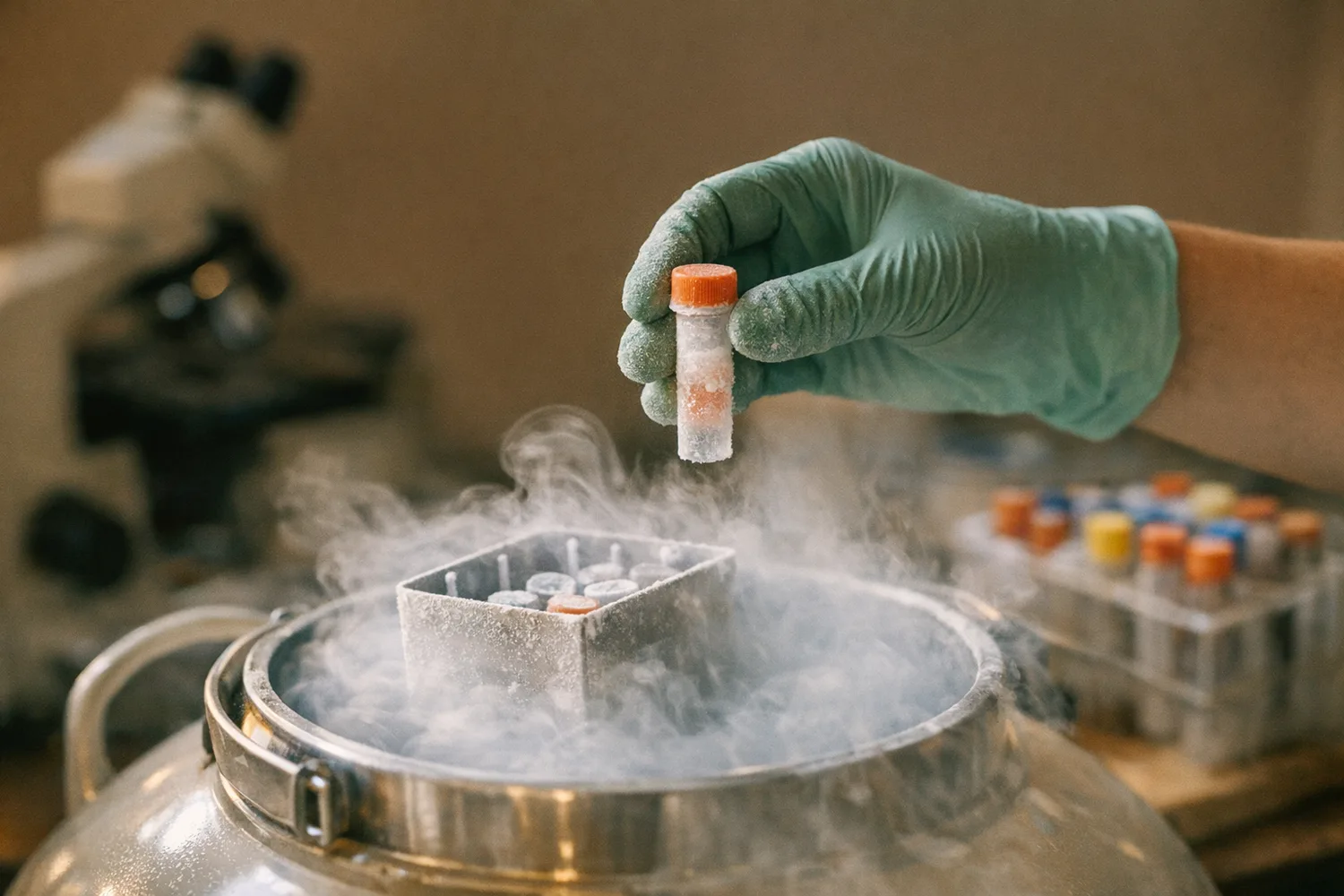
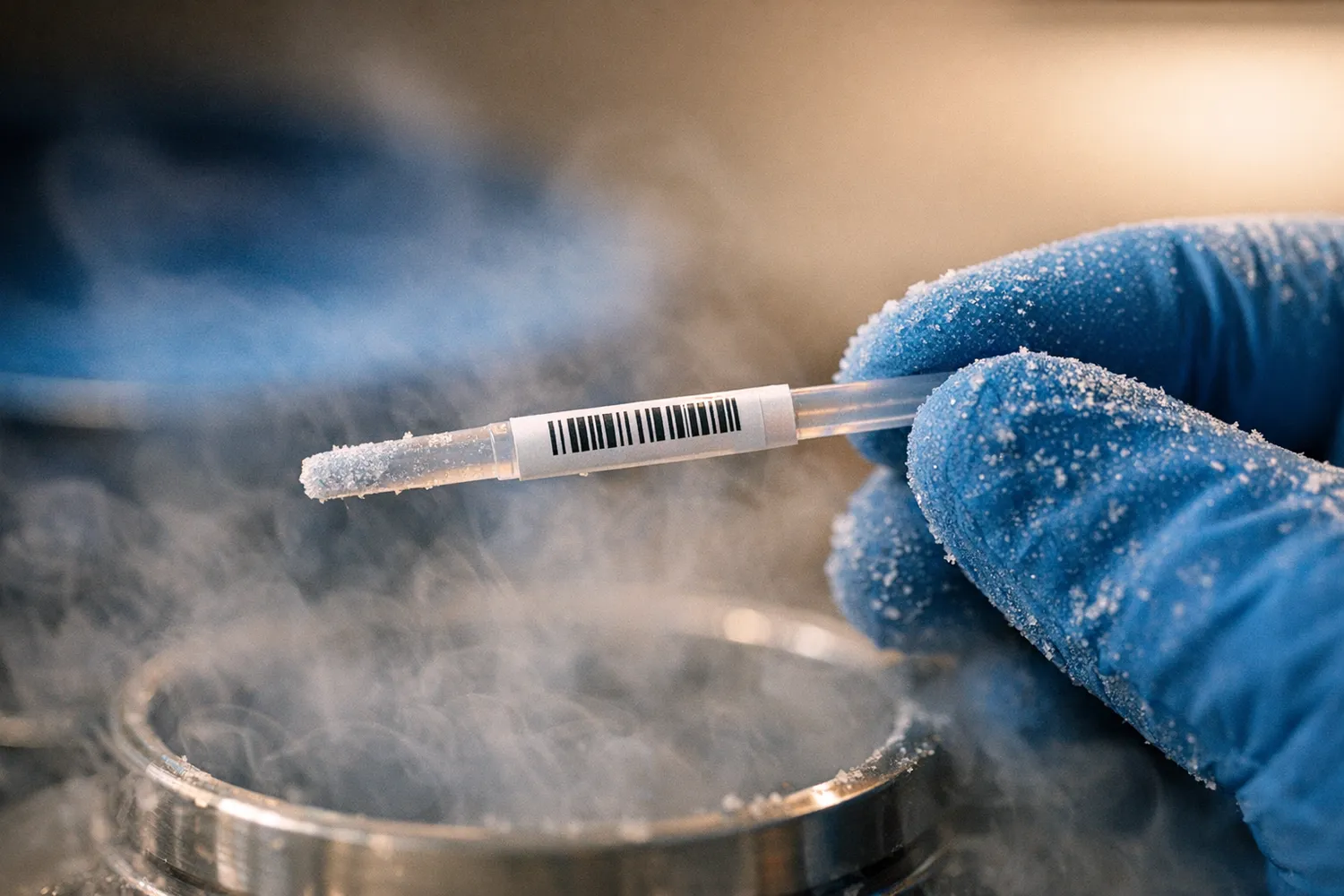
The processed sample is stored frozen (cryopreserved) in small tubes called straws. For an insemination, the guideline of the Working Group for Donor Insemination (AKDI) calls for a dose of more than 5 million progressively motile sperm. How many straws that takes is determined by the sperm bank depending on the sample type: some count on one portion per treatment, others on two or three. Sperm banks also distinguish between samples for IUI and IVF and samples for ICSI, in which individual sperm are placed directly into the egg. At some banks, ICSI samples are cheaper.
Donor sperm is subject to strict quality requirements. The AKDI guideline requires a sperm concentration of more than 60 million per milliliter. For comparison, in the WHO laboratory manual from 2021, the lower reference limit (5th percentile) is 16 million per milliliter.
Sperm donation is legal in all three countries, but with different rules. In Germany, the Sperm Donor Registry Act (Samenspenderregistergesetz, SaRegG) has applied since July 1, 2018 and ended donor anonymity. Since 2018, § 1600d para. 4 BGB has also protected the donor from being determined to be the father. Austria opened sperm donation to female couples with the 2015 amendment to the Reproductive Medicine Act (Fortpflanzungsmedizingesetz, FMedG), and Switzerland did so for married female couples on July 1, 2022. The German IVF Registry shows how common the treatment is: in 2023, 3,177 IVF and ICSI treatments with donor sperm were documented in Germany, not counting inseminations.

Who is sperm donation an option for?
- Couples with severe male infertility: when there is no sperm in the ejaculate (azoospermia) and even a TESE or micro-TESE finds no sperm in the testicular tissue. Or in severe oligozoospermia, when even ICSI treatments have not led to a pregnancy. You can find more on male diagnostics under andrology.
- Genetic conditions in the man: when the risk of passing on a serious hereditary disease is too high.
- After a vasectomy, when a reversal is not wanted.
- Single women who want to fulfill their wish for a child without a partner.
- Female couples for whom donor sperm is the route to having a child together.
Access, costs, and legal parenthood differ considerably depending on your situation and country. The sections on single women, female couples, and the legal situation go into detail.
The treatment process with donor sperm
In Germany, Austria, and Switzerland, the path to sperm donation follows a similar pattern: counseling, choosing a clinic and sperm bank, donor selection, shipping of the samples, and finally the treatment. How long this takes depends mainly on the sperm bank, the preliminary examinations, and your cycle. From the decision to the first treatment, allow a few weeks.
Step 1: Counseling and information
The initial consultation at the fertility clinic covers your medical starting point, the legal framework, and the emotional side. Psychosocial counseling before treatment is recommended, and some clinics require it. In Germany, under the Sperm Donor Registry Act, the clinic must inform you before treatment about, among other things, the child's right to information and about counseling services. You confirm this in writing.
In Austria, the process is more formalized: The medical information session must take place at least 14 days before treatment. If a third party's sperm is used, counseling with a notary is mandatory, and consent must be given as a notarial deed (Notariatsakt). When the sperm is introduced, this consent must not be older than two years (§§ 7 and 8 FMedG).
The questions raised in counseling are important: When and how do I tell my child how they came to be? How do I handle reactions from the people around me? How is my partner dealing with this? Thinking these questions through beforehand is not bureaucratic effort. It gives you confidence in the decision. In parallel, the preliminary examinations take place at the clinic, such as a blood count, ultrasound, and infectious disease serology.
Step 2: Choosing a fertility clinic and sperm bank
Treatment always takes place in a fertility clinic or practice; the sperm bank delivers the donor sperm there. So find out early whether your clinic will treat you, because not every clinic treats single women or female couples. Also ask which sperm banks it works with. Not every sperm bank delivers to every clinic, and some fertility clinics have their own donor bank only for their own patients. The clinic directory with the donor sperm filter shows you clinics that offer treatment with donor sperm. What to look for in a sperm bank is covered in the section Choosing a sperm bank.
Step 3: Selecting a donor
The sperm bank provides you with donor profiles without names. Typical details include:
- Physical characteristics: height, weight, hair and eye color, skin type
- Blood type
- Education and occupation, often also hobbies and interests
- Family health history
- CMV status: whether the donor has been exposed to cytomegalovirus
- Extended details at some banks: childhood photos, voice recording, motivation letters
Not all sperm banks work with an online catalog. Some suggest a small selection of suitable donors after a conversation, others show detailed profiles. Don't choose by looks alone. The donor's family health history and CMV status are more important medically. Whether the donor's CMV status should match your own is something you discuss with your clinic. In Switzerland, selection is limited by law: only blood type and similarity of outward appearance may be taken into account (Art. 22 para. 4 FMedG).
Anonymous, ID release, or known donor? In treatment in Germany, there are no anonymous donors. A clinic may only use donor sperm if it has the donation identifier from the sperm bank, and the donor data end up in the sperm donor registry at the BfArM. In Austria and Switzerland, too, sperm donation is not anonymous. At sperm banks abroad, you will come across the terms ID release (or open ID) and non-ID: ID-release donors agree that the child can learn their identity later, non-ID donors remain unknown. Only ID-release donors are eligible for treatment in Germany. Anonymous donations are only possible with treatment abroad, if the law there permits them.
This decision affects your child most of all. Being able to get to know the genetic father can be important for their identity development. So think about it: How will I handle the possibility that my child may get in touch later? What will they want to know themselves someday? If you are planning treatment abroad, check beforehand what rules apply there for anonymity and for information about the donor.

Step 4: Donor screening and quarantine
Donors go through several examinations before approval, and by their own account, sperm banks accept only a small share of applicants. In Germany, the Tissue Ordinance under the Transplantation Act (TPG-Gewebeverordnung, Annex 4) requires tests for HIV 1 and 2, hepatitis B and C, and syphilis, plus a chlamydia test on urine using a nucleic acid test (NAT). For donors who come from or live in areas with a high prevalence, a test for HTLV-I is added, and depending on their history, further tests, such as for CMV. The AKDI guideline additionally calls for tests for CMV and gonorrhea. According to the guideline of the German Medical Association, the donor should be no older than 40 at the time of donation.
Quarantine: Every donation is stored frozen for at least 180 days, after which the donor is tested again. Only then does the sperm bank release the sample. If the donor's blood is additionally tested for HIV and hepatitis B and C by NAT, the repeat test can be omitted. The 180-day quarantine remains mandatory anyway.
Genetics: The standard is a family history covering three generations (guideline of the German Medical Association 2022). According to the AKDI guideline, chromosome analyses or molecular genetic tests are generally not part of the donor examination. Some sperm banks offer them in addition, such as a chromosome analysis or a carrier test for cystic fibrosis.
Step 5: Ordering and shipping to the clinic
German sperm banks may release donor sperm only to medical care facilities, that is, not to you at home (§ 3 para. 1 SaRegG). This rule does not apply directly to sperm banks abroad. If insemination takes place at home, however, the donor protection under § 1600d para. 4 BGB does not apply (see Private sperm donation). The order is usually placed through the treating practice, and a specialized courier brings the samples to the clinic deep-frozen. Sperm banks state their processing and delivery times on their websites; allow a few weeks of lead time.
Some intended parents have several samples from the same donor stored at the clinic or at the bank so that the same donor is available for later cycles. Many sperm banks also offer reservations for a sibling, usually for a fee.
In Austria, a donor may only ever provide his sperm to the same hospital (Krankenanstalt) (§ 14 para. 1 FMedG). Ask your clinic where it gets its donor sperm. In Switzerland, donated sperm may only be passed on to persons holding a permit for reproductive procedures (Art. 20 para. 1 FMedG), and the treatment takes place at the clinic.
Step 6: Treatment with IUI, IVF, or ICSI
Which method fits depends on your situation, not on your relationship status.
Intrauterine insemination (IUI): the most common method with sperm donation. The thawed and processed donor sperm is placed directly into the uterus with a thin catheter at the time of ovulation, in a natural or lightly stimulated cycle. The procedure takes a few minutes, and afterward you can carry on as normal. IUI is less involved and less expensive than IVF.
IVF or ICSI: After hormonal stimulation, your eggs are retrieved and fertilized with the donor sperm in the lab. In conventional IVF, sperm and egg find each other on their own; in ICSI, a single sperm is injected directly into the egg. The clinic decides which procedure makes sense based on your results.
What favors which route: Open fallopian tubes, regular ovulation, and an unremarkable fertility workup favor starting with IUI. Blocked or damaged fallopian tubes, endometriosis, a low ovarian reserve, or older age favor going straight to IVF. If IUI does not work, IVF is often the next step. When a switch makes sense is explained in our article on IUI treatment. The choice of method is always discussed individually.
After the birth: reporting to the sperm donor registry
In Germany, you notify the clinic of the birth within three months at the latest (§ 4 SaRegG). The clinic reports your data, the date of birth, and the number of children to the BfArM, no later than four months after the estimated due date (§ 6 SaRegG). You can calculate the expected date after an embryo transfer with our IVF Due Date Calculator.
Chances of success with donor sperm
Donor sperm must meet strict quality criteria. For IUI, rates with donor sperm are higher than with a partner's sperm, according to the German IVF Registry: in 2024, 16.0% of inseminations with donor sperm led to a clinical pregnancy, compared with 10.3% with the partner's sperm.
| Method | Clinical pregnancy | Live birth |
|---|---|---|
| IUI with donor sperm (per insemination) | 16.0% (2024) | 14.2% (2023) |
| IVF/ICSI with donor sperm (per embryo transfer) | 31.3% (2023) | 23.3% (2023) |
Source: German IVF Registry, Yearbook 2024. The women in the IVF/ICSI group were 37.2 years old on average.
These are averages across all age groups, and the two rows refer to different units. The most important influencing factor is the woman's age. How strongly the chances with IUI depend on age is shown by the age breakdown in our article IUI success rates by age. None of these figures is a guarantee for your individual case.
Sperm donation for single women
The desire for a child does not stop at relationship status. More and more women are deliberately choosing to become mothers on their own. The term single mother by choice is often used for this. In Germany, this is possible with donor sperm; in Austria and Switzerland, it currently is not. Anyone taking this path should know the legal, financial, and emotional sides.

Legal situation for single women in Germany
In Germany, no law defines which group of people may receive fertility treatment. Neither the Embryo Protection Act (Embryonenschutzgesetz) nor the Sperm Donor Registry Act prohibits treating single women. A professional article in the Hessian Medical Journal of the State Medical Chamber of Hesse (2021) concludes that using donor sperm for single women and for female couples is permissible in Germany.
Professional medical regulations used to create uncertainty. In 2018, the board of the German Medical Association declared its former (model) guideline obsolete. The guideline on assisted reproduction that applies today does not address who may be treated. Based on the old model guideline, all state medical chambers except those of Bavaria, Berlin, and Brandenburg had issued their own guidelines (Federal Fiscal Court, BFH, 2017); Hesse repealed its guideline effective December 1, 2020. A current overview of all the chambers has not been published.
There is no obligation to treat (§ 10 Embryo Protection Act). Whether a clinic or sperm bank serves single women is its own decision. According to the AKDI member list, seven of the eleven member sperm banks provide donor sperm to all groups, including single women. For one of these seven, the website is currently not working. Three exclude single women, and one gives no information (as of October 4, 2026).
Legally, your child then has one parent: you. The mother is the woman who gave birth to the child (§ 1591 BGB). If the sperm comes from a sperm bank and conception is medically assisted in a clinic, the donor cannot be determined to be the father (§ 1600d para. 4 BGB). He then has neither rights nor obligations toward your child, so there is no child support from the donor. Since 2018, the legal situation has therefore been much clearer than before.
Finding a clinic and sperm bank
Not every fertility clinic treats single women. The easiest approach is to call directly and ask specifically. Many clinics clarify this over the phone, which saves you unnecessary appointments and disappointment. You can find clinics offering treatment with donor sperm in the clinic directory. The member list of the AKDI gives a first overview of the sperm banks: for ten of the eleven banks, it states whether they also serve single women.
Reputable clinics always offer detailed counseling. For single women it is especially important, because you carry the responsibility financially, emotionally, and legally on your own. Many clinics therefore require psychosocial counseling. That is not distrust toward you but sensible preparation.
Practical and emotional questions
Single women face questions that couples do not face in the same way: Who goes with me to appointments and to the birth? How do I organize the first phase with the baby on my own? How do I explain to my child why they don't have a dad?
For many, the biggest challenge is less their own decision than the reaction of family and friends. Some women keep the topic to themselves at first, others are open about it from the start. Either can work. In the long run, however, openness makes many things easier, especially with the child. The decision is rarely made spontaneously. A reliable network, a plan for childcare and work, and a realistic idea of what lies ahead are helpful.

Financial planning as a solo mother
Without a partner, you bear the costs alone, and for donor sperm the statutory health insurance fund in Germany pays nothing. Every sample, every monitoring visit, and every cycle is at your own expense. Plan for several treatment cycles, because an IUI rarely leads to pregnancy on the first attempt. What the individual items cost is covered in the section Costs.
- Taxes: Treatment costs can be deductible as an extraordinary burden if you have illness-related infertility. In 2020, the Fiscal Court of Münster ruled that it does not matter whether the woman is married or in a steady relationship. It allowed an appeal to the Federal Fiscal Court (BFH); we found no BFH decision on this. Only the portion above the reasonable burden is deductible, which, depending on income, marital status, and number of children, amounts to 1% to 7% of total income. More on this: deducting fertility treatment costs from your taxes.
- Private health insurance: Some plans contribute, but fertility treatments are often excluded. Submitting a request before treatment begins is worthwhile.
- Parental allowance (Elterngeld): The basic parental allowance is 67% of net income before the birth; for income above €1,200, the rate drops to as low as 65%, and the minimum is €300 per month (§ 2 BEEG). Single parents can, under certain conditions, including entitlement to the relief amount, also use the partner months and thus receive parental allowance for up to 14 months (§ 4c BEEG).
- Relief amount for single parents: €4,260 per year, plus €240 for each additional child (§ 24b EStG).
- Childcare costs: 80% of the costs, up to €4,800 per child per year, are deductible as special expenses, for children under 14 (§ 10 EStG).
As a single parent, you need larger financial cushions: for times when you can work less because of pregnancy complications, for gaps in childcare, and for a career break that is harder to absorb on your own.
Austria and Switzerland: no access for single women
Austria: Medically assisted reproduction is permitted only within a marriage, a registered partnership, or a cohabiting partnership (§ 2 para. 1 FMedG). Single women are thus excluded. The Greens have filed a motion in the National Council to change this (motion 496/A, Parliamentary Correspondence of October 17, 2025). That is a motion, not current law: the rule is unchanged (RIS, version of October 4, 2026).
Switzerland: Donated sperm may only be used for married couples (Art. 3 para. 3 FMedG). The Federal Council wants to make sperm donation possible for unmarried couples in the future and has commissioned the Federal Department of Home Affairs to prepare a consultation draft by the end of 2026. The announcement does not mention single women. This, too, is not current law.
Some women from Austria and Switzerland therefore have treatment abroad, for example in Germany, where the law does not exclude single women. This means additional travel and costs. Which law then applies to parentage can also depend on the country where the child lives (see Cross-border cases). Have a lawyer check beforehand whether the donor is also protected from a determination of paternity under that law.
Sperm donation for female couples
For female couples, donor sperm is the obvious route to a child together, and in principle it is possible in all three countries. The differences lie in access and, above all, in how the birth mother's partner becomes a legal parent.

Germany: access and costs
Treating female couples with donor sperm is permitted in Germany, married or not. Not every clinic and not every sperm bank serves all couples, however. According to the AKDI member list, three of the eleven member sperm banks do not provide donor sperm to unmarried female couples, and one of them does not provide it to married couples either (as of October 4, 2026).
The health insurance fund does not pay: § 27a of Book V of the German Social Code (Sozialgesetzbuch V, SGB V) requires that only the spouses' eggs and sperm be used. According to familienplanung.de, this applies equally to lesbian married couples. Some health insurance funds contribute voluntarily for same-sex couples as well, but there is no entitlement. Some federal states fund female couples from state funds, and treatment costs may be tax deductible. Both are covered in the section Costs.
Germany: second mother only through stepchild adoption
The legal mother is only the woman who gave birth to the child (§ 1591 BGB). Under current law, the partner does not automatically become the second parent, not even in a marriage. According to the Federal Ministry of Justice, same-sex spouses always need a (stepchild) adoption for joint parenthood. This is how it works:
- Application: The partner files an application with the family court to adopt the child, which must be notarized (§ 1752 BGB). The court at the habitual residence of the adopting person has jurisdiction (§ 187 FamFG).
- Married couples: A spouse can adopt her spouse's child on her own (§ 1741 para. 2 BGB). After that, the child has the legal status of a joint child of both (§ 1754 para. 1 BGB).
- Unmarried couples: Possible in an established long-term partnership, as a rule if you have lived together for at least four years or already have a child together (§ 1766a BGB).
- Mother's consent: It can be given no earlier than when the child is eight weeks old (§ 1747 para. 2 BGB).
- Opinion: The court obtains an expert statement from the adoption placement agency or, if none was involved, from the youth welfare office (§ 189 FamFG).
- Counseling: The counseling otherwise required is not needed if you were married at the time of the birth (§ 9a para. 4 AdVermiG).
There is no uniformly published information on how long the procedure takes. A reform introducing co-motherhood by operation of law has not been passed; proceedings on this are pending before the Federal Constitutional Court. You can find the exact status under Reform of parentage law. For the adoption and your specific situation, a specialist family law attorney is the right point of contact.
Austria: partner becomes a parent without adoption
Austria opened sperm donation to female couples in 2015. The Reproductive Medicine Act expressly permits donor sperm when the treatment is to be carried out for two women in a registered partnership or cohabiting partnership (§ 2 para. 2 no. 3, § 3 para. 2 FMedG).
Parenthood is regulated more simply than in Germany: If the mother is married to a woman or in a registered partnership with a woman at the time of the birth, that woman automatically is the other parent (§ 144 para. 2 of the Austrian General Civil Code, ABGB). A cohabiting partner becomes a parent by acknowledging parenthood before or after the birth, in a public or publicly certified document (§ 145 para. 1 ABGB), or by court determination. A stepchild adoption is not necessary.
Since January 1, 2015, female couples have been entitled to claim from the IVF Fund (IVF-Fonds) if the requirements are met by the woman who is to carry the child. The fund does not pay for the donor sperm itself or for inseminations.
Switzerland: only married female couples
Since July 1, 2022, married female couples in Switzerland have access to sperm donation. Unmarried female couples are excluded because donated sperm may only be used for married couples (Art. 3 para. 3 FMedG). If the child is conceived according to the rules of the Reproductive Medicine Act, the mother's wife is automatically considered the other parent (Art. 255a of the Swiss Civil Code, ZGB). If the child was instead conceived through a private sperm donation or a sperm donation abroad, a stepchild adoption is still necessary, according to the Federal Office of Justice.
Legal situation in Germany, Austria, and Switzerland
The legal side is central to sperm donation. Who is legally a parent? What rights does the child have? Can the donor owe child support or assert rights? These questions should be settled before treatment, not after. This section summarizes the status as of October 4, 2026 and is not a substitute for legal advice.

Germany: the Sperm Donor Registry Act
The Sperm Donor Registry Act (SaRegG) came into force on July 1, 2018. Its full title is “Act on the Establishment of a Sperm Donor Registry and on the Regulation of the Provision of Information About the Donor After Heterologous Use of Sperm.” It ended the decades-long anonymity of donors. It rests on the right to know one's own parentage, which the Federal Constitutional Court derived from the general right of personality (judgment of January 31, 1989, 1 BvL 17/87). The most important rules:
- Registry at the BfArM (§ 1 para. 1): The Sperm Donor Registry is maintained by the Federal Institute for Drugs and Medical Devices. Until May 2020, DIMDI was responsible, which was then merged into the BfArM.
- Only medically assisted reproduction (§ 1 para. 2): Children conceived through medically assisted reproduction are covered. Private sperm donations do not end up in the registry.
- Donor data (§ 2 para. 2): Family name and, if different, birth name, first names, date and place of birth, nationality, and address. Further details, such as motives, only with the donor's written consent, which he can withdraw at any time (§ 2 para. 3).
- Release only to clinics and practices (§ 3 para. 1): Sperm banks in Germany may release donor sperm only to medical care facilities, that is, a hospital or another facility under permanent medical direction, not to private individuals.
- Donation identifier (§ 5 para. 1): The clinic may only use the sperm if it has the donation identifier sequence or a unique donation number. Sperm from other EU states, the European Economic Area (EEA), or third countries is permitted if the clinic ensures that the foreign sperm bank transmits the donor data to the BfArM on request.
- Reports (§§ 4 and 6): You inform the clinic of the birth, and the clinic reports your data, the date of birth, and the number of children to the BfArM. The sperm bank transmits the donor data at the BfArM's request.
- 110 years (§ 8): That is how long the BfArM stores the data.
- No retroactive effect: For children conceived before July 1, 2018, the BfArM holds no data. Sperm banks must, however, retain existing older data for 110 years after the sperm was collected (§ 13 para. 3). Donor-conceived people from that period turn to the clinic or sperm bank of the time or search by other means, such as DNA databases.
- Fines (§ 12): up to €30,000 if a sperm bank releases donor sperm in violation of § 3 or a clinic uses it in violation of § 5, up to €5,000 for other violations.
The child's right to information
Your child has a claim against the BfArM to be told who the donor is. There is no minimum age for this. From their 16th birthday, however, the child can assert the claim only themselves (§ 10 para. 1 SaRegG). Before that, the parents can apply for the information as legal representatives (§ 10 para. 3), but only in order to inform the child about their parentage. According to the BfArM, the parents have no right of their own to know the donor's identity, and the child must have the necessary maturity.
The information includes the donor's identity data and, if he has consented, his voluntary details. Medical test results or characteristics such as blood type, height, and hair color are not included; such details appear at most in the donor profiles of the sperm banks. Half-siblings cannot be traced through the registry, because the information only covers the donor's data.
The application is submitted in writing with a birth certificate and a copy of an ID. Counseling before the information is released is not mandatory, but the BfArM recommends it and points to services (§ 10 para. 4). It can help you prepare for potentially distressing information, for example through family counseling centers or specialized therapists. The donor is informed four weeks before the information is released (§ 10 para. 5). Before donating, he is told about the right to information and must expect that children may seek contact later. The law does not, however, grant a right to contact; whether and how contact comes about is for the people involved to decide.

Paternity, child support, and inheritance law
Under § 1592 BGB, the father of a child is the man who is married to the mother at the time of the birth, who has acknowledged paternity, or whose paternity has been established by a court. The donor does not automatically become the legal father through the treatment.
- Married couples: The husband is the legal father by operation of law, even without a biological relationship.
- Unmarried couples: The partner must acknowledge paternity, which can be done even before the birth (§ 1594 para. 4 BGB). Without acknowledgment, the child legally has only the mother. Acknowledgment before the birth is therefore advisable.
No challenge after consent (§ 1600 para. 6 BGB): If the man and the mother consented to fertilization with donor sperm, they cannot later challenge paternity. The law excludes a challenge “if the child was conceived through assisted reproduction using a sperm donation from a third party, with the consent of the man and the mother.” The child themselves retains the right to challenge.
Child support from an unmarried intended father: In 2015, the Federal Court of Justice (BGH) ruled that a man who consented, together with his unmarried partner, to fertilization with donor sperm owes support to the child even if he never acknowledged paternity (judgment of September 23, 2015, XII ZR 99/14). According to the BGH, the consent constitutes a contract for the benefit of the child. From this arises the obligation “to provide for the child's support like a legal father.”
Protection of the donor (§ 1600d para. 4 BGB): If the child is conceived through medically assisted reproduction at a medical care facility using sperm that the donor made available to a sperm bank (a collection facility under the SaRegG), “the sperm donor cannot be determined to be the father of this child.” Both conditions must come together: medically assisted fertilization in a clinic and sperm via a sperm bank. This blocks the court route of having the donor established as the father, for example for child support. Private donations are not covered by the provision. The explanatory memorandum to the bill states expressly: “Cases of artificial insemination that is not medically assisted (in particular by means of the so-called cup donation) are therefore not covered by the exemption.” Neither the law nor the explanatory memorandum expressly says whether the protection also applies if the sperm comes from a sperm bank abroad.
Inheritance rights: Without determination as the father, there is no statutory right of inheritance between donor and child. Donor-conceived children inherit from their legal parents; conversely, the donor does not inherit from them either. In a private donation with established paternity, by contrast, the normal rules apply, including the compulsory portion.

Paternity challenge: new version of § 1600 BGB since April 1, 2026
Challenging paternity has been regulated anew since April 1, 2026. The law of March 29, 2026 was promulgated on March 31, 2026 (Federal Law Gazette, BGBl. 2026 I No. 83) and entered into force the next day. According to the government draft, it stays “within the framework of existing parentage law” and does not change the two-parent principle. For sperm donation, that means: the exclusion of a challenge after consent remains in § 1600 para. 6 BGB; the law does not bring co-motherhood.
What is newly regulated is above all the challenge by the biological father. Previously, a social-family relationship between the child and the legal father always excluded it. Today, that applies to a minor child only with exceptions, for example if such a relationship also exists between the child and the biological father, or if he has made serious efforts to establish one, without fault of his own, and failed. Even then, the challenge remains excluded if the continuation of legal paternity is necessary for the child's welfare (§ 1600 para. 3 BGB). If the child is an adult, it depends on whether the child objects to the challenge (§ 1600 para. 2 BGB).
A motion for a resolution by the Greens that was meant to clarify that a sperm donor may not challenge paternity (Bundestag printed matter, BT-Drs. 21/4324) was rejected in the Bundestag. That leaves the previous line of the Federal Court of Justice: a private donor can, under certain circumstances, challenge another man's legal paternity (judgment of May 15, 2013, XII ZR 49/11).
Reform of parentage law: status as of October 2026
So far, there is no comprehensive reform introducing co-motherhood. In January 2024, the Federal Ministry of Justice presented key points for modernizing parentage law. Among other things, the plans were:
- Co-motherhood: The partner of the birth mother was to be able to become the second legal mother without the detour of stepchild adoption.
- Parenthood agreements: Even before conception, binding agreements on parenthood were to become possible, relevant for private sperm donations, for example.
- Donor data registry: “The sperm donor registry is to be expanded into a donor data registry that also covers past cases, embryo donations, and private sperm donations.”
The draft bill of the previous legislative term (as of December 2024) was not pursued further because the governing coalition ended early, and it was published only as a discussion draft. The 2025 coalition agreement does not mention a reform of parentage law, co-motherhood, or sperm donation. On parentage, it names only the goal of preventing abusive paternity acknowledgments. In May 2025, the German Bundesrat called on the federal government to change parentage law in favor of two-mother families; that is not a law. Six proceedings on so-called co-motherhood are pending before the Federal Constitutional Court (1 BvL 1/21 and others). They are on the list of decisions planned for 2026; no decision has been made yet (as of October 4, 2026). The proceedings are based on different constellations, with both official and private sperm donation.
For you, this means: Female couples still need stepchild adoption, and the legal situation of private sperm donations remains unchanged. Anyone waiting for the reform should not plan on it coming into force in the short term.
Austria: Reproductive Medicine Act
The Austrian Reproductive Medicine Act (FMedG) has regulated sperm donation since 1992; it was opened to female couples in 2015. The most important points:
- Access (§ 2 para. 1): only within a marriage, registered partnership, or cohabiting partnership. Single women are excluded.
- Donor sperm (§ 3 para. 2): permitted if the sperm of the husband or cohabiting partner is not capable of reproduction, or if the treatment is to take place for two women in a registered partnership or cohabiting partnership.
- Form (§§ 7 and 8): medical information session at least 14 days beforehand, counseling with a notary, consent as a notarial deed.
- Donor (§§ 13 and 14): at least 18 years old, written consent that also covers later disclosure of information. He may only give his sperm to the same hospital, and it may be used for at most three marriages, registered partnerships, or cohabiting partnerships.
- Information (§ 20 para. 2): After reaching the age of 14, the child can access the donor data. Parents receive access only in exceptional cases justified on medical grounds.
- Retention (§ 15 para. 3): The hospital keeps the data for 30 years, after which they go to the provincial governor (Landeshauptmann), who keeps them permanently.
- Paternity: A donor who has given his sperm to an authorized hospital cannot be determined to be the father (§ 148 para. 4 ABGB). The man who consented to the treatment in the form of a notarial deed can be determined to be the father (§ 148 para. 3 ABGB). On the mother's partner, see female couples.
- No trade, no brokering, no advertising (§ 16): Giving sperm may not be the subject of a transaction for payment (§ 16 para. 1). Brokering sperm is not permitted (§ 16 para. 2). The law adds: “Likewise, any advertising for the giving or brokering of sperm, eggs, or cells capable of development is not permitted.” Violations of the ban on brokering can be penalized with up to €50,000 (§ 22).
- Egg donation: In Austria, egg donation is also permitted, unlike in Germany and Switzerland.
What the IVF Fund covers is described in the section Costs.
Switzerland: Reproductive Medicine Act and Civil Code
The Federal Act on Medically Assisted Reproduction (Reproductive Medicine Act, FMedG) dates from 1998 and has been amended several times since, including in 2022 with “marriage for all.” The version in force is as of August 1, 2025.
- Access (Art. 3): Reproductive procedures only for couples, donated sperm only for married couples. Since July 1, 2022, married female couples are included. Unmarried couples can use only their own eggs and sperm; single women are excluded.
- Permit (Art. 8): Anyone who uses reproductive procedures or who stores and brokers donated sperm needs a permit from the canton.
- Donor (Art. 19 to 22): A donor may make his sperm available to only one agency. The sperm donation as such is free of charge. A donor's sperm may be used for at most eight children. Only blood type and similarity of outward appearance may be taken into account in selection. The sperm may be passed on only to persons with a permit (Art. 20 para. 1).
- Registry (Art. 25 and 26): After the birth, the donor data go to the Federal Civil Status Office, which has kept a registry since 2001 and retains the data for 80 years.
- Information (Art. 27): From the age of 18, the child can request information about the donor's outward appearance and personal details, and, if there is a legitimate interest, about all data at any time. Anonymous sperm donations are prohibited.
- Parenthood (Art. 23 FMedG, Art. 255a ZGB): Neither the child nor the mother's wife or husband can challenge the parent-child relationship with the mother's wife or husband. After a sperm donation under the FMedG, the mother's wife is considered the other parent. A paternity suit against the donor is excluded, unless the sperm was knowingly donated to a person without a permit.
- Planned revision: The Federal Council wants to make egg and sperm donation possible for unmarried couples as well; a consultation draft is due by the end of 2026. That is not current law.
Sperm donation in Germany, Austria, and Switzerland compared
| Rule | Germany | Austria | Switzerland |
|---|---|---|---|
| Single women | no statutory exclusion, clinic and sperm bank decide | excluded | excluded |
| Female couples | permitted, second mother through stepchild adoption | permitted (according to the law, in a registered partnership or cohabiting partnership), partner becomes a parent without adoption | only if married (since 2022), wife is considered a parent |
| Unmarried couples | permitted | permitted, consent as a notarial deed | excluded (opening planned, not current law) |
| Information for the child | no minimum age, from 16 only the child themselves | from age 14 | from age 18 |
| Registry and retention | BfArM, 110 years | clinic 30 years, then permanently with the provincial governor | Federal Civil Status Office, 80 years |
| Maximum per donor | no statutory limit, AKDI recommendation 15 families | 3 marriages, partnerships, or cohabiting partnerships | 8 children |
| Donor can be determined to be the father | no with sperm bank and clinic (§ 1600d para. 4 BGB) | no with a donation to a hospital (§ 148 para. 4 ABGB) | no, except with a donation to a person without a permit |
| Private donation | no protection from a determination of paternity | protection only with the consent of the spouse or registered partner | paternity suit possible |
| Release to private individuals | prohibited for German sperm banks (§ 3 SaRegG) | brokering and advertising not permitted (§ 16 FMedG) | only to permit holders (Art. 20 FMedG) |
| Anonymous donation | no | no | no |
| Egg donation | not permitted | permitted | not permitted |
| Health insurance fund or IVF Fund | no statutory coverage for donor sperm | IVF Fund: 70% of IVF/ICSI with an indication, not for sperm and insemination | Basic health insurance: IUI up to 3 cycles per pregnancy (donor sperm not expressly regulated), no IVF |
In terms of access, Germany is the most open, because single women can also be treated here. Anonymous sperm donations, by contrast, do not exist in any of the three countries.
Cross-border cases
If donor and recipient live in different countries or the treatment takes place abroad, it gets complicated. From a German perspective, parentage is in principle governed by the law of the state in which the child has their habitual residence. It can also be determined by the law of a parent's home country (Art. 19 of the Introductory Act to the Civil Code, EGBGB). In donations between Germany and Austria, different legal systems can therefore apply. In Switzerland, after a sperm donation abroad, the mother's wife still needs a stepchild adoption.
For detailed legal questions, such as stepchild adoption, acknowledgment of paternity for unmarried intended parents, or cross-border cases, the next step is a specialist family law attorney, not the fertility clinic.
Costs of sperm donation
The costs consist of several components: donor sperm, shipping, treatment, medication, and, where applicable, storage of further samples. Many people initially think only of the price of the sperm sample and underestimate the total cost. The detailed calculation is in the article donor sperm cost; here is the overview.
Donor sperm and treatment
According to familienplanung.de (Federal Institute for Public Health, as of January 2026), a sperm sample costs between €700 and over €1,000. Because shipping is complex, €150 to over €300 are added. The public price lists of German sperm banks show how different the models are: some charge only for the portion and shipping, others additionally a one-time basic or provision fee, and depending on the bank, one, two, or three portions are used per insemination. For the donor sperm for a first IUI at a clinic away from the bank's location, the published prices come to roughly €860 to €2,480 (retrieved October 4, 2026). At some banks VAT is included, at others it is not.
On top of that come the clinic's costs for monitoring, insemination, or IVF/ICSI, medication in the case of IVF, and, where applicable, storage and reservation of further samples. As a guide, a German sperm bank cites about €200 to €400 per insemination cycle and about €2,000 to €4,000 per IVF or ICSI cycle for treatment at the practice, in each case plus storage of the donor sperm at the practice. More on this under treatment costs with donor sperm. Because not every cycle is successful, you should plan for several samples and cycles.
Donor sperm cost 2026 in Germany, Austria & Switzerland
Donor sperm: €864 to €2,476.30 per insemination at six German sperm banks (October 2026), plus treatment and insurance in Germany, Austria & Switzerland.

Health insurance and taxes in Germany
The situation is clear: Statutory health insurance funds pay nothing for treatment with donor sperm, not even a share. § 27a SGB V requires that the partners be married and that only the spouses' eggs and sperm be used. That also applies to married couples with proven male infertility. Unmarried couples, single women, and female couples also bear the costs themselves. Some funds contribute voluntarily, also for same-sex couples, but there is no entitlement. Private health insurers handle it differently depending on the contract. What insurance funds cover in general is shown on our page on health insurance coverage.
For tax purposes, the costs can count as an extraordinary burden. In 2017, the Federal Fiscal Court ruled that a woman with infertility in a same-sex partnership can deduct the costs of IVF with donor sperm, including the costs of providing and processing the donor sperm (VI R 47/15). The condition is that the treatment complies with professional medical regulations and the Embryo Protection Act. The BFH had already decided this in 2010 for heterologous fertilization in a married couple (VI R 43/10). For single women, there has so far been only one ruling, by the Fiscal Court of Münster (see single women). Only the portion above the reasonable burden is ever deductible. Details: deducting fertility treatment costs from your taxes.
Funding by federal states
The federal government does not fund treatment with donor sperm; its funding requires the use of one's own eggs and sperm. Some states provide funding from their own budgets (as of October 4, 2026):
| State | Who is eligible | Subsidy |
|---|---|---|
| Bremen | same-sex couples (marriage, civil partnership, non-marital cohabiting partnership) | up to 50%, maximum €1,200 (IVF) or €1,300 (ICSI) in attempts 1 to 3, €1,600 or €1,700 in attempt 4 |
| Rhineland-Palatinate | same-sex female couples | up to 12.5% in cycles 1 to 3, 25% in cycle 4; maximum €400 (IVF) or €450 (ICSI), in cycle 4 €800 or €900 |
| Saarland | same-sex female couples | up to 25% of the out-of-pocket cost, maximum €500 per cycle (1st to 4th), treatment in Saarland or Rhineland-Palatinate |
| Thuringia | female couples and couples using donor sperm (Thuringia Foundation HandinHand) | up to 25%, maximum €800 (IVF) or €900 (ICSI), in attempt 4 €1,600 or €1,800; woman under 42 |
| Berlin | former state program, also for female couples and donor sperm | discontinued, no funds for 2026 and 2027 |
Since June 1, 2026, no applications for funding of assisted reproduction can be approved in Lower Saxony at all.
Austria and Switzerland
Austria: The IVF Fund covers 70% of the costs of an IVF or ICSI if there is a medical indication under the IVF Fund Act (IVF-Fonds-Gesetz), such as male infertility. This also applies to an IVF or ICSI with donor sperm. The fund does not co-finance the cost of providing the donor sperm, and inseminations do not fall under the IVF Fund Act at all. The out-of-pocket cost per attempt under rates effective July 1, 2025 is €971.54 to €1,063.86 for an IVF and €1,078.36 to €1,170.68 for an ICSI, in each case before taxes. An announced reduction of the out-of-pocket cost has not yet been implemented in the IVF Fund Act (version of October 4, 2026). In principle, at most four attempts per couple are funded. At the start of an attempt, the woman who is to carry the child must be younger than 40, and the man or the partner younger than 50 (brochure “We Would Like a Baby”). More on this under costs in Austria.
Switzerland: According to the Health Insurance Benefits Ordinance (Krankenpflege-Leistungsverordnung), basic health insurance covers up to three IUI cycles per pregnancy, but not IVF. Whether inseminations with donor sperm fall under this, and who bears the cost of the donor sperm, is not expressly regulated by the ordinance, and the clinics' statements on this differ. Clarify this in advance with the clinic and the health insurance fund. Swiss clinics with a donor program quote roughly CHF 1,100 to CHF 1,800 for an insemination with donor sperm, in some cases plus a basic fee (retrieved October 4, 2026). More on this under costs in Switzerland.
Choosing a sperm bank
You usually make the choice of sperm bank together with your clinic. We do not rate or recommend individual sperm banks. These criteria help you compare:
- License: Sperm banks in Germany are tissue establishments and need an official license under §§ 20b and 20c of the Medicinal Products Act (Arzneimittelgesetz). License and supervisory authority are usually stated in the legal notice.
- Registry obligation: The bank must provide the donor data for the sperm donor registry. For banks abroad, this means: only ID-release donors are eligible for treatment in Germany.
- Delivery to your clinic: Not every bank delivers to every clinic. Some fertility clinics release donor sperm from their own donor bank only to their own patients.
- Target groups: Some banks do not serve single women or unmarried female couples. The AKDI member list states this for ten of the eleven banks.
- Donor selection and profile depth: Larger banks have more donors, which increases the chance of a suitable phenotype. Some offer only basic data such as appearance and blood type, others extended profiles with childhood photos, voice recordings, or motivation letters. Some deliberately do without an online catalog and suggest suitable donors after a conversation.
- Family limit: In Germany, the AKDI recommends at most 15 families per donor. Sperm banks abroad name their own limits, in some cases considerably higher, often counted worldwide.
- Transparent prices: Pay attention to what is included in the price: portion, basic or provision fee, shipping, storage, reservation for siblings, and whether VAT is included.
- Counseling: Good sperm banks advise on donor selection and on later disclosure to the child. Some also put people who were conceived through sperm donation in touch with one another, on request.
In Germany, the Working Group for Donor Insemination lists eleven member sperm banks; in addition there are individual providers outside this list. Most sperm banks ship to clinics all over Germany, so you do not need to live in the same city. In Austria, advertising for the giving or brokering of sperm is not allowed (§ 16 para. 2 FMedG); your clinic is the first point of contact there. In Switzerland, according to the National Ethics Commission (2019), there are no sperm banks operated independently of a fertility clinic. The professional society SGRM (Swiss Society for Reproductive Medicine) lists eight sperm donor centers, but the list is not exhaustive.
You can find a neutral overview with locations in our directory of sperm banks.
If you want to find a sperm donor, on this route you choose him together with the clinic and sperm bank. Only through a sperm bank and clinic does the donor protection under § 1600d para. 4 BGB apply in Germany. What is risky with donor exchanges and private contacts is covered under finding a sperm donor.

Private sperm donation, the cup method, and at-home insemination
A common question is whether you can simply use an acquaintance as a donor instead of going through a sperm bank. In a private sperm donation, a man passes on his sperm without a sperm bank. In the so-called cup method or at-home insemination, the ejaculate is handed over in a container and introduced by the woman herself. This is possible, but the risks are considerable, and most of them are legal in nature. We explain this in detail in the article on private sperm donation, including the cup method and at-home insemination.
The obvious difference: You know the donor and you know who your child's genetic father is. That can feel emotionally easier than a profile in a database, and the cost of a sperm bank sample does not apply. Against this stand the following risks.
Legal risks
- Germany: The protection of § 1600d para. 4 BGB does not apply; the cup donation is expressly excluded in the explanatory memorandum. The private donor can be determined by a court to be the father, with all the consequences: obligation to pay child support, custody and visitation rights, inheritance rights. A private or notarial agreement does not prevent judicial determination (§ 1600d para. 1 BGB). It is excluded only in the cases of paragraph 4. Future child support cannot be waived (§ 1614 BGB), not even in a notarial contract, and child support can in some circumstances be claimed retroactively (§ 1613 para. 2 BGB). Conversely, a private donor can himself assert rights and, in some circumstances, challenge another man's paternity (BGH, XII ZR 49/11). A private donation does not enter the sperm donor registry.
- Austria: The private donor cannot be determined to be the father if the person who is married to the mother or in a registered partnership with her has consented (§ 148 para. 5 ABGB). In all other cases, for example with single women or cohabiting partners without a marriage or registered partnership, he can still be determined to be the father.
- Switzerland: If the sperm was knowingly donated to a person without a permit, a paternity suit against the donor is admissible (Art. 23 para. 2 FMedG). The mother's wife does not automatically become a parent.
On self-insemination in Germany: A woman who performs an insemination on herself does not commit a criminal offense, nor does the man whose sperm is used (§ 11 para. 2 Embryo Protection Act). According to the wording, however, this exception does not apply to a third person, such as a partner who performs the insemination. German sperm banks may not release donor sperm to private individuals (§ 3 SaRegG). And even if the sperm comes from a sperm bank: if insemination takes place at home, the protection of § 1600d para. 4 BGB does not apply according to its wording, because it requires fertilization at a medical care facility.
Health risks
With a donation through a sperm bank in Germany, infection tests and at least 180 days of quarantine are mandatory, followed by a repeat test, unless the donor's blood was additionally tested by NAT. With a private donation, there is neither mandatory screening for infections nor quarantine, and family history is not systematically collected. At-home insemination takes place without medical supervision. Kits for at-home insemination count as medical devices under the EU Medical Device Regulation because they serve to promote conception.
There are no reliable study data per cycle on the success rate of private at-home inseminations with fresh sperm. A randomized trial in fertility clinics using frozen donor sperm compared insemination at the opening of the cervix (intracervical insemination, ICI, the technique of at-home insemination) with IUI: Within eight months, treatment led to a pregnancy with live birth in 24% of the women in the ICI group and 39% in the IUI group (Kop et al., 2022).
Known donor via a sperm bank
Some sperm banks and clinics also work with donors whom you bring yourself. The known donor then goes through the normal screening and quarantine, and fertilization takes place medically in the clinic. If he donates through a sperm bank and fertilization takes place medically in the clinic, he cannot be determined to be the father according to the wording of § 1600d para. 4 BGB. For donors you bring yourself, however, this has not been conclusively clarified. A sperm bank itself points this out as well. More on this under known or exclusive donor. Not all sperm banks offer this route. Because this is a special constellation, in any case have a specialist family law attorney advise you beforehand.
At home insemination in Germany, Austria & Switzerland
Private sperm donation by cup method or at home insemination: law in Germany, Austria, and Switzerland, missing tests, risks, and the clinic route.
Talking to your child about sperm donation
The medical side of sperm donation is often the easier part. Emotional processing often takes longer than the treatment itself.
For couples with male infertility, the step toward sperm donation is often a grieving process. The partner has to accept that the child will not be his genetic child. This takes time and often professional support, ideally in counseling specialized in fertility, before the decision is made.
For single women, the biggest challenge is often the reaction of those around them; for female couples, sometimes the question of how the roles in the family are named. For everyone, plan early how you will tell your child about the story of their origin.
An open, age-appropriate explanation from the start, as early as preschool age, is often recommended, rather than letting the child find out only as a teenager. If a child finds out late or by chance, that can strain trust within the family. Children pick up on secrets, and coincidences such as DNA tests can bring the truth to light. Honest but child-appropriate is the right tone: hide nothing, but do not overwhelm them either. There are children's books on building a family with sperm donation, and counseling services that help with this.
Later, your child can learn the donor's identity and may also have half-siblings. Some children develop a strong interest in their origins, others hardly any. Some families stay in touch with other families of the same donor, others do not. Both are fine.
Not sure whether sperm donation is the right path for you? Our Fertility Clinic Finder helps you assess your options in a few minutes, free of charge.
Frequently asked questions
Can I get to know or meet the donor beforehand?
As a rule, no. At sperm banks in Germany, Austria, and Switzerland, you get a profile of the donor but no direct contact. An exception is a donor you know yourself who donates through a sperm bank or clinic. Later, your child can learn the donor's identity: in Germany via the sperm donor registry (from age 16 only the child themselves, before that through the parents), in Austria from age 14, and in Switzerland from age 18. At sperm banks abroad, the option of learning the identity later is called ID release or open ID. In Germany, the registry applies to all donors anyway.
How many children may one donor father?
In Germany, there is no statutory upper limit. The Working Group for Donor Insemination recommends at most 15 families per donor; the recommendation is voluntary. In Austria, a donor's sperm may be used for at most three marriages, registered partnerships, or cohabiting partnerships, and in Switzerland for at most eight children. Sperm banks abroad work with their own limits, in some cases considerably higher. The limits are meant to reduce the risk that half-siblings unknowingly enter into a relationship.
Should I tell my child about the sperm donation?
Yes. Early, age-appropriate disclosure is often recommended. If a child learns about how they came to be only late or by chance, this can strain trust within the family. Children's books and counseling services help in finding the right words.
Can I reserve samples from the same donor for a sibling?
Yes, many sperm banks offer reservations for siblings, usually for a fee. The number of samples from a donor is limited. If you can imagine a second child with the same donor, ask early about the options and costs.
How long does it take from the decision to the first treatment?
Usually a few weeks. This includes counseling and preliminary examinations at the clinic, such as a blood count, ultrasound, and infectious disease serology, donor selection, and shipping of the samples to the clinic. Sperm banks state processing and delivery times on their websites. After that, the first IUI can take place in the next suitable cycle; with IVF, the phase of hormonal stimulation is added. For rare characteristics or a particular blood type, the selection can be smaller. In Austria, the medical information session at least 14 days before treatment and the notarial deed are added.
Does health insurance cover costs for sperm donation?
Not in Germany once donor sperm is used. Under § 27a SGB V, statutory health insurance funds contribute only if the spouses' own eggs and sperm are used exclusively. This also applies to married couples with male infertility, to single women, and to female couples. Some funds contribute voluntarily, private insurers depending on the contract. In Austria, the IVF Fund covers 70% of an IVF or ICSI when there is an indication, but not the donor sperm and no insemination. In Switzerland, basic health insurance provides for up to three IUI cycles per pregnancy, but no IVF. Whether this also applies to inseminations with donor sperm is not expressly regulated by the ordinance. In Germany, costs can also be tax deductible.
What does sperm donation cost in total?
That depends on the method, the number of attempts, and the sperm bank. The donor sperm alone for a first IUI costs roughly €860 to €2,480 according to the public price lists of German sperm banks. familienplanung.de cites €700 to over €1,000 per sample plus €150 to over €300 for shipping. On top of that come the practice's costs: as a guide, a German sperm bank cites about €200 to €400 per insemination cycle and about €2,000 to €4,000 per IVF or ICSI cycle, in each case plus storage of the donor sperm. Depending on the case, medication, counseling, and attorney fees for legal safeguards are added. Plan for several cycles. The detailed calculation is in the article donor sperm cost.
Does a sperm donor get paid?
You pay the sperm bank or the clinic, not the donor. In Austria, giving sperm may not be the subject of a transaction for payment (§ 16 para. 1 FMedG). In Switzerland: “The sperm donation as such is free of charge.” (Art. 21 FMedG). Donors there therefore do not receive a purchase price for their sperm. Fertility clinics do, however, mention compensation for donors' time and effort.
How high is the risk of a genetic condition?
It cannot be ruled out entirely. The standard is a family history of the donor covering three generations. According to the AKDI guideline, chromosome analyses or genetic tests are generally not part of the donor examination, but some sperm banks offer them in addition, as well as a genetic match between donor and recipient. If you yourself are a carrier of a hereditary condition, discuss this with the clinic and sperm bank. In unclear cases, the German Medical Association recommends genetic counseling.
What happens if the treatment does not lead to pregnancy?
Then it is worth taking a close look at your situation: Are there factors on your side that were not known before, for example with the fallopian tubes or the ovarian reserve? After several unsuccessful IUI cycles, the switch to IVF is often the next step. When that makes sense is explained in our article on IUI treatment. No treatment path guarantees a pregnancy.
Does a sperm donor have rights or obligations toward the child?
Not if the sperm came through a sperm bank and fertilization took place medically in a clinic. In that case, § 1600d para. 4 BGB rules out judicial determination as the father. The donor has neither child support obligations nor custody, and there is no statutory right of inheritance. He can be contacted by the child but does not have to take on a father role. In Austria and Switzerland, the same principle applies to donations through authorized clinics. For private donations without a sperm bank and clinic, this protection does not apply; there, the donor can become the legal father.
Does a sperm donor have to pay child support?
Not with a donation through a sperm bank with medically assisted fertilization. With private donations, the risk is real, because the donor can be determined to be the father and is then obligated to pay child support. A waiver of future child support is ineffective (§ 1614 BGB), even in notarial form. Independently of that, according to the BGH, an unmarried intended father who consented to the sperm donation must also provide for the child's support (judgment of September 23, 2015, XII ZR 99/14).
At what age can a donor-conceived child request information about the donor?
In Germany, there is no minimum age. From the age of 16, the child can assert the claim only themselves (§ 10 para. 1 SaRegG). For younger children, the parents can apply for the information as legal representatives, but only to inform the child about their parentage and only if the child has the corresponding maturity. The information includes the donor's name, date and place of birth, nationality, and address and, where applicable, his voluntary details. In Austria, the right of access exists from age 14, in Switzerland from age 18.
How long are the donor data stored?
In Germany, 110 years. § 8 SaRegG prescribes this period for the sperm donor registry at the BfArM. In Austria, the hospital keeps the data for 30 years, after which the provincial governor keeps them permanently. In Switzerland, they are kept for 80 years at the Federal Civil Status Office.
What happens if the sperm donor dies before the information is released?
The right to information does not expire with the donor's death. As long as the data are stored in the registry, the claim continues, that is, for up to 110 years. The donor-conceived person then receives the identity data but can no longer make personal contact. The recommended counseling before the information is released can prepare you for such situations.
What does it cost to get information from the sperm donor registry?
The law allows the BfArM to charge fees for information (§ 10 para. 6 SaRegG). The BfArM does not state an amount on its information pages. Counseling before the information is released is voluntary. Whether there are costs for it depends on the respective counseling service.
Can I get sperm donation as a single woman in Germany?
Yes. There is no statutory ban, and a professional article in the Hessian Medical Journal expressly considers the treatment of single women permissible. There is no obligation to treat, however: some clinics and sperm banks exclude single women, and many now treat them as a matter of course. Ask your first-choice clinic directly, and you will know right away whether treatment is possible.
Can single women be treated in Austria or Switzerland?
No. In Austria, medically assisted reproduction is permitted only within a marriage, registered partnership, or cohabiting partnership. In Switzerland, donated sperm may only be used for married couples, and since July 1, 2022 also for married female couples. In both countries there are initiatives to open this up, but they are not current law. Some women therefore have treatment in Germany. Which legal system then applies to parentage is something you should have clarified by a lawyer beforehand.
Can lesbian couples use sperm donation in Germany?
Yes, access is open, but not every clinic and not every sperm bank treats all couples. The birth mother's partner currently does not automatically become the second mother; she needs the stepchild adoption. Co-motherhood by operation of law has not been passed; proceedings on this are pending before the Federal Constitutional Court. Some federal states fund female couples from state funds.
Is IUI or IVF the better route with donor sperm?
That depends on your starting situation, not on your relationship status. If your fallopian tubes are open and there are no other findings, many clinics begin with IUI because it is less involved and less expensive. With blocked tubes, a low ovarian reserve, endometriosis, or older age, IVF can be the more direct route. According to the German IVF Registry, in 2024, 16.0% of inseminations with donor sperm led to a clinical pregnancy; for IVF/ICSI with donor sperm, it was 31.3% per embryo transfer in 2023. The figures refer to different units and cannot be compared directly. You can find the IUI age breakdown under IUI success rates.
How do I find a reputable sperm bank?
Look for an official license as a tissue establishment, complete donor examinations according to the legal requirements, including at least 180 days of quarantine, and provision of the donor data for the sperm donor registry. Transparent prices, meaningful donor profiles, and good counseling are also important. Whether the bank supplies your clinic and serves you as a single woman or female couple is best clarified together with the clinic. Our directory of sperm banks offers a neutral overview.
Can I use donor sperm from abroad?
Yes, this is permitted in Germany. Sperm from other EU states, the EEA, or third countries may be used if the clinic ensures that the foreign sperm bank transmits the donor data to the BfArM on request (§ 5 para. 1 SaRegG). That is why only ID-release donors are eligible, not non-ID donors. Whether the donor's protection from a determination of paternity also applies to sperm from a foreign sperm bank is not expressly stated by the law or the explanatory memorandum. If you have treatment abroad, the rules of the country of treatment apply, for example on anonymity and information about the donor. Check them beforehand.
Is at-home insemination with donor sperm allowed?
In Germany, a woman who performs an insemination on herself does not commit a criminal offense (§ 11 para. 2 Embryo Protection Act). According to its wording, this exception does not apply to a third person who performs the insemination. German sperm banks may release donor sperm only to clinics and other medical facilities, not to private individuals (§ 3 SaRegG). Legally decisive: The donor's protection from a determination of paternity (§ 1600d para. 4 BGB) applies only to medically assisted fertilization at a medical facility. In the clinic, moreover, ovulation is determined precisely and the sample is processed. In a randomized trial with donor sperm, IUI led to a live birth more often than insemination at the cervix (39% versus 24% within eight months).
Sources
Laws of Germany
- Sperm Donor Registry Act (SaRegG), Federal Ministry of Justice, as of 2026
- § 1591 BGB: Motherhood, Federal Ministry of Justice, as of 2026
- § 1592 BGB: Paternity, Federal Ministry of Justice, as of 2026
- § 1594 BGB: Acknowledgment of paternity, Federal Ministry of Justice, as of 2026
- § 1600 BGB: Persons entitled to challenge, exclusion of challenge, Federal Ministry of Justice, as of 2026
- § 1600d BGB: Judicial determination of paternity, Federal Ministry of Justice, as of 2026
- § 1613 BGB: Child support for the past, Federal Ministry of Justice, as of 2026
- § 1614 BGB: Waiver of the right to child support, Federal Ministry of Justice, as of 2026
- § 1741 BGB: Admissibility of adoption, Federal Ministry of Justice, as of 2026
- § 1747 BGB: Consent of the child's parents, Federal Ministry of Justice, as of 2026
- § 1752 BGB: Family court decision, application, Federal Ministry of Justice, as of 2026
- § 1754 BGB: Effect of adoption, Federal Ministry of Justice, as of 2026
- § 1766a BGB: Adoption of the unmarried partner's children, Federal Ministry of Justice, as of 2026
- § 187 FamFG: Local jurisdiction, Federal Ministry of Justice, as of 2026
- § 189 FamFG: Expert statement, Federal Ministry of Justice, as of 2026
- § 9a AdVermiG: Counseling obligation for stepchild adoption, Federal Ministry of Justice, as of 2026
- Introductory Act to the Civil Code (Art. 19 EGBGB), Federal Ministry of Justice, as of 2026
- Embryo Protection Act (ESchG, §§ 9 to 11), Federal Ministry of Justice, as of 2026
- § 1a TPG: Definitions, Federal Ministry of Justice, as of 2026
- TPG Tissue Ordinance, Annex 4, Federal Ministry of Justice, as of 2026
- § 27a SGB V: Assisted reproduction, Federal Ministry of Justice, as of 2026
- § 33 EStG: Extraordinary burdens, Federal Ministry of Justice, as of 2026
- § 24b EStG: Relief amount for single parents, Federal Ministry of Justice, as of 2026
- § 10 EStG: Special expenses, Federal Ministry of Justice, as of 2026
- § 2 BEEG: Amount of parental allowance, Federal Ministry of Justice, as of 2026
- § 4c BEEG: Sole receipt by one parent, Federal Ministry of Justice, as of 2026
- Federal Law Gazette 2026 I No. 83 (paternity challenge), promulgated March 31, 2026
Parliament, ministries, and authorities in Germany
- Draft bill on regulating the right to know one's parentage in the case of heterologous use of sperm, BT-Drs. 18/11291, German Bundestag, 2017
- Government draft on paternity challenge, BT-Drs. 21/2997, German Bundestag, 21st legislative term
- Motion for a resolution, Alliance 90/The Greens, BT-Drs. 21/4324, German Bundestag, February 25, 2026
- Text archive: Paternity challenge, German Bundestag, 2026
- Parentage law, Federal Ministry of Justice and Consumer Protection, 2026
- Key points for the reform of parentage law, Federal Ministry of Justice, January 16, 2024
- Coalition agreement of CDU, CSU, and SPD, 2025
- Resolution on parentage law, printed matter 161/25 (resolution), Bundesrat, May 23, 2025
- Planned decisions for 2026, Federal Constitutional Court, 2026
- BVerfGE 79, 256: Knowledge of one's own parentage, Federal Constitutional Court (via Das Fallrecht, University of Bern), 1989
- Press release 89/2013 on the judgment XII ZR 49/11, Federal Court of Justice, 2013
- Press release 163/2015 on the judgment XII ZR 99/14, Federal Court of Justice, 2015
- Judgment VI R 47/15 on fertility treatment costs as an extraordinary burden, Federal Fiscal Court, 2017
- Costs of fertility treatment deductible for a single woman (1 K 3722/18 E), Fiscal Court of Münster, 2020
- Sperm Donor Registry (SaReg), Federal Institute for Drugs and Medical Devices (BfArM), 2026
- Information for donor-conceived children, BfArM, 2026
- FAQ on the Sperm Donor Registry, BfArM, 2026
- History of DIMDI, BfArM, 2026
- Sperm donation, familienplanung.de (Federal Institute for Public Health), as of January 7, 2026
- Fertility treatment: What is allowed and who pays the costs?, familienplanung.de (Federal Institute for Public Health), as of January 7, 2026
- Financial support, Fertility Information Portal (BMBFSFJ), 2026
- Funding check, Fertility Information Portal (BMBFSFJ), 2026
- FAQ on fertility treatment, Saarland State Office for Social Affairs, 2026
- Funding requirements for fertility treatment, Thuringia Foundation HandinHand, 2026
- Funding of fertility treatment, Service Portal Berlin, notice of February 6, 2026
Professional societies, registries, and studies
- Donor insemination, Hessian Medical Journal 09/2021, State Medical Chamber of Hesse, 2021
- Guideline on the collection and transfer of human germ cells in the context of assisted reproduction, German Medical Association, update 2022
- Guidelines for quality assurance of treatment with donor sperm in Germany, Working Group for Donor Insemination e.V. (AKDI), 2006
- Guideline (print version), Working Group for Donor Insemination e.V. (AKDI), 2006
- Recommendation of a maximum of 15 families per sperm donor, Working Group for Donor Insemination e.V. (AKDI), 2026
- Sperm banks in Germany, Working Group for Donor Insemination e.V. (AKDI), as of October 4, 2026
- Yearbook 2024, German IVF Registry (D.I.R.), 2025
- WHO laboratory manual for the examination and processing of human semen, 6th edition, World Health Organization, 2021
- Kop et al.: Randomized trial of intrauterine versus cervical insemination with donor sperm, Human Reproduction 2022;37(6):1175-1182
- Regulation (EU) 2017/745 on medical devices, Art. 2 No. 1, EUR-Lex, consolidated version of January 10, 2025
Public price lists and information from German sperm banks (alphabetical, retrieved October 4, 2026)
- Fertility and prices, Berliner Samenbank GmbH
- Price list 2026, Cryobank München
- Exclusive donation with a known donor, Cryobank München (the sperm bank's statement on the legal situation, not a legal source)
- Costs, Cryostore Deutschland GmbH
- Cost of a treatment, Erlanger Samenbank
- Process and costs, SEJ Samenbank Berlin GmbH
- Costs, Sperm Bank Germany GmbH
Austria
- Reproductive Medicine Act (FMedG), Federal Legal Information System (RIS), version of October 4, 2026
- § 144 ABGB: Parenthood, Federal Legal Information System (RIS), as of 2026
- § 145 ABGB: Acknowledgment, Federal Legal Information System (RIS), as of 2026
- § 148 ABGB: Judicial determination of paternity, Federal Legal Information System (RIS), as of 2026
- IVF Fund Act, Federal Legal Information System (RIS), version of October 4, 2026
- Brochure “We Would Like a Baby,” Federal Ministry of Social Affairs, as of July 25, 2025
- IVF Fund to be expanded, news.at (APA), July 18, 2026
- Parliamentary Correspondence No. 917: Motion on assisted reproduction for single women (496/A), Austrian Parliament, October 17, 2025
Switzerland
- Federal Act on Medically Assisted Reproduction (FMedG, SR 810.11), Fedlex, as of August 1, 2025
- Swiss Civil Code (Art. 255a ZGB), Fedlex, as of July 1, 2026
- Reproductive medicine, Federal Office of Public Health (FOPH), 2026
- Federal Council decides key parameters for the authorization of egg donation, Federal Office of Public Health (FOPH), January 30, 2025
- Health Insurance Benefits Ordinance, Annex 1, Federal Office of Public Health (FOPH), as of July 1, 2026
- FAQ on marriage for all, Federal Office of Justice, 2026
- Donor data registry, Federal Office of Justice, 2026
- Marriage for all, Federal Department of Justice and Police, 2021
- Opinion No. 32/2019 on sperm donation, National Ethics Commission in the field of human medicine (NEK), 2019
- Sperm donor centers, Swiss Society for Reproductive Medicine (SGRM), 2026
- Costs, OVA IVF Clinic Zurich, retrieved October 4, 2026
- Costs, Fertility Medicine Unit, CHUV Lausanne, retrieved October 4, 2026
- Fee schedule ODL_I-ENDO-046 (undated), Centro cantonale di fertilità, EOC Locarno, retrieved October 4, 2026