This page covers Germany, Austria, and Switzerland.
TESE stands for testicular sperm extraction, the surgical retrieval of sperm directly from testicular tissue. For men with azoospermia (no sperm detected in the ejaculate), the procedure is often the last chance to have children of their own.
Success rates are good when the indication is right.
When is TESE necessary?
TESE is an option for two forms of azoospermia:
Obstructive azoospermia (OA): Sperm production in the testicles works, but the transport pathway is blocked, for example after a vasectomy, when the vas deferens is absent (CBAVD), or after infections. Because sperm are being produced, sperm can generally be retrieved here.
Non-obstructive azoospermia (NOA): Sperm production in the testicles is disrupted. The causes are varied: genetic (Klinefelter syndrome, Y chromosome microdeletions), after cancer treatment, with undescended testicles, or idiopathic (unknown cause). According to familienplanung.de, sperm retrieval succeeds here in about 50% of cases.
TESE vs. micro-TESE
| Feature | Conventional TESE | Micro-TESE |
|---|---|---|
| Procedure | Several tissue samples taken without magnification | Targeted search under a surgical microscope (20 to 25 times magnification) |
| Anesthesia | General anesthesia or local anesthesia | Usually general anesthesia |
| Duration | Shorter | Considerably longer |
| Tissue damage | More tissue removed, bruising and scarring more common | Less tissue removed, bruising and scarring less common |
| Sperm found in NOA | 35% to 46%, depending on the meta-analysis | 46% to 52%, depending on the meta-analysis |
| Suitable for | OA, NOA | Mainly NOA |
| Cost | €800 to €2,000 for one TESE according to familienplanung.de | Depends on the clinic |
For non-obstructive azoospermia, many centers regard micro-TESE as the method of choice. Whether it really finds sperm more often is disputed, however: one meta-analysis found 52% versus 35%, while another found no difference (about 46% each). The advantage is clearer when it comes to tissue: less is removed, and bruising and scarring in the testicle are less common.
How a micro-TESE is performed
Preparation (a few weeks beforehand):
- Semen analysis to confirm azoospermia
- Hormone testing (FSH, LH, testosterone)
- Genetic counseling (karyotype, Y microdeletions)
- For NOA: outside of studies, the guideline of the European Association of Urology (EAU) does not recommend hormonal pretreatment; the evidence on this is limited
Day of surgery:
- Anesthesia, usually general anesthesia
- Small incision in the scrotum
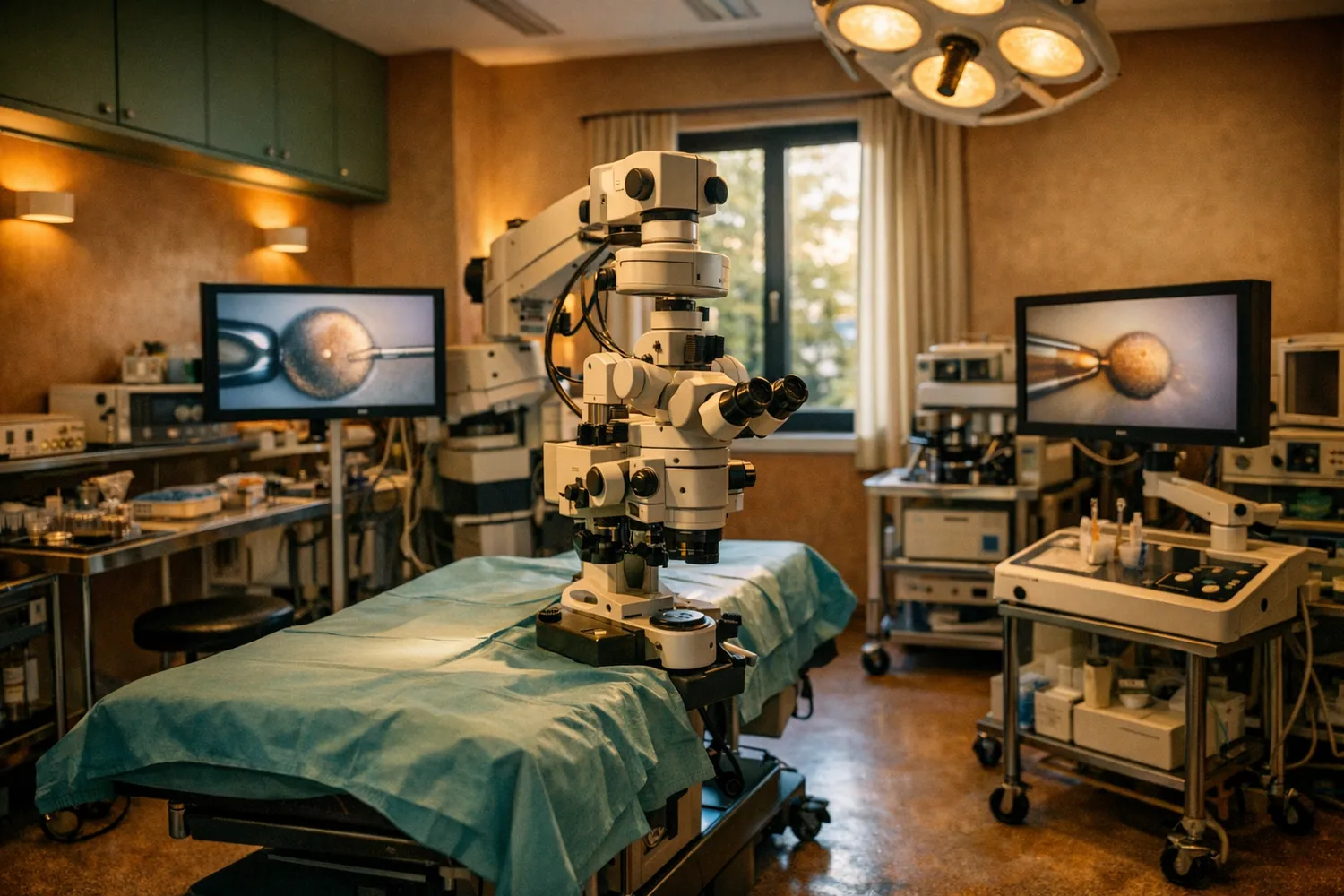
- The testicle is opened and searched systematically under the surgical microscope (20 to 25 times magnification)
- Larger, opaque tubules are removed selectively, because that is where sperm are most likely to be found
- Immediate examination of the samples in the lab
- If sperm are found: freezing (cryopreservation) for later ICSI
- Wound closure and compression bandage
After the procedure:
- A few days of physical rest
- Cooling and elevating the testicle
- Exercise and sex only after checking with the clinic
- Wound check and, if needed, suture removal as directed by the clinic
Costs in Germany, Austria, and Switzerland
| Country | Cost | Coverage |
|---|---|---|
| Germany | €800 to €2,000 (familienplanung.de) | Statutory health insurance may cover half for married couples under certain circumstances; in full only before a therapy that damages germ cells |
| Austria | No official price information | The IVF Fund (IVF-Fonds) may co-fund MESA/TESE as part of an IVF or ICSI attempt (couple pays 30%) |
| Switzerland | No official price information | Mandatory basic health insurance (Grundversicherung) only for fertility preservation, for example before cancer treatment; otherwise paid out of pocket |
In Germany, the statutory health insurance fund may cover half of the TESE costs for married couples. It pays for TESE, including freezing, in full only when a therapy that damages germ cells, such as chemotherapy, is coming up. Some private health insurers cover the costs completely if the insured person is the cause of the infertility. A few statutory insurance funds pay a subsidy as a voluntary benefit under their statutes, so ask your insurance fund. For the IVF/ICSI treatment that follows, the usual rules apply: 50% for up to three attempts for married couples. The cryopreservation of the sperm is not part of this benefit.
Success rates and prognosis
The rate at which sperm are found depends heavily on the cause:
| Diagnosis | Sperm found |
|---|---|
| Obstructive azoospermia | Usually yes |
| NOA overall | About 50% (familienplanung.de) |
| Klinefelter syndrome | Up to 50% |
| Y microdeletion (AZFc) | 50% to 75% |
| Y microdeletion (AZFa/b, complete) | Very unfavorable, TESE not recommended |
The tissue sample also helps with the prognosis: if it shows reduced but present sperm production (hypospermatogenesis), the chances according to the EAU guideline are better than with maturation arrest or Sertoli cell-only syndrome.
If sperm are found, the chances with ICSI are encouraging. According to the German IVF Registry (Deutsches IVF-Register, D.I.R.), the live birth rate for ICSI with TESE sperm in 2023 was 21.8% per embryo transfer; for all fresh cycles it was 22.5%. The clinical pregnancy rate with TESE sperm was 28.2% per transfer. That is good news.
If no sperm are found, there are unfortunately few alternatives. A second attempt is possible: after an unsuccessful micro-TESE, repeat procedures in studies still found sperm in 18% to 43% of cases, and after an unsuccessful conventional TESE in about 39% to 47%.
Risks
TESE is a surgical procedure with manageable risks:
- Swelling and hematoma (common, especially after conventional TESE)
- Pain (a few days, can be managed well with common pain relievers)
- Infection (rare)
- Drop in testosterone (after both procedures, testosterone levels usually recover in the long term; follow-up checks make sense)
- Scarring in the testicle (more common after conventional TESE than after micro-TESE; the long-term significance is unclear)
Frequently asked questions
Does TESE hurt?
The procedure itself is painless because it takes place under anesthesia. Afterward, you will have a feeling of pressure and mild pain in the scrotum for a few days. Common pain relievers are usually enough. When you can go back to work depends on the procedure and your job.
Can TESE be repeated?
Yes. After an unsuccessful micro-TESE, repeat procedures in studies still found sperm in 18% to 43% of cases. After an unsuccessful conventional TESE, the rates for a subsequent micro-TESE were about 39% to 47%. Outside of studies, the EAU guideline does not recommend hormonal pretreatment before TESE.
What do micro-TESE and ICSI cost together?
For TESE, familienplanung.de states €800 to €2,000. On top of that come the costs of the ICSI treatment, of which the statutory insurance fund pays half for married couples, the cryopreservation of the sperm, and any medication costs. Ask for a written cost estimate in advance. Compare clinics on Fertilio.
Do I need genetic counseling before TESE?
Yes, definitely. For azoospermia, medical genetic counseling is standard. According to the EAU guideline, a karyotype and a Y microdeletion analysis are part of the evaluation. For complete AZFa or AZFb deletions, TESE is advised against because the chances of finding sperm are very poor. That saves money, pain, and false hope.
How are the retrieved sperm used?
The sperm are cryopreserved (frozen) and used in a later ICSI treatment. Each retrieved sperm is injected directly into one egg. With obstructive azoospermia, one procedure is often enough for several ICSI cycles. With NOA, the amount retrieved is sometimes smaller. In that case, everything is used at once for one ICSI cycle.
Sources
- TESE (testicular sperm extraction), familienplanung.de (Federal Institute for Public Health), 2026
- EAU Guidelines on Sexual and Reproductive Health: Male Infertility, European Association of Urology, 2026
- D·I·R Yearbook 2024, German IVF Registry, 2025
- Section 27a Social Code Book V (SGB V): Assisted reproduction, Federal Ministry of Justice, as of 2026
- Cryopreservation of egg and sperm cells as a statutory health insurance benefit, Federal Joint Committee (Gemeinsamer Bundesausschuss, G-BA), 2020
- We would like a baby (brochure on the IVF Fund), Austrian Ministry of Social Affairs, 2025
- Health Care Benefits Ordinance (Krankenpflege-Leistungsverordnung, KLV), Annex 1 (edition of July 1, 2026), Federal Office of Public Health (BAG), 2026