This page covers Germany, Austria, and Switzerland.
When it comes to a male fertility test, many people first think of a sperm test from the pharmacy. In fact, there are four options: an at-home test, a kit with which you mail the sample to a lab, a semen analysis at a urologist or andrologist, and the evaluation at a fertility clinic.
The yardstick is the same for all of them: the semen analysis according to the 2021 WHO laboratory manual. According to the US guideline from the AUA and ASRM, there is currently no substitute for a semen analysis in a specialized andrology lab (2024). And even the semen analysis alone cannot distinguish between fertile and infertile men, the European Association of Urology stresses (EAU 2026).
Getting tested is still worthwhile, and not only after your partner has been tested. In a large multicountry WHO study of 8,500 couples from 25 countries, male factors contributed wholly or in part to 45.1% of cases of infertility. The data are several decades old, as the WHO itself points out (WHO guideline 2025). The professional societies therefore advise testing both partners at the same time (EAU 2026, AUA/ASRM 2024). What belongs in your partner’s evaluation is covered in the article Fertility test for women.
Data box: a close look at 20 at-home sperm tests
A research team evaluated 20 over-the-counter at-home and mail-in tests (Ernandez, Andrology 2025). 85% report sperm concentration, 60% report motility, and only 15% report the shape of the sperm (morphology). Only 40% recommend more than one test. None points out that the partner should be tested as well.
Only 25% of the tests have been validated in men with reduced fertility, which is exactly the group that matters when you are trying to conceive.
Which option is right for you?
The table matches typical situations to the recommendations of the professional societies. It does not replace a conversation with your doctor.
| Your situation | What the guidelines say | A sensible next step |
|---|---|---|
| You and your partner are not trying yet, and you just want to know where you stand | At-home tests usually only show whether a threshold is exceeded or not reached. Even a normal result does not allow a reliable statement about fertility (familienplanung.de) | If you want a real result: a semen analysis at a urology practice, as a self-pay patient if there is no medical reason |
| No pregnancy for 12 months | Evaluation recommended, both partners at the same time (EAU 2026) | Semen analysis at a urologist or andrologist, in Germany the insurance fund pays |
| Your partner is 35 or older | Evaluation after just 6 months (ASRM 2021). If your partner is 36 or older, NICE recommends immediate referral to specialists (2026). Over 40, the joint guideline of Germany, Austria, and Switzerland (the “DACH guideline”) says to start the evaluation right away at a reproductive medicine center (2026) | Semen analysis right at the start, not only after your partner’s tests |
| A possible cause is known in you or your partner | Evaluate right away, without the usual waiting period (NICE 2026, ASRM 2021) | Appointment with a urologist or andrologist |
| Unsuccessful assisted reproduction or two or more miscarriages | The man should be evaluated (AUA/ASRM 2024) | Andrology evaluation, depending on the guideline including a test for sperm DNA damage |
| Abnormal at-home test result | No substitute for a semen analysis in the lab (AUA/ASRM 2024) | Semen analysis at the practice |
| First semen analysis abnormal | Repeat it, with further evaluation only after at least two abnormal tests (EAU 2026). If sperm are absent or very few, as soon as possible (NICE 2026) | Follow-up semen analysis, then andrology evaluation |
The guide Male infertility explains what can cause abnormal values.
At-home test, mail-in kit, urologist, or fertility clinic compared
What each option delivers:
| Option | What is measured | What the result shows | Assessment |
|---|---|---|---|
| At-home sperm test | Usually only the concentration or the motile sperm, some smartphone tests several values according to the manufacturer | Usually only whether a threshold is exceeded or not reached | Rough guidance, not a substitute for a semen analysis (AUA/ASRM 2024) |
| Mail-in semen analysis | Lab values such as concentration, motility, and morphology, in some cases extrapolated back to the baseline value | A lab report from a sample that was in transit for many hours | Outside the WHO standard protocol, and we have not verified any offering with a lab in Germany, Austria, or Switzerland |
| Urologist or andrologist | Semen analysis per WHO 2021, hormones and physical exam if needed | Result with a doctor’s interpretation | First point of contact, an abnormal result is repeated |
| Fertility clinic | Semen analysis as part of the evaluation of both partners | Overall picture for the couple, basis for planning treatment | Both partners under one roof |
What they cost:
| Option | Germany | Austria | Switzerland |
|---|---|---|---|
| At-home sperm test, mail-in | Prices not collected | Prices not collected | Prices not collected |
| Semen analysis, self-pay | Lab analysis €23.31 to €30.31 (German fee schedule for physicians, item 3668), about €37 to €47 with a consultation, €80 to €200 in practice according to the Fertility Information Portal (Informationsportal Kinderwunsch) | Private price depending on the lab or private doctor (Wahlarzt) | Lab analysis CHF 130.50 (Analysis List), plus medical consultation |
| Semen analysis to evaluate infertility | Insurance fund pays for the evaluation in full | Usually the insurance fund with a doctor’s referral | Mandatory basic health insurance (Grundversicherung), minus the deductible (franchise) and 10% co-insurance |
The details are in the section Costs and health insurance.
At-home sperm test: what it measures and what it does not
At-home sperm tests are sold online and in pharmacies. We have not checked which products are currently available in Germany, Austria, or Switzerland. We deliberately do not name brands, but we do cite the studies on individual tests. The reason is that, according to the US guideline, each test has to be checked individually for its accuracy (AUA/ASRM 2024).
Male fertility test from the pharmacy: four test principles
| Test principle | What is measured | Threshold | What studies show |
|---|---|---|---|
| Test strip (immunoassay) | Sperm concentration only | 20 and 5 million sperm/ml | Over 96% of 225 samples classified correctly, but only 10 of 13 in the range of 5 to 20 million/ml, and 8 of 9 authors with ties to the manufacturer (Coppola 2010) |
| Smartphone attachment | Concentration of motile sperm | 6 million motile sperm/ml | Samples below the threshold reliably detected, donor samples from 24 men, comparison device from the same manufacturer (Agarwal 2018) |
| Smartphone test with app | According to the manufacturer, volume, concentration, progressive motility, and total number of motile sperm | Comparison with the WHO reference values | Only a manufacturer poster on concentration, 40 external quality assessment samples, 4 of them below 16 million/ml |
| Test for progressively motile sperm | Whether progressively motile sperm are above or below the threshold | 5 million progressively motile sperm/ml | Falsely “normal” in 8 of 29 men with a low value, 100 men, tests provided by a company involved (Yoon 2020) |
None of these four tests measures the shape of the sperm.
Test strip: concentration only
Using a specific sperm protein (SP-10), the test strip measures only sperm concentration. In the validation study, more than 96% of 225 samples were correctly sorted into three groups: 20 million/ml or more, 5 to 20 million/ml, and under 5 million/ml (Coppola 2010). Of the 225 samples, 45 came from men who had had a vasectomy. Only 13 samples fell in the range of 5 to 20 million/ml, and the test wrongly showed 3 of them as normal. Eight of the nine authors reported financial interests or other relationships with the companies involved, and the manufacturer paid the development and manufacturing costs.
The study’s threshold of 20 million/ml is an older WHO value, and the current lower reference limit is 16 million/ml (WHO 2021). The strip says nothing about motility or shape.
Smartphone attachment: motile sperm
An attachment with an app measures the concentration of motile sperm. In a comparison study with an automated lab device from the same manufacturer (donor samples from 24 men, divided into 144 subsamples), it reliably detected samples with fewer than 6 million motile sperm per ml (Agarwal 2018). So the comparison was not made against counting according to the WHO manual. The authors see the device as a screening tool that distinguishes “low” from “medium or normal” values. It does not provide individual values according to the WHO scheme.
Smartphone test with app: several values, thin data
According to their manufacturer, other smartphone tests report semen volume, sperm concentration, progressive motility, and the total number of motile sperm, and compare them with the WHO reference values. The shape of the sperm is not mentioned.
As evidence of accuracy, one manufacturer points to its own conference poster, written by its own employees. In it, 40 samples from a British external quality assessment scheme (UK NEQAS) were all classified correctly relative to the WHO threshold of 16 million/ml (Ahmed, manufacturer poster). Only concentration was tested. Only 4 of the 40 samples were below the threshold, so in the abnormal range the result rests on very few samples. We did not find a peer-reviewed validation study on PubMed.
Test for progressively motile sperm
According to its manufacturer, another test only indicates whether the concentration of progressively motile sperm is above or below 5 million/ml. It does not report individual values or the shape of the sperm.
In a study of 100 men from a fertility clinic in Seoul, it was compared with the WHO semen analysis (5th edition) (Yoon 2020). Of the 29 men with a truly low value, the test showed “low” for 21 (72.4%) and wrongly showed a normal result for 8. Of the 71 men with a normal value, it correctly showed “normal” for 63 (88.7%) and wrongly showed “low” for 8. So about one in four men with a low value received a reassuring result. The company TopHealth provided the tests free of charge, and an employee of that company is a coauthor. According to the authors’ statement, there were no conflicts of interest.
What experts say about at-home tests
The US guideline is clear: at present, no at-home or mail-in test replaces a semen analysis in a specialized andrology lab (AUA/ASRM 2024). The portal familienplanung.de adds that at-home tests only determine whether the sperm count is above or below a threshold. Even a normal value does not allow a reliable statement about fertility.
If you take an at-home test, this context helps:
- Normal result: This does not rule out a fertility problem (familienplanung.de). If it still has not worked after 12 months, a semen analysis belongs in the evaluation anyway (EAU 2026).
- Abnormal result: That does not mean you are infertile. Even a lab value just below the WHO limit does not mean infertility (EAU 2026). Have the result checked with a semen analysis.
- Labeling: At-home sperm tests are in vitro diagnostic devices for self-testing. In the EU, they need a CE marking with the identification number of a notified body, under the IVD Regulation (EU) 2017/746 or, during a transition period, still under the earlier IVD Directive. Clearance by the US Food and Drug Administration (FDA) does not count as proof in the EU.
- Accuracy percentages on the packaging or website are manufacturer claims. Ask yourself what the test was validated on and which values it measures at all.
Semen analysis at home: collecting the sample at home or sending it by mail
“Semen analysis at home” can mean two things: you collect the sample at home and bring it to the practice yourself. Or you send it by mail to a lab.
Collecting the sample at home and bringing it to the practice
By arrangement with the practice, you can collect the sample at home (familienplanung.de). Then timing matters:
- No more than one hour may pass between ejaculation and the analysis (familienplanung.de).
- According to the WHO, the sample should reach the lab within 30 minutes if possible and no later than 50 minutes after collection, transported close to the body.
- During transport, the sample should not cool below 68°F (20°C) or warm above 98.6°F (37°C) (WHO 2021).
Ideally, the analysis should begin within 30 minutes, and no later than after 60 minutes (WHO 2021).
Mail-in: sending the sample to a lab by mail
With mail-in testing, the sample is analyzed only after many hours. That is far outside the requirements of the WHO laboratory manual, under which the analysis should begin within 30 minutes if possible and no later than after 60 minutes (WHO 2021). Whether such a method delivers reliable values therefore has to be demonstrated separately. There are studies on two US services:
- In a study of 104 ejaculates, the concentration stayed stable for up to 52 hours. Motility dropped by 0.39% per hour, and the share of normally shaped sperm by 0.1% per hour. The service calculates both values back to the baseline value (Samplaski 2021). Only men with normal values were studied, and coauthors worked for the provider. So the study does not show whether the conversion also holds for reduced values.
- In a second study (30 participants, 60 samples, measurements after 30 minutes and after 1, 6, 24, and 30 hours), motility fell over time, most sharply after 6 hours (Alexander 2025). All five authors are affiliated with the provider: three as employees, two as scientific advisors.
We have not verified whether these services are available in Germany, Austria, or Switzerland. We also could not verify any mail-in semen analysis offering with a lab in the German-speaking region.
Semen analysis at the urologist or andrologist: the process
For most men, a urology practice is the first point of contact. Andrologists specialize in male fertility. What andrology examines and treats is shown in the overview Andrology. Fertility clinics also perform the semen analysis, usually together with the evaluation of the partner.
1. Observe the abstinence period. According to the WHO laboratory manual, the sample should be collected after at least 2 and at most 7 days without ejaculation. The portal familienplanung.de gives a narrower window of 3 to 5 days for Germany. Follow your practice’s instructions.
2. Provide the sample. At the practice or, by arrangement, at home, see above. Ideally, the analysis begins within 30 minutes (WHO 2021).
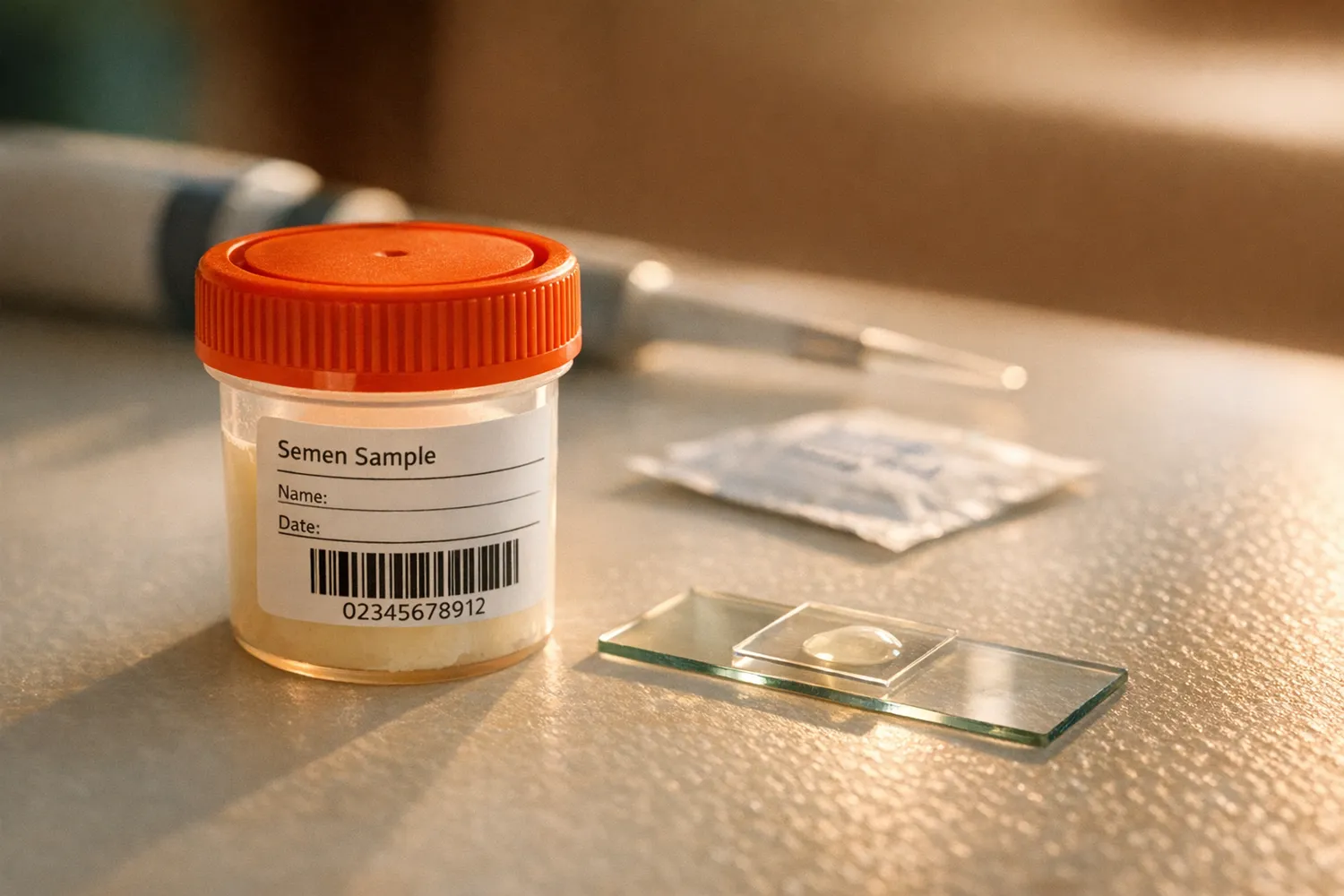
3. Lab analysis. The lab determines, among other things, volume, pH value, concentration, total number, motility, vitality, and shape of the sperm according to the 2021 WHO laboratory manual.
4. Discussing the results. If the semen analysis is normal by WHO criteria, one test is enough according to the EAU (2026). The joint guideline of the professional societies from Germany, Austria, and Switzerland (DACH guideline) generally recommends at least two tests because of the large fluctuations (2026). An abnormal result is repeated in every case, more on this under How often should it be repeated?.
5. Further tests. According to the DACH guideline, an andrology evaluation includes, besides the semen analysis, a physical exam, a testicular ultrasound, and the hormones FSH, LH, and testosterone (2026). NICE provides for a physical exam and hormone levels only after two or more abnormal semen analyses (2026).
Semen analysis values, briefly explained
The lower reference limits come from the 2021 WHO laboratory manual, and the British NICE guideline reproduces them in the same way (2026):
| Parameter | Lower reference limit (WHO 2021) |
|---|---|
| Ejaculate volume | ≥ 1.4 ml |
| Sperm concentration | ≥ 16 million/ml |
| Total sperm count | ≥ 39 million per ejaculate |
| Total motility | ≥ 42% |
| Progressive motility | ≥ 30% |
| Vitality | ≥ 54% |
| Normally shaped sperm | ≥ 4% |
The limits are the 5th percentile of around 3,500 men from 12 countries whose partner became pregnant spontaneously within 12 months. They do not mark a boundary between fertile and infertile: a value just below does not mean infertility, and a value above does not guarantee fertility (EAU 2026). A single parameter alone is also not enough for a diagnosis (AUA/ASRM 2024). What the individual values mean and which technical terms appear in a report is explained in the article Semen analysis values. For your own result, what your lab states is what counts.
How often should it be repeated?
A semen analysis is a snapshot. The recommendations differ on whether and when to repeat it:
| Source | Normal result | Abnormal result |
|---|---|---|
| DACH guideline (2026) | At least two tests recommended | Two to three tests may be needed |
| WHO guideline (2025) | Do not repeat | Repeat after 11 weeks at the earliest |
| NICE (2026) | No statement | Confirmatory test ideally after 3 months, as soon as possible if sperm are absent or very few |
| EAU (2026) | One test is enough | At least two consecutive analyses, further evaluation if at least two tests are abnormal |
| familienplanung.de | No statement | Usually after 8 to 12 weeks |
The DACH guideline bases its recommendation on the considerable fluctuations in semen quality in one and the same man. The WHO makes its recommendations conditionally, and the certainty of the evidence is very low. NICE bases the 3 months on the length of one cycle of sperm production.
Further tests: hormones, ultrasound, genetics
Which tests follow the semen analysis depends on the result.
Hormones: testosterone, FSH, and LH
The DACH guideline counts FSH, LH, and testosterone as part of the basic hormonal work-up of men, alongside medical history, physical exam, and semen analysis (2026). For too few or absent sperm (oligozoospermia or azoospermia), the EAU recommends hormone testing with total testosterone, FSH, and LH (2026, strong recommendation). NICE advises considering testing for testosterone, LH, and FSH after two or more abnormal semen analyses (2026).
In the US guideline, FSH and testosterone form the basis. If the total testosterone measured in the morning on an empty stomach is low (under 300 ng/dl according to the guideline), total and free testosterone should be repeated, and LH, estradiol, and prolactin should be measured as well (AUA/ASRM 2024). So prolactin there is a follow-up value, not a routine value at the start. What LH is and which values labs report for men is explained in the article LH levels.
Testicular ultrasound
The EAU recommends a scrotal ultrasound for men with a fertility problem because their risk of testicular cancer is increased (2026, weak recommendation). The US guideline, by contrast, advises against using ultrasound routinely in the initial evaluation (AUA/ASRM 2024, expert opinion). Like the EAU, the DACH guideline counts testicular ultrasound as part of the andrology exam before fertility treatment (2026, expert consensus). The guidelines disagree here. Whether an ultrasound makes sense for you is for your doctor to decide after the exam.
Genetic tests
Genetic testing is considered mainly for certain findings:
- Y chromosome microdeletions (AZF): The EAU recommends the test at no more than 1 million sperm per ml and advises considering it below 5 million/ml (2026, strong recommendation). The DACH guideline requires the test for azoospermia without an obstruction of the sperm ducts and recommends it below 1 million/ml, in each case after other causes have been ruled out (2026). NICE recommends it for unexplained azoospermia or an unexplained concentration below 1 million/ml (2026).
- Chromosome analysis (karyotype): NICE recommends it for unexplained azoospermia and advises considering it for a concentration that stays below 5 million/ml (2026). The DACH guideline provides for it in men whose testicles underperform despite elevated FSH and LH levels (hypergonadotropic hypogonadism), and recommends it for both partners if no other cause is found (2026). The thresholds differ depending on the guideline. Genetic counseling is part of the analysis (EAU 2026).
- CFTR gene: If the vas deferens is missing on one or both sides without kidney abnormalities, the man and his partner should be tested for changes in the CFTR gene, the cystic fibrosis gene (EAU 2026, strong recommendation).
DNA fragmentation: the guidelines disagree
A test for sperm DNA damage is sometimes offered. The guidelines assess it very differently:
| Guideline | Recommendation |
|---|---|
| EAU (2026) | Test for recurrent miscarriage after natural conception, after unsuccessful assisted reproduction, and for unexplained male infertility (strong recommendation) |
| AUA/ASRM (2024) | Not in the initial evaluation, but measure it in the man for recurrent miscarriage |
| NICE (2026) | Explicitly no test for sperm DNA damage |
| DACH guideline (2026) | Not sufficiently validated, consider only within scientific studies |
If the test is offered to you, ask why, and as a self-pay patient have the costs quoted in advance.
When should you get tested?
The professional societies name these times for starting an evaluation:
- After 12 months of regular, unprotected intercourse without a pregnancy (EAU 2026, strong recommendation). The US professional society ASRM confirms this rule in its 2023 definition.
- After 6 months if your partner is 35 or older (ASRM 2021). The DACH guideline gives 6 months for women over 35 (2026). If she is older than 40, the evaluation should begin right away at a reproductive medicine center according to the DACH guideline (2026).
- Right away if your partner is 36 or older or if a cause is known or suspected in either of you (NICE 2026). The ASRM likewise advises immediate evaluation when there is a history associated with infertility (2021).
- After unsuccessful assisted reproduction or after two or more miscarriages, the man should be evaluated (AUA/ASRM 2024).
Specifically, at the same time as your partner: the evaluation starts for both of you together, and because male factors are common, at least one semen analysis belongs at the start (ASRM 2021). The initial evaluation of the man includes one or more semen analyses (AUA/ASRM 2024, strong recommendation).
Male fertility test: costs and health insurance
What you pay depends mainly on the reason for the test. If the semen analysis is done to evaluate infertility, the statutory health insurance fund pays in Germany. Without a medical reason, it is an individual health service (Individuelle Gesundheitsleistung, IGeL) that you pay for yourself. The prices come from our article Semen analysis cost, where you will also find the billing in detail (as of October 2026). We did not collect prices for at-home tests and mail-in kits.
Germany
| Service | Price | Basis |
|---|---|---|
| Lab analysis (semen analysis), self-pay | €23.31 to €30.31 | German fee schedule item 3668, 1.0- to 1.3-fold rate |
| Semen analysis with medical consultation, self-pay | about €37 to €47 | Example calculation under the fee schedule |
| Privately billed test with evaluation and consultation | €80 to €200 | Fertility Information Portal |
| Evaluation for infertility | Insurance fund pays in full | familienplanung.de |
The statutory health insurance funds pay in full for medical examinations to find the cause when a pregnancy does not occur, in women as well as men, which includes the semen analysis at the doctor’s office (familienplanung.de, January 2026). Privately insured people should check their plan. We did not collect prices of our own for hormone levels, ultrasound, and special tests. As a self-pay patient, have the costs quoted in advance.
Austria
With a doctor’s referral, the semen analysis is usually covered by the insurance fund. Without a referral, you pay privately, and prices differ depending on the lab or private doctor. We did not find an explicit rule from the Austrian Health Insurance Fund on basic diagnostics, so if in doubt, ask your insurance fund in advance.
If the evaluation leads to IVF or ICSI, the IVF Fund (IVF-Fonds) covers 70% of the costs for no more than four attempts. If the cause of reduced sperm values is unclear (idiopathic pathospermia), the fund requires two abnormal semen analyses at least four weeks apart. The diagnosis must be made by a specialist physician, for example from urology (Austrian Federal Ministry of Social Affairs 2025).
Switzerland
The basic health insurance covers the tests to find the cause in women and men, explicitly including semen analyses and hormone tests (University Hospital Zurich). The lab analysis is valued at CHF 130.50 in the Analysis List, plus the medical consultation. You pay the deductible (franchise) and the co-insurance (10%) yourself. The basic health insurance does not pay for IVF and ICSI (University Hospital Zurich).
What the result means and what comes next
An abnormal semen analysis is a finding, not a verdict. If a second semen analysis confirms the values, hormone levels and an exam of the scrotum and testicles should be added at the latest now, and with very few or absent sperm, genetic tests as well. Our male fertility guide gives an overview of causes, treatment, and the path to assisted reproduction.
On dietary supplements for men: what the authorized claims say and what large studies have shown is covered in the article Vitamins for men trying to conceive.
For the evaluation, you need a practice that knows its way around male fertility. Before fertility treatment, the DACH guideline says an andrologist should examine you (2026). You can find andrology practices near you in the andrology directory. If you and your partner are not sure where to start as a couple, the Fertility Clinic Finder helps with orientation.
Frequently asked questions
How can a man get his fertility tested?
With a semen analysis at a urologist, an andrologist, or a fertility clinic. Following the WHO laboratory manual, it measures, among other things, the volume, concentration, motility, and shape of the sperm. At-home tests usually only show whether a threshold is exceeded or not reached, and there is no substitute for a semen analysis in the lab (familienplanung.de, AUA/ASRM 2024).
How much does a fertility test for men cost?
When the semen analysis is done to evaluate infertility, the statutory health insurance fund in Germany pays for it. As a self-pay patient, the lab analysis costs €23.31 to €30.31 under the German fee schedule, about €37 to €47 with a consultation, and €80 to €200 in practice according to the Fertility Information Portal. In Switzerland, the lab analysis is valued at CHF 130.50, and in Austria private prices depend on the lab.
How reliable is an at-home sperm test?
It depends on the test, and the evidence is thin. In a study with ties to the manufacturer, a test strip classified more than 96% of 225 samples correctly, but only 10 of 13 in the intermediate range of 5 to 20 million/ml (Coppola 2010). In a study of 100 men, a test for progressively motile sperm wrongly showed a normal result for 8 of 29 men with a low value (Yoon 2020). None of the at-home tests presented here measures the shape of the sperm.
Is there a sperm test at dm or at the pharmacy?
At-home sperm tests are sold online and in pharmacies. We have not checked which products are currently available at the drugstore chain dm, in pharmacies, or in online shops. This holds for all of them: they do not replace a semen analysis, and even a normal result does not allow a reliable statement about fertility (AUA/ASRM 2024, familienplanung.de).
Can I do a semen analysis at home?
You can collect the sample at home by arrangement with the practice. No more than one hour may then pass between ejaculation and the analysis, and the sample is transported close to the body at 68 to 98.6°F (20 to 37°C) (familienplanung.de, WHO 2021). Mail-in semen analyses with analysis after many hours fall outside the WHO standard. We have not verified an offering with a lab in Germany, Austria, or Switzerland.
How long should you go without ejaculating before a semen analysis?
According to the WHO laboratory manual, at least 2 and at most 7 days, and the portal familienplanung.de gives 3 to 5 days. Follow your practice’s instructions.
How often does a semen analysis need to be repeated?
If the first semen analysis is normal, one test is enough according to the EAU (2026), and the WHO advises against repeating it (2025). The DACH guideline, by contrast, generally recommends at least two tests (2026). An abnormal result is repeated: usually after 8 to 12 weeks (familienplanung.de), after 11 weeks at the earliest according to the WHO, and ideally after 3 months according to NICE. If sperm are absent or nearly absent, NICE advises repeating it as soon as possible.
Which blood tests are done for men?
According to the DACH guideline, FSH, LH, and testosterone are part of the basic work-up (2026), and according to the EAU, they are measured when sperm are too few or absent (2026). If testosterone measured in the morning is low, the US guideline adds free testosterone, estradiol, and prolactin (AUA/ASRM 2024). Which values make sense for you is for your doctor to decide based on your results.
Sources
Guidelines and statements
- NICE guideline NG257: Fertility problems, assessment and treatment, section 1.17 Testing for male factor fertility problems, National Institute for Health and Care Excellence, March 31, 2026
- NICE NG257: Defining infertility and initial assessment, recommendation 1.16.8, NICE, March 31, 2026
- EAU Guidelines on Sexual and Reproductive Health, chapter 11 Male Infertility, European Association of Urology, 2026
- Diagnosis and Treatment of Infertility in Men: AUA/ASRM Guideline, American Urological Association and American Society for Reproductive Medicine, 2020, updated 2024
- Diagnosis and therapy before medically assisted reproduction treatment, S2k guideline AWMF 015-085, version 2.0, DGGG, OEGGG, and SGGG, as of April 2026
- Guideline for the prevention, diagnosis and treatment of infertility, chapter 1 and section 5.7, World Health Organization, November 27, 2025
- WHO laboratory manual for the examination and processing of human semen, 6th edition, World Health Organization, 2021
- Fertility evaluation of infertile women: a committee opinion, Fertil Steril 2021;116:1255-1265, ASRM Practice Committee, 2021
- Definition of infertility: a committee opinion, ASRM Practice Committee, 2023
Studies on at-home and mail-in tests
- Ernandez J et al.: Direct-to-consumer semen analysis products: Content, accountability, and adherence to clinical guidelines, Andrology 2025;13(8):2206-2215
- Coppola MA et al.: Immunodiagnostic at-home test for detecting normozoospermia and severe oligozoospermia, Hum Reprod 2010;25(4):853-861, development funded by the manufacturer (original title includes the trade name)
- Agarwal A et al.: Home sperm testing device versus laboratory sperm quality analyzer: comparison of motile sperm concentration, Fertil Steril 2018;110(7):1277-1284
- Yoon et al.: Validation of an at-home test for progressively motile sperm compared with the WHO semen analysis (5th edition), World J Mens Health 2020 (original title includes the trade name)
- Ahmed W, Jensen ND, Ulsted M, Andersen E: External quality control of a smartphone at-home sperm test, manufacturer poster, data through September 2024 (original title includes the trade name)
- Samplaski MK et al.: Development and validation of a novel mail-in semen analysis system and the correlation between one hour and delayed semen analysis testing, Fertil Steril 2021;115(4):922-929
- Alexander U, Sakkas D, Arredondo F, Kteily K, Abou Ghayda R: Evaluating Semen Parameters for Predictive Correlations Between Fresh and Delayed Analysis Using an At-Home Semen Collection Kit, Am J Mens Health 2025;19(6)
- Manufacturer information on measured values and thresholds of at-home tests: manufacturers’ product pages, retrieved October 4, 2026. We deliberately do not name brands.
Consumer information and cost coverage
- Fertility tests in men, familienplanung.de (Federal Institute for Public Health), January 7, 2026
- Fertility treatment: what is allowed and who pays the costs?, familienplanung.de (Federal Institute for Public Health), January 7, 2026
- We want a baby. Information on cost coverage for medically assisted reproduction through the IVF Fund, Federal Ministry of Labor, Social Affairs, Health, Care and Consumer Protection (Austria), as of July 25, 2025
- The costs of fertility treatment: what the health insurers cover, University Hospital Zurich, retrieved October 4, 2026
- Self-pay prices for the semen analysis: taken from our article Semen analysis cost (sources there: German fee schedule for physicians, Analysis List of the Federal Office of Public Health, Fertility Information Portal), as of October 2026.