
This page covers Germany, Austria, and Switzerland.
Perhaps embryos or pronuclear stages are still in the liquid nitrogen tank after your last egg retrieval. Perhaps your clinic advised freezing everything and transferring later. In that case, the next step is a frozen embryo transfer: The frozen cells are thawed and transferred in a later cycle, without new stimulation or egg retrieval.
Here you will read what the 2026 studies show about the cycle types, how a frozen cycle works, how high the chances are, and what health insurance and the IVF Fund (IVF-Fonds) pay. For every figure, we state what it refers to: per transfer, per woman, or per pregnancy.
What is a frozen embryo transfer?
A frozen embryo transfer (FET), also called a thaw cycle, is the transfer of previously frozen and thawed embryos or pronuclear stages in a later cycle. The embryo transfer itself is the same step as after a fresh IVF or ICSI: The embryo is placed into the uterus with a thin catheter through the cervix. How treatment works up to that point is described in the article IVF process.
In Germany in 2024, 49,487 of 131,801 started treatment cycles were thaw cycles, or 37.5% (D.I.R. Yearbook 2024 of the German IVF Registry, Deutsches IVF-Register, p. 24). For first egg retrievals with a fresh transfer, additional freezing took place in 32.9% of cases in 2018 and in 47.4% in 2024 (p. 33).
Why pronuclear stages are often frozen in Germany
The Embryo Protection Act (Embryonenschutzgesetz) prohibits fertilizing more eggs than are to be transferred in one cycle (Section 1, paragraph 1, no. 5 ESchG). Under the law, a fertilized egg counts as an embryo only from nuclear fusion (Section 8, paragraph 1). German labs therefore often freeze pronuclear stages, which are fertilized eggs before this step. Even so, about half of the thawings in 2023 involved embryos: 21,944 of 42,108 (D.I.R. Yearbook 2024, p. 31). Only physicians may carry out the freezing (Section 9, no. 4 ESchG).
Freezing and thawing: vitrification and survival rates
The European professional society ESHRE recommends vitrification, a very fast freezing method, for eggs, pronuclear stages, and embryos (laboratory guideline 2026). Compared with the older slow-freezing method, more embryos survive: In 7 randomized trials with 3,615 embryos, the survival rate was clearly higher (relative risk 1.59; moderate certainty of evidence; Rienzi 2017). If an embryo is frozen a second time after a biopsy, for example for preimplantation genetic testing, this is associated with lower live birth rates and higher miscarriage rates (ESHRE 2026).
According to our research, the registries in Germany, Austria, and Switzerland do not publish a survival rate per embryo. According to expert consensus, labs should recover at least 90% of warmed blastocysts intact, and very good labs 99% (Vienna Consensus 2017). In a center in Bregenz using a closed system, it was 83% (Wirleitner 2013). Calculated per cycle, 95.5% of the 45,714 thawings in Germany in 2024 were followed by a transfer (D.I.R. Yearbook 2024, p. 24). Feel free to ask your clinic for its own survival rate.
Three ways to prepare the uterus
The transfer is timed so that the age of the embryo matches the cycle: A blastocyst is transferred about 5 days after ovulation or 5 days after the start of progesterone (Wei 2026). There are three ways to prepare for this, and a fourth if you do not ovulate regularly.
Natural cycle
You take no hormones. Ultrasound and blood tests or at-home LH urine tests show when ovulation is coming. At-home tests appear to be sufficient for this: In the Dutch trial Antarctica-2 with 1,464 ovulatory women aged 18 to 44, 20.8% had an ongoing pregnancy after at-home LH tests, compared with 20.9% with ultrasound at the clinic and a trigger shot (Antarctica-2, Zaat 2023). Vaginal progesterone in the second half of the cycle increased the live birth rate in 2 studies with 923 cycles (relative risk 1.43; moderate certainty of evidence; Erden 2026).
Modified natural cycle with a trigger shot
Here, too, your uterine lining grows through your own hormones. Once the leading follicle is mature, an hCG shot triggers ovulation, about 36 hours later according to the prescribing information. In a European trial, the shot was given once a follicle was larger than 17 mm, and the blastocyst followed 6 or 7 days later (Stormlund 2020). In a Danish trial of 602 women, there were similar numbers of live births on both days (33.8% versus 33.0%), and additional progesterone brought no established benefit (34.9% versus 31.9%; Saupstad 2026). Compared with the natural cycle without a shot, there was no established difference in live births (Venetis 2026, 6 trials, 1,708 women).
hCG products (choriogonadotropin alfa, urinary hCG) are prescription-only and, according to the prescribing information, approved for triggering ovulation after stimulation of follicle growth. The wording does not mention a cycle without stimulation; as we read it, this is off-label.
Artificial cycle with estrogen and progesterone
Here, no ovulation takes place, so no corpus luteum forms. Estrogen tablets (estradiol, prescription-only) build up the uterine lining, and progesterone is added afterward. In the large Chinese trial, estrogen started on cycle day 2 or 3 at 6 to 8 mg daily, and an ultrasound followed after 10 to 12 days. Once the lining measured at least 7 mm and the progesterone level was below 1.5 ng/ml, progesterone was started, and the blastocyst was transferred 5 days later (Wei 2026). Because the corpus luteum is missing, progesterone is continued into early pregnancy, in the trial until weeks 10 to 11 of pregnancy. The Federal Joint Committee (Gemeinsamer Bundesausschuss, G-BA) gives about week 12 for women after therapy that damages germ cells, and the prescribing information for vaginal progesterone gives week 12 at most. More on this in the article Luteal phase defect.
The artificial cycle needs fewer monitoring appointments (in a Belgian trial 2.4 on average instead of 3.0; Geysenbergh 2026). After therapy that damages germ cells, there is usually no cycle of your own anymore; in that case, the artificial cycle is required according to the G-BA.
Vaginal progesterone 200 mg is approved for luteal phase support in assisted reproduction and is prescription-only. Dydrogesterone, which was used in some trials, is not approved for this in Germany (off-label). We could not conclusively clarify whether your clinic's estrogen product is explicitly approved for building up the lining. Ask about its approval status.
Stimulated cycle with irregular ovulation
With polycystic ovary syndrome (PCOS) or infrequent ovulation, ovulation can be induced with tablets, for example letrozole. In a Chinese trial of 200 women with PCOS, 66.0% achieved a clinical pregnancy this way, compared with 53.0% in the artificial cycle, not statistically established (Jiang 2025). In Germany, letrozole is approved only for breast cancer after menopause; for fertility treatment, it is off-label and prescription-only. The 2023 international PCOS guideline gives no recommendation on preparing for a frozen embryo transfer. More on this: Getting pregnant with PCOS.

Natural or artificial cycle: the 2026 evidence
The 2025 Cochrane review of 32 trials and 6,352 women still considered it open, because of uncertain data, whether one cycle type is better. Its literature search, however, ended in December 2022. Since then, large randomized trials and two meta-analyses on women who ovulate have been published.
| Study | Who was studied | Result, natural versus artificial cycle |
|---|---|---|
| Wei 2026, randomized | 4,376 women aged 20 to 40, China, one blastocyst | Live birth 51.1% vs. 50.1% per woman; early miscarriage 12.1% vs. 15.2% |
| Martins and Nastri 2026, meta-analysis | 17 randomized trials, 10,611 women | Miscarriages less common (relative risk 0.75; high certainty of evidence); live births equal or slightly more common (1.07; 1.15 without trials at high risk of bias) |
| Lin 2026, meta-analysis | 11 randomized trials, 9,955 women | Live birth 41.5% vs. 39.2% (1.11; moderate certainty), benefit mainly in the cycle with a trigger shot; miscarriage 13.4% vs. 17.5% |
| Geysenbergh 2026, randomized | 561 women aged 18 to 45, Belgium | Pregnancy with cardiac activity 33.1% vs. 28.9%, not established; not designed for live births |
Bottom line: In women who ovulate, the cycle with your own ovulation, with or without a trigger shot, is at least as successful as the artificial cycle, and miscarriages are less common. The British guideline NICE NG257 (2026) carries over its 2013 recommendation unchanged, according to which the chance of a live birth with regular ovulation is similar in both cycle types. German registry data fit this, but are not randomized: In the artificial cycle, 28.3% of pregnancies ended in a miscarriage, versus 19.6% in the natural cycle (D.I.R. Yearbook 2022, pp. 16 to 17).
The findings on whether the natural cycle is canceled more often are inconsistent: more often in the Chinese trial (16.2% versus 11.5%), less often in the Belgian trial and the older Dutch ANTARCTICA trial (Geysenbergh 2026: 3.9% versus 9.4%; Groenewoud 2016).
Preeclampsia: observational studies and randomized trials
Preeclampsia is a high blood pressure disorder during pregnancy.
Data box: preeclampsia after an artificial and a natural cycle
In observational studies, the risk after an artificial cycle was about twice as high (Busnelli 2022: odds ratio 2.11; low certainty of evidence). In the large randomized trial, the difference was smaller: Preeclampsia occurred in 4.6% of pregnant women after an artificial cycle and in 2.9% after a natural cycle (Wei 2026). A meta-analysis of all randomized trials found a trend for high blood pressure in pregnancy, but no established difference (relative risk 0.77; moderate certainty; Martins and Nastri 2026).
Suspected cause: Without ovulation, the corpus luteum, which produces hormones that act on blood vessels, is missing. ESHRE names this as a possible partial explanation; it has not been proven. In a US cohort of 683 singleton births after IVF with the women's own eggs, the preeclampsia rate was 12.8% after an artificial frozen cycle and 3.9% after a modified natural cycle (von Versen-Hoynck 2019). An analysis of 30 observational studies recommends preferring the natural cycle in women who ovulate (meta-analysis, Zaat 2023).
If you ovulate regularly, talk with your clinic about whether a natural cycle is an option for you. If the artificial cycle is medically necessary, it is the right path.
The process day by day
Typical protocols from studies; your clinic may differ:
| Step | Natural cycle | With trigger shot | Artificial cycle |
|---|---|---|---|
| Start | Day 1 of your period, no medication | Day 1 of your period, no medication | Estrogen from cycle day 2 or 3 |
| Monitoring | Ultrasound and blood tests or at-home LH urine tests until ovulation | Ultrasound until the leading follicle is mature (more than 17 mm in one trial) | Ultrasound after 10 to 12 days |
| Trigger | Own LH surge and ovulation | hCG shot, ovulation about 36 hours later | Progesterone once the lining measures at least 7 mm |
| Transfer of a blastocyst | 5 days after ovulation or 6 days after the LH surge | 6 or 7 days after the shot | 5 days after progesterone starts |
| Afterward | Vaginal progesterone increased the live birth rate in 2 studies (Erden 2026) | Progesterone showed no established benefit in studies | Progesterone until weeks 10 to 12 of pregnancy |
Sources: Wei 2026, Stormlund 2020, Saupstad 2026, Erden 2026, prescribing information for urinary hCG.
If pronuclear stages were frozen, the lab thaws them before the transfer and continues to culture them. In 2023, Germany had 7,601 such single embryo transfers on day 5 or 6, with 25.2% live births per transfer (D.I.R. Yearbook 2024, p. 31). For day 6 blastocysts, two studies in the artificial cycle found no established difference depending on whether the transfer took place one day earlier or later after the start of progesterone (Celicanin 2025, 746 cycles; Zhou 2026, randomized, 338 women).
In studies, the pregnancy test followed 10 to 15 days after the transfer (Wei 2026; Stormlund 2020: 11 days). Your clinic sets the exact day. You keep taking the progesterone until your clinic tells you otherwise.
The embryo transfer: what happens on transfer day
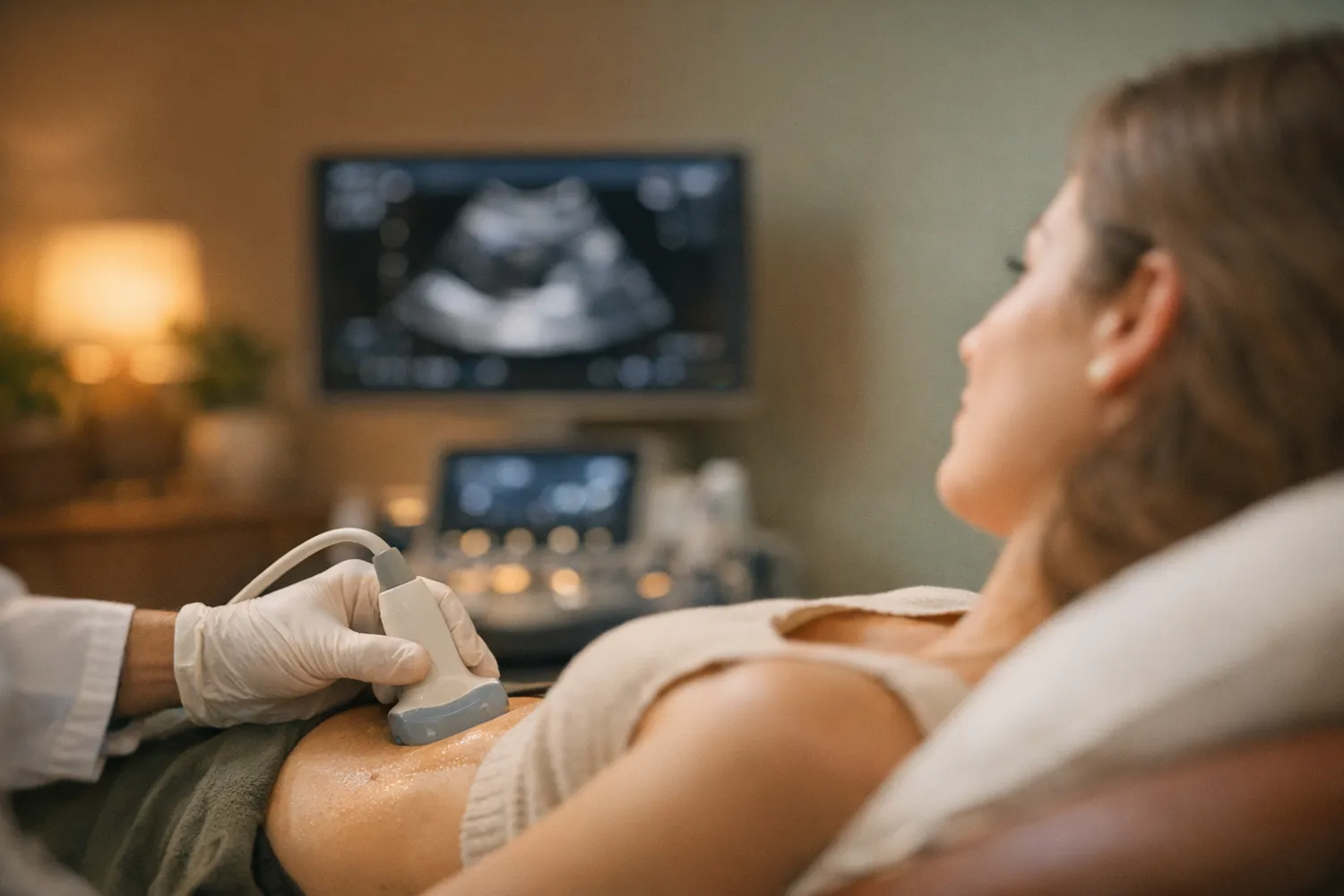
In a frozen cycle, the embryo transfer works the same way as after a fresh IVF. The doctor guides a thin catheter through the cervix and places the embryo in a tiny drop of culture medium, 10 to 30 microliters according to ESHRE. An ultrasound through the abdominal wall shows where the catheter is. ESHRE calls this the gold standard, and NICE recommends it too. In a Cochrane review, this raised the chance of a live birth or ongoing pregnancy compared with a transfer guided by touch: With a baseline chance of 23%, the chance rose to 28% to 33% (13 trials, 5,859 women; low certainty of evidence; Brown 2016). If the lining is thinner than 5 mm, NICE advises against the transfer.
Afterward, you can get up. ESHRE advises against bed rest, and according to NICE, lying down for more than 20 minutes does not improve the outcome. We did not find evidence in these guidelines for prohibitions such as exercise, sauna, or sex. Follow your clinic's instructions.
One embryo or two?
The guidelines differ here. NICE bases the number on age: Under age 37, one embryo should be transferred in the first cycle; at ages 40 to 41, NICE allows two embryos to be considered, never more than two. The 2024 ESHRE guideline, by contrast, gives a strong recommendation for single embryo transfer both under and from age 38, with very low certainty of evidence from age 38. According to it, neither earlier unsuccessful attempts nor age alone justify two embryos, and in a frozen cycle, no finding about the lining does either.
In German frozen cycles in 2023, two embryos led to a live birth in 25.3% of transfers, and one embryo in 22.6%. Among the live births, however, 19.3% instead of 1.2% were multiples (D.I.R. Yearbook 2024, p. 31; transfers of thawed embryos, not randomized). Two single embryo transfers in a row achieved similar numbers of live births as one double embryo transfer in randomized trials, with clearly fewer multiples (Cochrane, Kamath 2020; low certainty of evidence).
Frozen embryo transfer success rates
A clinical pregnancy is not yet a live birth, and registry figures are averages for groups, not a prediction for you.
Germany: pregnancies in 2024
In 2024, 13,674 of 43,653 frozen embryo transfers led to a clinical pregnancy, 31.5% per transfer and 29.9% per treatment. After IVF and ICSI, the rates were almost identical (31.3% and 31.7%), and with thawed unfertilized eggs it was 25.3% (D.I.R. Yearbook 2024, p. 24). In the fresh cycle, the figure was 30.5% (p. 22), so the frozen embryo transfer was one percentage point higher for the first time. The groups are not directly comparable, however.
Germany: live births in 2023
In 2023, 8,798 of 40,083 frozen embryo transfers ended in a live birth, which is at least 21.9% per transfer and 20.9% per treatment (fresh transfer 22.5%). For 5.5% of pregnancies, the outcome had not yet been recorded as of the cutoff date, so the actual rate is somewhat higher. Of all pregnancies, 22.4% ended in a miscarriage, and 0.9% were ectopic pregnancies. Among the live births, 6.1% were twins (D.I.R. Yearbook 2024, p. 25).
By age
| Age | Clinical pregnancy per frozen embryo transfer | Transfers analyzed |
|---|---|---|
| up to 29 | 35.3% | 17,743 |
| 30 to 34 | 33.7% | 49,133 |
| 35 to 39 | 28.6% | 46,447 |
| 40 and older | 18.9% | 12,461 |
Source: D.I.R. Yearbook 2024, p. 32, frozen cycles 2020 to 2023, prospective data, pregnancies followed up to the end of 2024. All transfer numbers combined (our own calculation).
In its yearbook, the registry does not publish live birth rates per frozen embryo transfer by age. It does not state there whether age at egg retrieval or at transfer is meant. Pregnancy and live birth rates in the fresh cycle by age are in the guide Assisted reproduction.
What frozen embryo transfers contribute to the overall chance
The registry analyzed 54,019 first egg retrievals from 2018 to 2022 after which embryos were frozen in addition to the fresh transfer. After the fresh transfer, there were 30.0 live births per 100 egg retrievals, after the first thaw cycle 45.1, and after four or more thaw cycles 54.8. Per thaw cycle, the live birth rate stayed similar: 22.5% in the first, 20.4% from the fourth on (D.I.R. Yearbook 2024, p. 33).
Austria
In the IVF Fund, there were 4,995 frozen embryo transfers in 2024, and 37.0% led to a pregnancy. The registry counts a pregnancy only once cardiac activity has been confirmed. For attempts in 2023, the live birth rate was 30.6% per frozen embryo transfer, 1,446 live births from 4,718 transfers (IVF Registry Annual Report 2024). The data apply only to couples covered by the Fund, so the woman is under 40, and are not directly comparable with the German figures.
Switzerland
We did not find published success rates for frozen embryo transfers in Switzerland.
Freeze-all or fresh transfer?
With freeze-all, all embryos are frozen and no fresh transfer takes place. In Germany, this was the case in 7,369 of 61,612 cycles with fertilization in 2024, or 12.0% (D.I.R. Yearbook 2024, p. 22).
The 2021 Cochrane review (8 trials, 4,712 women) probably found no difference in the overall chance of having a baby: If it is 58% with a fresh transfer, it would be 57% to 63% with freeze-all. Ovarian hyperstimulation syndrome (OHSS) became less common, from a baseline risk of 3% to about 1%. High blood pressure in pregnancy was more common (Peto odds ratio 2.15; low certainty of evidence), and the babies were 127 g heavier on average (Zaat 2021).
Two large Chinese trials found more live births after the first transfer with freeze-all: in 1,508 women with PCOS, 49.3% versus 42.0% (Chen 2016), and in 1,650 ovulatory women with one blastocyst, 50% versus 40% singleton live births (Wei 2019). Preeclampsia was more common in these, 4.4% versus 1.4% and 3.1% versus 1.0%. Other large trials found no established difference (Shi 2018; Maheshwari 2022). In 460 women with regular cycles in Europe, live births after at least two years were 42.6% with freeze-all and 41.7% with fresh transfer; it took a median of 106 days to pregnancy with freeze-all instead of 29 (Stormlund 2020 and 2025).
ESHRE currently does not recommend elective freeze-all as routine, but only for a clear reason, such as an increased risk of ovarian hyperstimulation, problems with the uterine lining, or preimplantation genetic testing (good practice recommendations on add-ons, 2023). To prevent late ovarian hyperstimulation, it recommends freeze-all with a strong recommendation, at low certainty of evidence (stimulation guideline 2025). The 2023 PCOS guideline also advises, in a consensus recommendation, freezing all suitable embryos when the risk of ovarian hyperstimulation is increased.
How long can embryos stay frozen?
| Country | Maximum duration | Basis |
|---|---|---|
| Germany | no statutory maximum duration | Embryo Protection Act |
| Austria | at most ten years | Section 17, paragraph 1, Austrian Reproductive Medicine Act (Fortpflanzungsmedizingesetz, FMedG) |
| Switzerland | five years, extendable by at most five years at the couple's request, then to be destroyed | Art. 16, paragraphs 2 and 4, Swiss Federal Act on Medically Assisted Reproduction (Fortpflanzungsmedizingesetz), as of August 1, 2025 |
Whether the chance falls with storage time has not been settled. Cohorts from Japan, Spain, and Austria found no association (Ueno 2018; Cobo 2024; Wirleitner 2013), but storage times there were mostly under three years. In Japan, the live birth rate across 8,736 single blastocyst transfers with up to 97 months of storage was between 34.9% and 37.3% depending on storage duration, with no established difference (Ueno 2018). In Spain, the longest tenth of storage times began at just under 35 months (Cobo 2024).
Two Chinese cohorts found somewhat lower live birth rates after more than five years, 34.91% versus 37.29% after up to 2 years (Zhan 2024). The second cohort, with 13,054 first frozen embryo transfers, also saw lower live birth rates after more than five years, narrowly established from as early as 2 years; according to the authors, the effect applied only to women up to 35 (Ji 2026). Randomized data are missing, so this is not an established disadvantage.
What does a frozen embryo transfer cost?
Germany
| Service | Price | Source |
|---|---|---|
| Frozen cycle with thawing, cycle monitoring, and transfer | approx. €800 to €1,100 | Kinderwunschzentrum Ludwigshafen |
| Frozen transfer cycle with medication | approx. €1,000 | Kinderwunsch-Arzt Berlin |
| Thaw cycle, medication not specified | about €400 to €600 | Kinderwunschzentrum Ludwigsburg |
| Freezing of fertilized eggs | €350 (Ludwigshafen), about €350 (Ludwigsburg); Berlin gives contradictory figures for pronuclear stages, approx. €400 and approx. €600 | Clinic websites |
Figures undated, retrieved in October 2026. We did not find prices for storing pronuclear stages and embryos; ask your clinic about them.
Statutory health insurance does not pay for freezing fertilized eggs or for the frozen embryo transfer. The G-BA guideline excludes services “such as the cryopreservation of sperm cells, fertilized eggs, or embryos that have not yet been transferred” (no. 4). Among the methods, it does not list the transfer of thawed embryos (no. 10). The federal health subsidy for civil servants (Beihilfe) does not list it either (Section 43 BBhV).
One exception: If freezing eggs is medically necessary because of therapy that damages germ cells, such as chemotherapy, there is an entitlement to it (Section 27a, paragraph 4, of Book V of the German Social Code, Sozialgesetzbuch V, SGB V). The later ICSI with the thawed eggs, including preparation of the lining and transfer, then counts among the services covered by statutory health insurance (G-BA guideline no. 11.5 b, 12.3 b, and 12.8). This entitlement does not cover fertilized eggs and embryos, and the G-BA's cryopreservation guideline does not mention them either.
Some health insurance funds pay voluntarily. The TK (Techniker Krankenkasse) covers 50% of the contractual costs for the transfer of surplus frozen eggs from a treatment it has approved, counted as an attempt (as of July 28, 2026). In its BKK Kinderwunsch program, Mobil Krankenkasse, for example, pays €350 twice toward a frozen cycle (as of August 10, 2026). More on this in cost coverage. We did not separately check private plans and taxes for frozen embryo transfer costs; general rules are at deducting fertility treatment costs from your taxes.
Austria
The IVF Fund covers 70% of the costs, including for a frozen embryo transfer (Section 2, paragraph 2, of the IVF Fund Act, IVF-Fonds-Gesetz). Requirements include, among others, one of the diagnoses specified by law, the woman being under 40, and a contracted center. There are at most four attempts, and four more after a pregnancy (Section 4, paragraph 2). Each frozen attempt counts as its own attempt, unless an attempt was canceled after egg retrieval for medical reasons. Freezing and storage for up to six months are included in the Fund tariff (Austrian Ministry of Social Affairs 2025).
In private contracted centers, you pay an out-of-pocket share of €298.29 per frozen attempt (since July 2026; Zech). Services outside the Fund may be added, for example €285 at Pavlik in Wels for an electronic identity system in the lab. Without the Fund, a frozen embryo transfer costs €1,250 (Zech, from September 10, 2026) or from €1,616 (Pavlik). Freezing costs €380 (Zech) or €428 for 1 to 4 embryos (Pavlik), and storage €380 or €321 per year.
Switzerland
Mandatory basic health insurance (Grundversicherung) does not pay for IVF or embryo transfer (KLV Annex 1, edition of July 1, 2026). For fertility preservation before therapy that damages germ cells, it pays, under certain conditions, for freezing eggs, but “any fertilization before cryopreservation is not charged to the insurance.” Inselspital Bern quotes CHF 2,200 for a thaw cycle including all cycle costs, gonadotropins extra, and CHF 396 per year for storing eggs.
What a treatment costs overall in your country is calculated by the cost calculator.

After the transfer: progesterone, test day, and due date
The days after the transfer are the hardest for many people. Your clinic decides when you test. The guidelines we reviewed do not specify a fixed day; in studies, testing took place 10 to 15 days after the transfer. After a trigger shot, the hCG from the shot can make a test positive for up to 10 days (prescribing information). Because the transfer takes place 6 to 7 days after the shot, this mainly affects the first days afterward (our own calculation). The IVF Due Date Calculator shows common testing times.
In the artificial cycle, you usually take progesterone until weeks 10 to 12 of pregnancy. The prescribing information for vaginal progesterone gives 400 to 600 mg daily, at least until week 7 and at most until week 12. Do not stop it on your own; talk with your clinic first.
You calculate the due date from the transfer: 261 days for a day 5 blastocyst and 263 days for a day 3 embryo (ACOG). The rule counts the age of the embryo on transfer day, not the storage time (our own derivation). The IVF Due Date Calculator does this calculation for you.
If hCG falls again after a positive test, that can be a biochemical pregnancy. Have bleeding or pain after the transfer checked by a doctor. If you are planning a new transfer after a loss, you will find answers in the article Getting pregnant after miscarriage. For an overview of all options, see the guide to infertility. If you are looking for a fertility clinic, also for a second opinion, the clinic directory can help. After a few questions, the Fertility Clinic Finder suggests suitable clinics for you.
Frequently asked questions
How does a frozen embryo transfer work?
Frozen embryos or pronuclear stages are thawed and transferred in a later cycle, without new stimulation and egg retrieval. A blastocyst is transferred about 5 days after ovulation, 6 to 7 days after the trigger shot, or 5 days after the start of progesterone (Wei 2026, Saupstad 2026).
Which is better: a natural or an artificial cycle?
With regular ovulation, the natural cycle is at least as successful, with fewer miscarriages (relative risk 0.75; Martins and Nastri 2026). In the largest trial, with 4,376 women, 51.1% in the natural cycle and 50.1% in the artificial cycle had a baby (Wei 2026).
What are the chances of success with a frozen embryo transfer?
In Germany, 31.5% of frozen embryo transfers led to a clinical pregnancy in 2024, and at least 21.9% ended in a live birth in 2023 (D.I.R. Yearbook 2024). In Austria, the live birth rate for attempts in 2023 was 30.6% per frozen embryo transfer, counting only couples covered by the Fund with the woman under 40; this is not directly comparable with the German figures (IVF Registry 2024).
What is the chance with a frozen embryo transfer at 40?
For women aged 40 and older, frozen embryo transfers in Germany from 2020 to 2023 led to a clinical pregnancy in 18.9% (D.I.R. Yearbook 2024, p. 32, our own calculation). The registry does not publish live birth rates by age for frozen embryo transfers.
Is a frozen embryo transfer more successful than a fresh transfer?
Per transfer, the two are almost equal in Germany: 31.5% versus 30.5% pregnancies (2024), 21.9% versus 22.5% live births (2023), in groups that are not directly comparable. Freezing everything does not raise the overall chance of having a baby (Cochrane 2021).
Do I have to lie down after the embryo transfer?
No. ESHRE advises against bed rest, and according to NICE, lying down for more than 20 minutes does not improve the outcome (ESHRE 2022; NICE NG257).
How long do I have to take progesterone after a frozen embryo transfer?
In the artificial cycle, usually until weeks 10 to 12 of pregnancy, and according to the prescribing information at most until week 12 (Wei 2026; prescribing information for vaginal progesterone). In the cycle with a trigger shot, progesterone showed no established benefit (Saupstad 2026). In the natural cycle without a shot, vaginal progesterone raised the live birth rate in 2 studies with 923 cycles (moderate certainty of evidence; Erden 2026).
What does a frozen embryo transfer cost?
In Germany, clinics quote about €400 to €1,100 per thaw cycle, plus freezing (about €350 to €600) and storage. In Austria, couples covered by the Fund pay an out-of-pocket share of €298.29 in private centers (since July 2026), and self-pay patients €1,250 (Zech) or from €1,616 (Pavlik). Inselspital Bern quotes CHF 2,200, gonadotropins extra.
Does health insurance cover a frozen embryo transfer?
In Germany, statutory health insurance does not cover it (G-BA guideline nos. 4 and 10), except after freezing unfertilized eggs before therapy that damages germ cells. Some health insurance funds pay voluntarily, for example the TK, which covers 50% for the transfer of surplus frozen eggs from a treatment it has approved. In Austria, the IVF Fund covers 70%, and in Switzerland, basic health insurance does not pay.
Sources
Registries
- German IVF Registry: D.I.R. Yearbook 2024, pp. 6, 8, 22, 24, 25, 31 to 33, D.I.R., data as of April 16, 2025
- German IVF Registry: D.I.R. Yearbook 2022, special analysis of endometrial preparation in the thaw cycle, pp. 16 to 17, D.I.R.
- IVF Registry Annual Report 2024, tables 9, 13, and 19, Austrian National Public Health Institute on behalf of the Austrian Ministry of Social Affairs
Guidelines and consensus papers
- NICE guideline NG257: Fertility problems, assessment and treatment, recommendations 1.49.2 to 1.49.12, National Institute for Health and Care Excellence, March 31, 2026
- ESHRE: Good practice recommendations on add-ons in reproductive medicine, Hum Reprod 2023;38(11):2062-2104
- ESHRE Guideline Ovarian Stimulation for IVF/ICSI, Update 2025, Hum Reprod 2026;41(4):498-514, ESHRE
- ESHRE guideline on the number of embryos transferred, Hum Reprod 2024;39(4):647 ff.
- ESHRE: Recommendations on embryo transfer technique, Hum Reprod Open 2022(4):hoac038
- ESHRE: Good practice recommendations for the IVF laboratory, Hum Reprod 2026;41(8):1245-1269
- The Vienna consensus: report of an expert meeting on the development of ART laboratory performance indicators, Hum Reprod Open 2017:hox011, ESHRE and Alpha
- Teede HJ et al.: International evidence-based guideline for the assessment and management of polycystic ovary syndrome 2023, Hum Reprod 2023;38(9):1655 ff.
- Committee Opinion No. 700: Methods for Estimating the Due Date, ACOG, 2017, reaffirmed 2025
Systematic reviews and meta-analyses
- Martins WP, Nastri CO: Meta-analysis of randomized trials on the cycle with ovulation versus the artificial cycle in frozen embryo transfer, Ultrasound Obstet Gynecol 2026
- Lin LT et al.: Meta-analysis of randomized trials on the natural versus the artificial cycle in frozen embryo transfer, Obstet Gynecol 2026;148(2):e92-e107
- Ghobara T, Gelbaya TA, Ayeleke RO: Cycle regimens for frozen-thawed embryo transfer, Cochrane Database Syst Rev 2025, CD003414.pub4
- Zaat T et al.: Fresh versus frozen embryo transfers in assisted reproduction, Cochrane Database Syst Rev 2021, CD011184.pub3
- Brown J et al.: Ultrasound versus 'clinical touch' for catheter guidance during embryo transfer in women, Cochrane Database Syst Rev 2016, CD006107.pub4
- Kamath MS et al.: Number of embryos for transfer following in vitro fertilisation or intra-cytoplasmic sperm injection, Cochrane Database Syst Rev 2020, CD003416.pub5
- Zaat TR et al.: Meta-analysis of observational studies on pregnancy and birth outcomes after natural and artificial frozen cycles, Hum Reprod Update 2023;29(5):634-654
- Busnelli A et al.: Meta-analysis on risk factors for high blood pressure in pregnancy after fresh and frozen embryo transfer, Hum Reprod 2022;37(7):1619-1641
- Erden M et al.: Systematic review of frozen embryo transfer in the natural cycle, Hum Reprod Update 2026;32(4):439-457
- Venetis C et al.: Meta-analysis of the modified natural versus the natural cycle in frozen embryo transfer, Fertil Steril 2026;125(5):833-844
- Rienzi L et al.: Oocyte, embryo and blastocyst cryopreservation in ART: systematic review and meta-analysis comparing slow-freezing versus vitrification, Hum Reprod Update 2017;23(2):139-155
Randomized trials
- Wei D et al.: Randomized trial of the natural versus the artificial cycle in frozen embryo transfer, BMJ 2026;392:e087045
- Geysenbergh B et al.: Randomized trial of the natural versus the artificial cycle in frozen embryo transfer in Belgium, Hum Reprod 2026;41(8):1420-1429
- Saupstad M et al.: Randomized trial of progesterone and transfer day in the modified natural frozen cycle, Hum Reprod Open 2026(1):hoag003
- Zhou R et al.: Randomized trial of the transfer day for day 6 blastocysts in the artificial cycle, Hum Reprod Open 2026(2):hoag023
- Zaat T et al.: Antarctica-2, randomized trial of at-home LH tests versus clinic monitoring in the natural frozen cycle, Lancet 2023;402:1347-1355
- Groenewoud ER et al.: A randomized controlled, non-inferiority trial of modified natural versus artificial cycle for cryo-thawed embryo transfer, Hum Reprod 2016;31(7):1483-1492
- Jiang L et al.: Randomized trial of letrozole versus the artificial cycle in frozen embryo transfer in PCOS, J Assist Reprod Genet 2025;42(6):1907-1915
- Stormlund S et al.: Freeze-all versus fresh blastocyst transfer strategy during in vitro fertilisation in women with regular menstrual cycles, BMJ 2020;370:m2519
- Stormlund S et al.: Follow-up analysis with cumulative live birth rate, Reprod Biomed Online 2025;50(6):104449
- Chen ZJ et al.: Fresh versus frozen embryos for infertility in the polycystic ovary syndrome, N Engl J Med 2016;375:523-533
- Shi Y et al.: Transfer of fresh versus frozen embryos in ovulatory women, N Engl J Med 2018;378:126-136
- Wei D et al.: Frozen versus fresh single blastocyst transfer in ovulatory women: a multicentre, randomised controlled trial, Lancet 2019;393:1310-1318
- Maheshwari A et al.: Elective freezing of embryos versus fresh embryo transfer in IVF (E-Freeze), Hum Reprod 2022;37(3):476-487
Observational studies
- von Versen-Hoynck F et al.: Increased preeclampsia risk and reduced aortic compliance with in vitro fertilization cycles in the absence of a corpus luteum, Hypertension 2019;73(3):640-649
- Celicanin M et al.: Cohort study of the transfer day for day 6 blastocysts in the artificial frozen cycle, Sci Rep 2025;15:32792
- Wirleitner B et al.: Storage duration of vitrified blastocysts, survival, and pregnancies, IVF Centers Prof. Zech Bregenz, Hum Reprod 2013;28(11):2950-2957
- Ueno S et al.: Storage duration of vitrified blastocysts and pregnancy and birth outcomes, Reprod Biomed Online 2018;36(6):614-619
- Cobo A et al.: Storage duration of vitrified blastocysts, survival, and live birth, Am J Obstet Gynecol 2024;231(2):238.e1 ff.
- Zhan S et al.: Long-term storage of blastocysts and live birth, Hum Reprod 2024;39(9):1960-1968
- Ji Y et al.: Storage duration and live birth after the first frozen embryo transfer, J Assist Reprod Genet 2026
Laws, guidelines, and official documents
- Embryo Protection Act (Embryonenschutzgesetz), sections 1, 8, and 9
- Section 27a SGB V, Assisted reproduction
- G-BA: Guideline on assisted reproduction, nos. 4, 10, 11.5, and 12, version of December 16, 2021, in force since February 9, 2022
- G-BA: Supporting reasons for the consequential amendments to the cryopreservation guideline, December 16, 2021, pp. 4 to 5
- G-BA: Cryopreservation guideline, last amended August 18, 2022
- Section 43 Federal Beihilfe Ordinance (Bundesbeihilfeverordnung)
- IVF Fund Act (IVF-Fonds-Gesetz), sections 2 and 4, RIS
- Reproductive Medicine Act Austria (Fortpflanzungsmedizingesetz), section 17, RIS
- Federal Act on Medically Assisted Reproduction Switzerland (Fortpflanzungsmedizingesetz), Art. 16, as of August 1, 2025, Fedlex
- KLV Annex 1, edition of July 1, 2026, Federal Office of Public Health
- We would like a baby, pp. 9 and 13, Austrian Ministry of Social Affairs, as of July 25, 2025
Prescribing information
- Prescribing information, progesterone 200 mg soft capsules for vaginal use, sections 4.1 and 4.2, as of February 2026
- Prescribing information, dydrogesterone 10 mg, section 4.1, as of September 2025
- Prescribing information, urinary hCG 5,000 IU, sections 4.1, 4.4, and 5.1, as of February 2024
- Product information, choriogonadotropin alfa 250 micrograms, sections 4.1 and 4.4, European Medicines Agency
- Prescribing information, letrozole 2.5 mg, section 4.1, as of April 2025
Insurers and clinics (retrieved in October 2026)
- Techniker Krankenkasse: Cost coverage for assisted reproduction, as of July 28, 2026
- Mobil Krankenkasse: BKK Kinderwunsch, as of August 10, 2026
- Kinderwunschzentrum Ludwigshafen: Success and costs
- Kinderwunsch-Arzt Berlin: Treatment costs
- Kinderwunschzentrum Ludwigsburg: Costs
- Kinderwunsch Clinic Dr. Zech: IVF costs and the IVF Fund
- Kinderwunschklinik Dr. Pavlik Wels: IVF Fund
- Kinderwunschklinik Dr. Pavlik Wels: Self-pay patients
- Inselspital Bern, Kinderwunschzentrum: Costs