This page covers Germany, Austria, and Switzerland.
What a semen analysis costs depends mainly on whether there is a medical reason for it. If the test is done to evaluate infertility, the statutory health insurance fund in Germany pays for it. As a self-pay patient, the lab analysis alone costs €23 to €30 under the German fee schedule for physicians, and around €37 to €47 with a medical consultation. The Fertility Information Portal (Informationsportal Kinderwunsch) of the German Federal Family Ministry lists €80 to €200 for the privately billed test, including evaluation and consultation.
The semen analysis is the basic test of male fertility. Giving the sample takes little time, and the lab analysis ideally begins within 30 minutes. Even so, hardly any fertility test raises as many questions. What exactly is being tested? Who pays? And at what point does it get serious?
Here you will find the concrete numbers, broken down for Germany, Austria, and Switzerland.
What is a semen analysis?
A semen analysis is the laboratory analysis of a semen sample. It measures volume, sperm concentration, motility (movement), morphology (shape), and other parameters. The test follows the WHO laboratory manual of 2021 (6th edition). It provides important clues about male fertility, but on its own it cannot reliably distinguish between fertile and infertile.
In about half of all couples facing infertility, a male factor is involved. Even so, the man is often the last to be tested. That is a mistake: the guideline of the European Association of Urology (EAU) recommends evaluating both partners at the same time. A semen analysis is quick, inexpensive, and provides clarity within a few days.
If you want to learn the basics of andrology testing, take a look at our andrology overview.
The process: from sample to results
Many men wonder beforehand how the test works. Here is the short version:
1. Observe the abstinence period. The WHO manual recommends no ejaculation for at least two and at most seven days before the sample. The portal familienplanung.de names three to five days. Because the abstinence period affects the values, it is noted in the lab report.
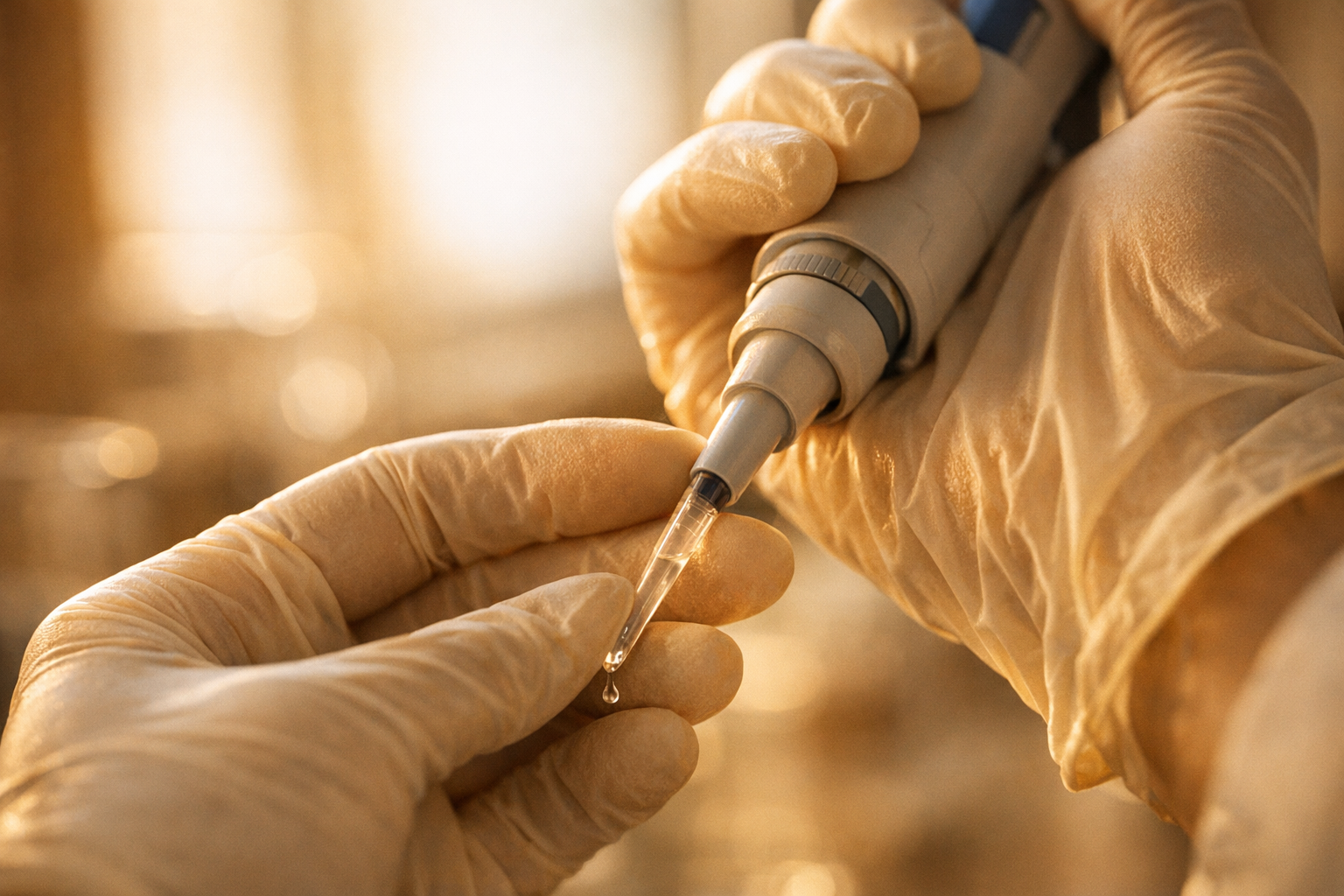
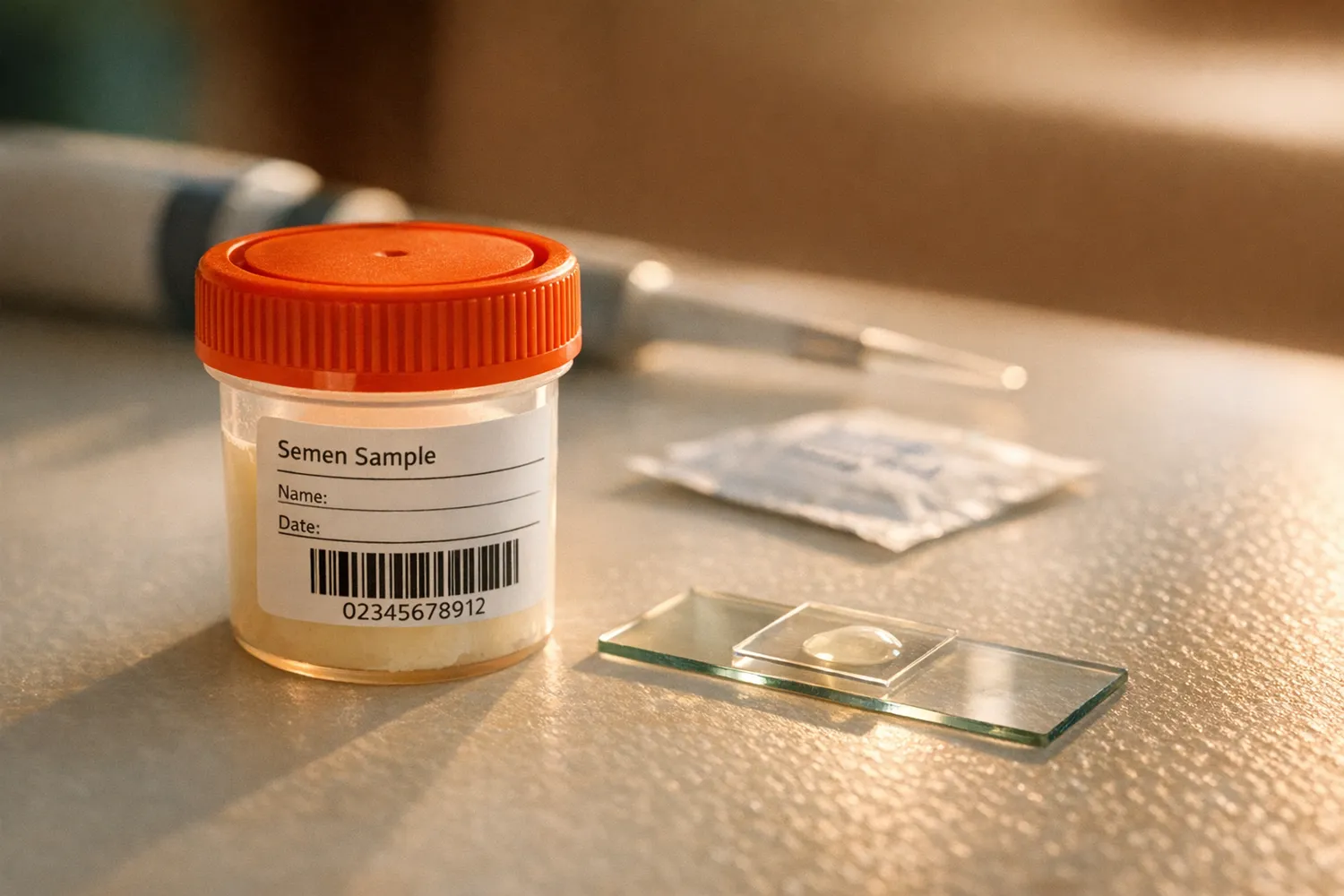
2. Provide the sample. At the practice or clinic, ideally on site: according to the WHO, the analysis should begin within 30 minutes if possible, and no later than one hour. A sample from home also works if it is transported at body temperature (in an inside pocket, not the glove compartment in winter) and reaches the lab in time.
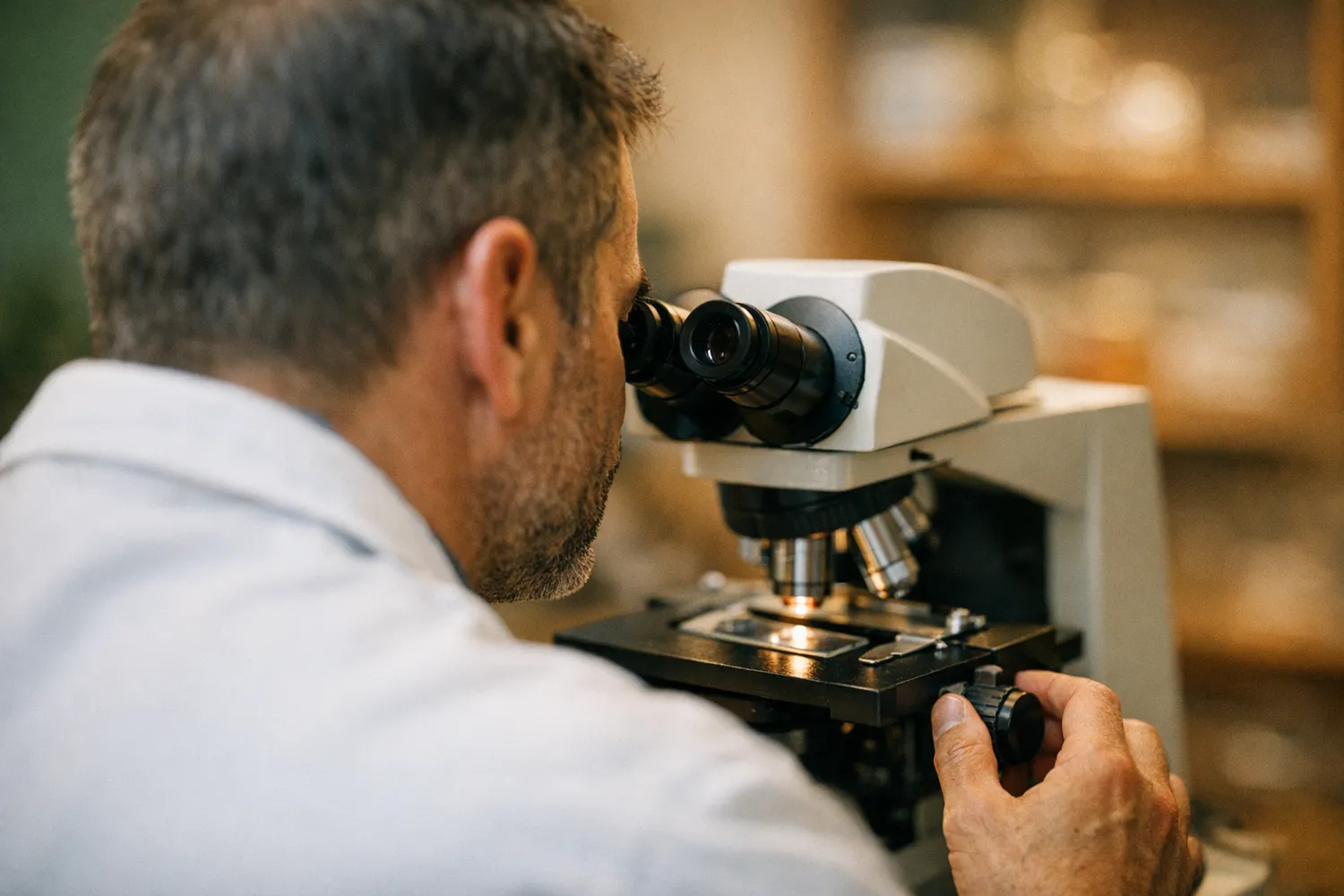
3. Lab analysis. The sample is examined according to the WHO standard: liquefaction time, pH value, volume, concentration, total sperm count, progressive motility, morphology.
4. Discussion of results. The result is discussed with you in person. An abnormal semen analysis does not automatically mean infertility. A single poor result says little. A repeat after 8 to 12 weeks is common.
The whole process is straightforward. No blood, no needle, no anesthesia.
Urologist, andrologist, or fertility clinic?
The most common question after “What does it cost?” is: where do I even get this done?
Urologist. The classic starting point. Urology practices are available nationwide, and the wait for an appointment varies by region. Many urology practices offer semen analyses; some send the sample to an external lab, and some have their own. Advantage: the insurance fund pays for evaluating infertility.
Andrologist. The specialist for male fertility. There are far fewer practices, mainly in large cities. In return, they have deeper expertise for complex findings: extended sperm function tests, hormone testing, surgical procedures. Billing follows the same fee schedule, but andrologists more often offer extended analyses.
Fertility clinic. Makes sense if you and your partner already know that you need help. The clinic performs the semen analysis as part of the initial evaluation, together with the diagnostic testing of the woman. Everything under one roof. Downside: the wait for the first appointment is often longer.
For most men, the urologist is the most sensible starting point. It is usually the fastest route. If the values are abnormal, a referral to an andrologist or directly to a fertility clinic follows.
Semen analysis cost: Germany, Austria, Switzerland
What you pay depends on whether the insurance fund steps in and what additional services apply. The key figures at a glance, as of 2026:
| Service | Germany | Austria | Switzerland |
|---|---|---|---|
| Lab semen analysis (self-pay) | €23.31 to €30.31 (fee schedule item 3668) | Private price depends on the lab | CHF 130.50 (item 1674.00 in the Analysis List, Analysenliste) |
| Semen analysis with medical consultation (self-pay) | approx. €37 to €47 under the fee schedule; according to the Fertility Information Portal, €80 to €200 in practice | Private price depends on the lab or private doctor (Wahlarzt) | plus medical consultation |
| With a medical reason | Insurance fund pays for the evaluation of causes in full | Insurance fund usually pays with a doctor’s referral | Mandatory basic health insurance (Grundversicherung), minus the deductible (franchise) and 10% co-insurance |
Special tests are only added for certain findings. The MAR test (a search for sperm antibodies) costs €11.66 to €15.15 under the fee schedule. For tests such as DNA fragmentation, get a cost estimate in advance.
In Germany, urologists and andrologists bill self-pay patients under the fee schedule. Important to know: the semen analysis is a laboratory service. For it, a range of 1.0 to 1.3 times the base rate applies, and anything above 1.15 times needs a written justification (Section 5, paragraph 4, and Section 12, paragraph 3 of the fee schedule). A fee agreement for higher rates is not permitted for lab services (Section 2, paragraph 3 of the fee schedule). The 2.3-fold or 3.5-fold rate exists only for medical services such as consultation.
In Switzerland, the lab analysis is valued at 130.5 tariff points in the official Analysis List, and one tariff point corresponds to one franc. The medical consultation comes on top. In Austria there are no uniform private prices, so ask the lab or private doctor in advance.
Fee schedule items: how billing works
If you receive an invoice as a self-pay patient, these fee schedule items typically appear on it. The amounts are calculated with the fee schedule point value of 5.82873 cents:
| Fee schedule item | Service | Base rate | Standard rate | Maximum rate |
|---|---|---|---|---|
| 3668 | Physical and morphological examination of semen (volume, viscosity, pH value, motility, sperm count, vitality, morphology) | €23.31 | €26.81 (1.15-fold) | €30.31 (1.3-fold) |
| 3889 | MAR test (sperm antibodies) | €11.66 | €13.41 (1.15-fold) | €15.15 (1.3-fold) |
| 1 | Consultation | €4.66 | €10.72 (2.3-fold) | €16.32 (3.5-fold) |
| 3 | Detailed consultation, at least 10 minutes | €8.74 | €20.11 (2.3-fold) | €30.60 (3.5-fold) |
Alongside item 3668, the individual items 3663, 3664, and 3667 may not be billed additionally. Further items can be added, such as a physical examination or a blood draw for hormone testing. Realistically, a semen analysis and consultation under the fee schedule come to about €37 to €47, and about €51 to €60 with a MAR test. If a rate is above the standard rate (above 1.15-fold for lab services, above 2.3-fold for medical services), the practice must justify this in writing on the invoice. Ask if the justification is missing.
Does health insurance cover the cost?
The answer depends on the country and the reason for the test.
Germany
If a pregnancy is taking a long time, the statutory health insurance fund pays in full for the medical evaluation of possible causes, in men as well as women. As a rule of thumb for an evaluation, the EAU guideline cites: no pregnancy after 12 months of regular, unprotected intercourse. The referral comes from your primary care doctor, a urologist, or the fertility clinic.
If you go to the urologist without a specific reason and say, “I’d like to have my sperm checked,” that is an IGeL service (Individuelle Gesundheitsleistung, individual health service). Then you pay as a self-pay patient, and you can see the ballpark figures above. Before treatment, the practice must inform you in writing of the expected costs (Section 630c, paragraph 3 of the German Civil Code, BGB). Do not sign until you know the price.
Private health insurance also pays for the evaluation of causes. Exactly what your plan covers is stated in your contract.
Austria
With a doctor’s referral and a medical justification, the insurance fund generally covers the costs. Without a referral, you pay as a private patient. Prices differ by lab, so ask in advance.
Important for couples in Austria: if the evaluation leads to IVF or ICSI treatment, the IVF Fund (IVF-Fonds) covers 70% of the costs, and you pay a 30% out-of-pocket share. Requirements include a recognized indication, and male infertility counts as one. When the attempt begins, the woman must not yet have turned 40 and the man must not yet have turned 50. Marriage, registered partnership, and cohabiting partnership all count as a couple. If the cause of reduced sperm values is unclear (idiopathic pathospermia), two abnormal semen analyses at least four weeks apart are needed. You do not submit a separate application to the fund; the fertility clinic checks your eligibility and bills directly.
Switzerland
In Switzerland, the semen analysis is listed in the official Analysis List and is billed through mandatory basic health insurance when a doctor orders it. The deductible (franchise) and the co-insurance (10%) are your responsibility.
Tax deductible?
Yes, with limits. In Germany, medical costs you pay yourself count as extraordinary burdens (Section 33 of the German Income Tax Act, Einkommensteuergesetz, EStG). However, only the portion that exceeds your reasonable burden is deductible. This depends on income, marital status, and number of children. For fertility treatment, the Federal Fiscal Court (Bundesfinanzhof) has recognized travel costs to treatment as part of the medical costs. This also applies to more advanced fertility treatments and their costs.
In Austria, medical costs can also count as an extraordinary burden, minus an income-dependent deductible of 6% to 12%. In Switzerland, medical costs you pay yourself are deductible for direct federal tax insofar as they exceed 5% of income. For cantonal taxes, cantonal law applies. Collect all receipts and invoices from the start.
WHO reference values: what is normal?
The current WHO reference values (6th edition, 2021) at a glance:
| Parameter | WHO reference value (lower limit) |
|---|---|
| Ejaculate volume | ≥ 1.4 ml |
| Sperm concentration | ≥ 16 million/ml |
| Total sperm count | ≥ 39 million |
| Progressive motility | ≥ 30% |
| Total motility | ≥ 42% |
| Normal forms (morphology) | ≥ 4% |
| Vitality | ≥ 54% |
| pH value | no percentile value; below 7.2 can indicate missing secretion from the seminal vesicles |
The values show the lower 5th percentile of around 3,500 men whose partner became pregnant within 12 months. 95% of these men were above it. According to the WHO, this limit is explicitly not a dividing line between fertile and infertile. A single value below the limit is no reason to panic. For a detailed explanation of all parameters and what they mean for your fertility, read our semen analysis values guide.
When should you get a semen analysis?
The most important reasons:
- After 12 months of actively trying to conceive without a pregnancy. From then on, the EAU guideline recommends evaluating both partners. If there are known risk factors, an earlier appointment makes sense, because a semen analysis is inexpensive and quick.
- Before a planned IVF or ICSI. Without a semen analysis, nobody knows whether a conventional IVF is enough or whether ICSI is needed. ICSI is more complex and more expensive, and you want to know that beforehand.
- After an undescended testicle, mumps orchitis, or varicocele, even if you are not currently trying to conceive. These histories raise the risk of reduced sperm quality.
- Early, as a baseline. Sperm quality also declines with age, in most men from about 40. DNA fragmentation also increases with age. If you know your baseline early, you can react faster to changes.

Abnormal result: now what?
A poor semen analysis is no reason to panic. But it is a reason to act.
Step 1: Repeat after 8 to 12 weeks. A single value says little. According to the WHO, a recent illness, especially one with fever, or an unusual abstinence period can distort the results. The maturation of new sperm takes a little over three months. An infection two months ago can therefore still have an effect today.
Step 2: Extended testing. If values are repeatedly poor, the following usually come next: hormone testing (FSH, LH, testosterone, prolactin), a testicular ultrasound, and if needed a DNA fragmentation test. In a large analysis cited by the EAU guideline, a possible cause was found in just over 40% of the men examined.
Step 3: Treatment decision. Depending on the result, there are different paths. With mildly reduced values, a lifestyle change is sometimes enough. With severely reduced values, the path often leads to ICSI. With azoospermia (no sperm in the ejaculate), a TESE is necessary, the surgical retrieval of sperm.
Do you want to know which clinic is right for your situation? Our clinic directory compares clinics by treatment focus and success rates.
What you can do yourself
Sperm quality can be influenced, though not in every man and not without limit. According to the EAU guideline, excess weight, little exercise, smoking, and heavy alcohol use are associated with poorer sperm values. These adjustments are worth it:
- Quit smoking. A large meta-analysis with 5,865 participants found a clear association between smoking and poorer sperm values.
- Reduce alcohol. Moderate consumption does not seem to worsen sperm values, but heavy drinking does. Regularly having more than two drinks a day can lower testosterone levels.
- Lose excess weight. Excess weight can impair testicular function. Losing weight can improve values, but the evidence is not clear-cut.
- Avoid heat. For sperm production, the testicles need a temperature about 2 degrees below body temperature. So: no laptop on your lap, no heated seats on high all the time, no daily sauna while you are trying to conceive.
- Micronutrients in moderation. Antioxidants such as zinc, selenium, or coenzyme Q10 are often recommended, but the evidence is contradictory. More is not better, so pay attention to the dosage and talk it over with your doctor.
Results show up after about three months at the earliest. That is how long the maturation of new sperm takes.
Home semen test vs. doctor
In pharmacies and online you will find home sperm tests. They sound tempting: quick, discreet, no doctor’s appointment. But they have a fundamental problem: as a rule, they only determine whether the sperm count is above or below a certain threshold.
What is completely missing: morphology, vitality, pH value, leukocytes, MAR test. Exactly the parameters that regularly make the difference between “all okay” and “action needed” in everyday andrology.
A “normal” result on a home test gives you a false sense of security, because even a normal sperm count does not allow a reliable statement about fertility. A “poor” result causes unnecessary panic without clinical context. A sound treatment decision cannot be made on the basis of a home test.
If you are putting off the doctor’s visit and a home test gets you to go after all, it has served its purpose. As a diagnostic tool, it is not suitable.
Frequently asked questions
What does a semen analysis cost at the urologist?
As a self-pay patient, the lab analysis in Germany costs €23.31 up to a maximum of €30.31 under the fee schedule, and with a consultation you come to around €37 to €47. The Fertility Information Portal lists €80 to €200 for the privately billed test including evaluation and consultation. When there is a medical reason, the statutory insurance fund pays. In Switzerland, the lab analysis is valued at CHF 130.50 in the Analysis List, and in Austria private prices differ by lab. Get a cost estimate in advance.
Does health insurance cover the semen analysis?
Yes, if the test is done to evaluate infertility. The statutory insurance funds in Germany cover this diagnostic work in full, and private insurers cover it too. Without a medical reason, it is a self-pay service.
How often should a semen analysis be repeated?
At least once. Values vary considerably from sample to sample. If the values are abnormal, the semen analysis is usually repeated after 8 to 12 weeks before a diagnosis is made. With borderline values or fluctuating results, sometimes a third time as well. The cost of a repeat is identical.
Can I do a semen analysis at home?
Home tests generally only determine whether the sperm count is above or below a threshold. Motility, morphology, and vitality are missing entirely. A “normal” home test does not rule out a fertility problem. For more, read the detailed comparison above in the section “Home semen test vs. doctor.”
At what age does sperm quality decline?
In most men from about 40 years of age: fewer sperm are produced, and their ability to fertilize may decrease. With age, DNA fragmentation also increases, and the risk of miscarriage goes up. That does not mean you cannot father a child at 45. But the chances decrease. If you are over 40 and want to have a child, you should not wait for months.
Is a semen analysis an IGeL service?
Yes, if there is no medical reason. Without a medical indication, the semen analysis is an individual health service (Individuelle Gesundheitsleistung, IGeL) that you pay for yourself. If the test is done to evaluate infertility, the statutory health insurance fund covers the costs in full.
Can I deduct the costs from my taxes?
Yes, as an extraordinary burden, but only the portion above your reasonable burden (Section 33 EStG). The costs you pay yourself for the semen analysis and the discussion of results are deductible. The Federal Fiscal Court has also recognized travel costs to treatment in fertility treatment. In Austria, an income-dependent deductible of 6% to 12% applies, and in Switzerland only medical costs above 5% of income count for direct federal tax. Keep all receipts and invoices.
How long does it take to get the results?
The lab analysis ideally begins within 30 minutes after the sample is provided. When you receive the report depends on the practice and the lab. Extended tests such as DNA fragmentation take longer. You receive the result as a written report, in addition to the personal discussion.
Your next step
A semen analysis is the fastest and least expensive way to assess male fertility. With a medical reason, the insurance fund pays; as a self-pay patient, you pay from around €37 under the fee schedule, and depending on the practice, considerably more.
Not sure whether a semen analysis is the right first step? Our Fertility Clinic Finder helps you find the right way into testing in 5 minutes. Anonymous, free, no registration.
Sources
- WHO laboratory manual for the examination and processing of human semen, 6th edition, World Health Organization, 2021
- German Fee Schedule for Physicians with Sections 2, 5, and 12 and the fee list, Federal Ministry of Justice, as of 2026
- Tests in men, Fertility Information Portal (BMFSFJ), retrieved 2026
- Fertility tests in men, familienplanung.de (Federal Institute for Public Health), 2026
- Fertility treatment: what is allowed and who bears the costs?, familienplanung.de (Federal Institute for Public Health), 2026
- EAU Guidelines on Sexual and Reproductive Health: Male Infertility, European Association of Urology, 2026
- Analysis List (Analysenliste), July 1, 2026 edition, Federal Office of Public Health (BAG), 2026
- We would like a baby (brochure on the IVF Fund), Austrian Ministry of Social Affairs, 2025
- Section 33 EStG: Extraordinary burdens, Federal Ministry of Justice, as of 2026
- Federal Act on Health Insurance (KVG), Art. 64 Cost sharing, Fedlex, as of 2026