This page covers Germany, Austria, and Switzerland.
The term fertility test covers very different things: an ovulation test from the drugstore, an AMH blood test by mail, an exam at the gynecologist, or the complete evaluation at a fertility clinic.
The same limit applies to every route: the AMH level and the number of small follicles on ultrasound (antral follicle count, AFC) estimate the ovarian reserve and the response to hormonal stimulation. They do not predict a spontaneous pregnancy. The British guideline NICE NG257 (2026), the European society ESHRE (2023), and the US societies ASRM (2020) and ACOG (Committee Opinion 773) agree on this. The German societies DGGEF and DGRM, together with the professional association of gynecologists (BVF), oppose a fertility check without a specific reason (2014).
If you are facing infertility, testing still makes sense, because it can find treatable causes, such as absent ovulation or blocked fallopian tubes. Which route suits you depends mainly on how long you have been trying and how old you are. We compiled the prices in October 2026. The underlying price lists date from December 2024 to October 2026, and some figures from practices are undated.
Data box: Low AMH level and natural pregnancy
A US study (Steiner et al., JAMA 2017) followed 750 women aged 30 to 44 with no known fertility problems who had been trying for no more than three months. After 12 cycles, 84% of the women with AMH below 0.7 ng/ml had a positive pregnancy test, compared with 75% in the comparison group. After 6 cycles, the figures were 65% and 62%.
The difference is not statistically significant, so a low level does not improve the chances. The low-AMH group included only 84 women. Positive tests were counted rather than births, and the proportions are adjusted.
Which route is right for you?
The table matches typical situations with the recommendations of the professional societies. It is not a substitute for a conversation with a doctor.
| Your situation | What the guidelines say | Sensible next step |
|---|---|---|
| You want a child later and are not trying yet | No fertility check without a specific reason (DGGEF/DGRM/BVF 2014, ASRM 2020). According to NICE, the woman's age is the first indicator of the chances. | A conversation with a gynecologist about your cycle, pre-existing conditions, and life planning |
| You have been trying for less than 12 months, or for less than 6 months if you are 35 or older | An ovarian reserve test does not predict the chance of a spontaneous pregnancy (NICE 2026, ESHRE 2023) | Identify your fertile days, for example with an ovulation test (Cochrane 2023) |
| No pregnancy after 12 months, or after 6 months if you are 35 or older | Evaluation recommended (ASRM 2021; DACH guideline for Germany, Austria, and Switzerland, 2026: over 35 after 6 months) | Evaluation of both partners with a gynecologist or at a fertility clinic |
| You are 36 or older and are trying to get pregnant | NICE: referral to a specialist at the first appointment (2026). Over 40, the DACH guideline says to get evaluated immediately at a reproductive medicine center (2026) | An appointment with a gynecologist or at a fertility clinic, without the usual waiting period |
| Irregular cycle, known endometriosis, or a previous pelvic inflammation | Evaluate earlier rather than wait out the usual waiting period (ASRM 2021) | Gynecologist, with a referral if needed |
| You are considering elective egg freezing | AMH should not be used to promote elective egg freezing (ASRM 2020). What matters most are age and life planning. | Counseling at a clinic, see our egg freezing guide |
More on common causes: Endometriosis and fertility and Getting pregnant with PCOS. The fertility check in the Ovulation Calculator shows you in two clicks when an evaluation is recommended.
Home test, gynecologist, lab, or fertility clinic compared
The prices are documented examples from lab price lists, practice information, and manufacturer websites. Where we ourselves calculated under the German fee schedule for physicians, the table says “Example calculation, fee schedule”.
What each route can do:
| Route | What is measured | What the result shows | Useful for |
|---|---|---|---|
| Ovulation test (urine, at home) | LH surge before ovulation, sometimes estrogen as well | Your fertile days, nothing else | Couples in the first 12 months, women under 40 |
| At-home AMH test (finger-prick blood by mail) | Usually AMH only | An estimate of the ovarian reserve, not a prediction of pregnancy | According to the professional societies, not recommended without an evaluation |
| Lab direct (blood draw without a doctor's appointment) | AMH alone or hormone panels | Values from venous blood, but without a doctor's interpretation | People who will have the values discussed with a doctor anyway |
| Gynecologist | Conversation, ultrasound with AFC, hormone testing, AMH if needed | Treatable causes such as cycle disorders, interpretation of the values | First point of contact |
| Fertility clinic | Both partners, fallopian tube testing, semen analysis, AMH before stimulation | Possible causes in both partners; in up to 30% of couples, no precise cause is found (familienplanung.de) | After the waiting period has passed, earlier from age 35 or 36 |
What they cost:
| Route | Germany | Austria | Switzerland |
|---|---|---|---|
| Ovulation test (urine, at home) | €57.95 for 20 digital tests (pharmacy retail price) | Price not documented | Price not documented, not covered by insurance |
| At-home AMH test (finger-prick blood by mail) | €50 to €89 | Example: €78.90 | Example: CHF 89 |
| Lab direct (blood draw without a doctor's appointment) | AMH €59.82 plus €5.00 blood draw, panel €272.23 | AMH €59.50 incl. blood draw | Fertility panel CHF 284.30 |
| Gynecologist | Evaluation: covered by the insurance fund. AMH as an individual health service (IGeL) about €45 to €66 (example calculation, fee schedule) | Hormones and ultrasound through a doctor contracted with the insurance fund, AMH usually paid out of pocket (examples: €59.50 at a private lab, €90 at a hospital lab) | Basic health insurance (Grundversicherung) with a deductible (franchise), AMH CHF 54.90 |
| Fertility clinic | With a referral, covered by the insurance fund; HyCoSy often private according to the practices (€295 plus contrast foam, or about €320) | Initial consultation: free to €168, HyCoSy €185.46 to €450 and above | Basic health insurance; self-pay consultation with ultrasound CHF 250 |
Individual prices with sources are in the section Fertility test for women: cost, and the insurance rules are under Does health insurance pay?.
At-home fertility tests
Products sold as an at-home fertility test for women measure very different things. We deliberately do not name brands or providers.
Ovulation test: shows your fertile days
An ovulation test measures the surge in luteinizing hormone (LH) in your urine before ovulation, and some tests also measure estrogen. It shows you the fertile days in the current cycle; it says nothing about ovarian reserve, fallopian tubes, or sperm.
For this purpose, it is well studied. According to a Cochrane review (Gibbons 2023), having intercourse after an ovulation test probably increases the live birth rate in women under 40 who have been trying for less than 12 months. The relative risk was 1.36 (one study with 844 women, moderate-certainty evidence). In absolute numbers: where 16 out of 100 women had a baby without the test, it would be 16 to 28 out of 100 with the test.
A pack of 20 digital tests costs, for example, €57.95 (pharmacy retail price, October 2026). In Switzerland, basic health insurance does not pay for ovulation tests. The German consumer testing foundation Stiftung Warentest considers cycle apps that calculate by calendar alone highly unreliable (2023). Our Ovulation Calculator is therefore a planning aid, not a confirmation of ovulation.
AMH blood test by mail
You prick your finger and send a tube of blood to a lab, and usually only anti-Müllerian hormone (AMH) is measured. In our research, the tests cost €50 to €89 in Germany, with examples of €78.90 in Austria and CHF 89 in Switzerland.
In studies, finger-prick values are closely correlated with venous blood values, but they are not always equally high. A manufacturer-funded study of 130 women reports correlations of 0.99 to 1.0 (Burke 2019). A study not funded by a manufacturer, with 90 women, found an average of 3.42 ng/ml in finger-prick blood and 2.74 ng/ml in venous blood, and the authors do not yet consider the two samples fully interchangeable (Lavadia 2026). The women studied were Korean, and a single test system was used. Whether the result applies to the tests sold in Germany, Austria, and Switzerland is open. We did not find an independent evaluation of these products.
For every AMH value, the following also applies: values from different test systems are not directly comparable. In one analysis, one test read on average 69% higher than another (de Kat 2017). In women using the combined pill or the vaginal ring, AMH was on average 19% lower after age adjustment (Birch Petersen 2015). For hormone panels from finger-prick blood, separator gel in the tube can also lower the values for estradiol and testosterone (Vasavan 2025).
FSH urine test
Some home tests measure follicle-stimulating hormone (FSH) in urine. FSH varies considerably within and between cycles. According to ASRM, an elevated level in the blood is specific but not sensitive for a reduced ovarian reserve, so a normal value does not rule it out. NICE advises against using FSH to predict the response to stimulation or the success of fertility treatment. We did not find any data that support FSH urine tests as a fertility test.
What experts say about home tests
The German Society for Endocrinology (DGE) advises against commercial hormone self-tests, especially saliva tests, and exempts ovulation tests (2024). An analysis of 27 websites that sell AMH tests directly to consumers found frequent misleading claims: 74% made statements about the chance of pregnancy, and 30% about egg freezing (Johnson, JAMA Network Open 2023). According to ESHRE, AMH shows roughly how many eggs can be retrieved in a stimulation. It does not reliably predict the chance of conceiving or the timing of menopause. If you do take a home test, have the result interpreted by a doctor.
At the gynecologist: AMH, ultrasound, and hormone testing
For most women, the gynecologist is the first point of contact: a conversation about your cycle and pre-existing conditions, an exam, a transvaginal ultrasound, and depending on the situation, blood tests. For fallopian tube testing and semen analysis, the practice usually refers you elsewhere.

For Germany, Austria, and Switzerland, there is a joint S2k guideline from DGGG, OEGGG, and SGGG (version 2.0, as of April 2026). For infertility, it recommends the following baseline hormones on cycle days 2 to 5: LH, FSH, TSH, prolactin, total testosterone, DHEAS, SHBG, estradiol, and AMH, plus an ultrasound with antral follicle count. Without infertility, by contrast, AMH is not informative, or only to a very limited extent, according to DGGEF, DGRM, and BVF.
AMH: the anti-Müllerian hormone test
AMH is produced by the cells of small, growing follicles in the ovaries. The level therefore shows roughly how many follicles can be stimulated during hormone treatment. Labs differ on the best time to test: some name any cycle day, others day 3 to 5. High-dose biotin (over 5 mg a day) can interfere with the measurement.
What AMH tells you: how the ovaries are likely to respond to stimulation for IVF or ICSI. For this purpose, NICE (2026) and the ESHRE guideline on ovarian stimulation (2025) recommend AMH or AFC. The test is therefore most useful when stimulation is planned (DGGEF/DGRM/BVF).
What AMH does not tell you: whether and when you will get pregnant naturally (NICE 2026, ACOG 773, Steiner 2017). It also does not reliably predict egg quality or the onset of menopause (ESHRE 2024). According to ASRM (2021), a low test result does not necessarily mean that pregnancy is not possible or is more difficult.
The level also varies in the same woman, by an average of 20% in a small study of 38 women (Hadlow 2016). Our AMH Chart shows which values were measured at which age in studies. For your result, what counts is your lab's reference range.
Ultrasound and antral follicle count (AFC)
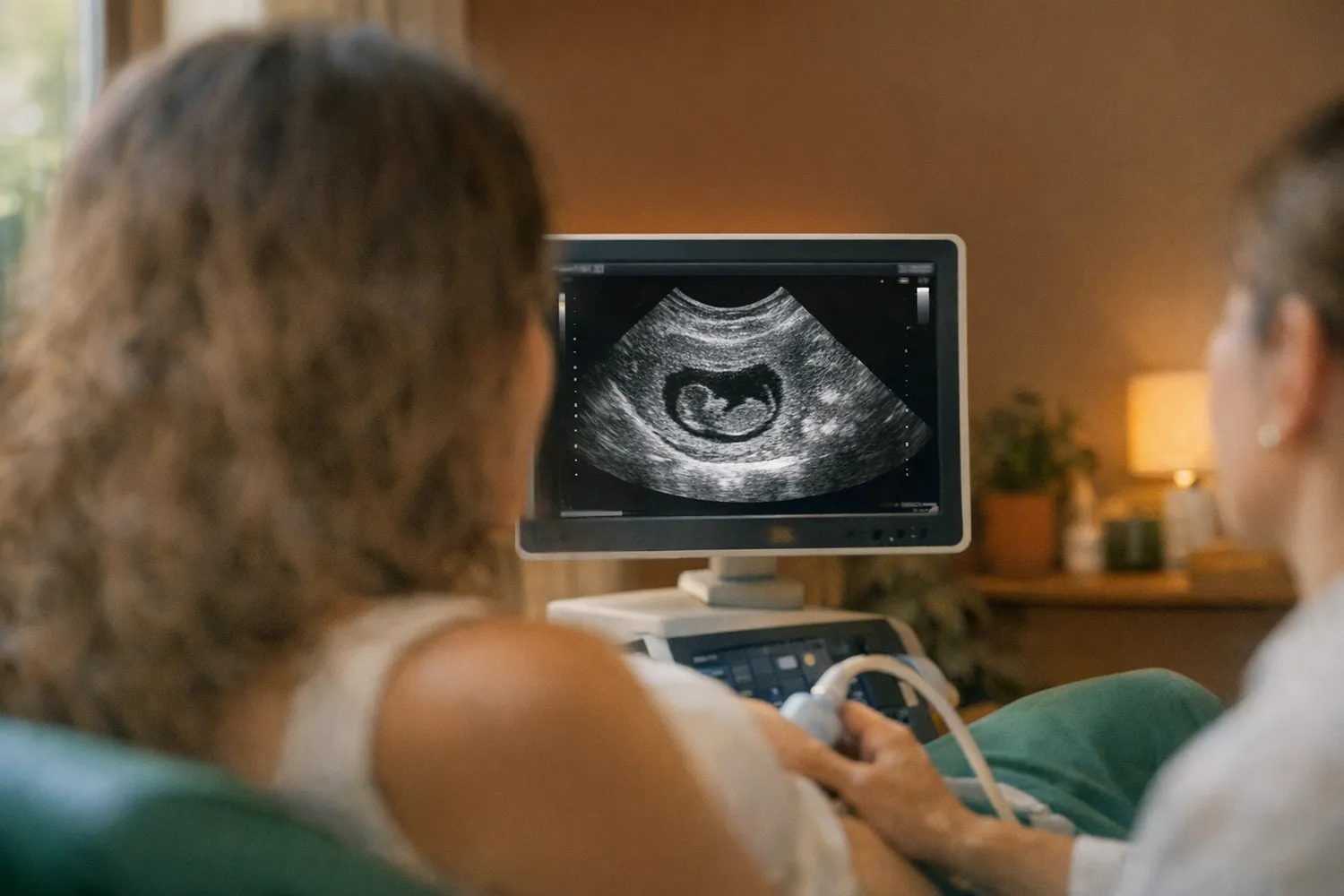
On ultrasound, the doctor counts the small follicles in both ovaries in the early phase of the cycle. Like AMH, the antral follicle count predicts the response to stimulation, but not a spontaneous pregnancy (ESHRE 2023, ASRM 2020). AMH is considered the more valid measure, and the two together do not improve the prediction in the individual case (DGGEF/DGRM/BVF). The ultrasound also shows abnormalities of the uterus and ovaries.
Cycle hormones, progesterone, thyroid, and prolactin
FSH, LH, and estradiol in the early phase of the cycle mainly help to interpret cycle disorders. Progesterone in the second half of the cycle shows whether ovulation has taken place (ASRM 2021) and, according to the DACH guideline (2026), is ideally measured 7 days after the presumed ovulation.
For thyroid and prolactin, the guidelines are inconsistent. The DACH guideline (2026) counts both as part of the baseline: TSH should be measured in all women with infertility, and fT4 and TPO antibodies only when TSH is above 4 mU/l. The guideline of the American Thyroid Association (ATA, 2026), which ESHRE and the European Thyroid Association co-endorse, also provides for TSH testing in all women with infertility. ASRM, by contrast, recommends TSH only when there are signs of a thyroid disorder, such as an irregular cycle (2024). ESHRE recommends TSH as good practice before pregnancy but advises against prolactin testing in unexplained infertility. NICE provides for prolactin only with a cycle disorder or milk discharge from the breast, and for thyroid levels only with symptoms. Which values make sense for you is decided by your doctor based on your history.
Hormone testing for women: cost
For an evaluation of infertility, the health insurance fund pays in Germany. As a self-pay patient, FSH, LH, and TSH cost you €14.57 to €16.76 each in the lab under the German fee schedule for physicians, and estradiol, progesterone, and prolactin €20.40 to €23.46 each.
| Option (basis: FSH, LH, estradiol, prolactin, TSH) | Price | Basis, as of |
|---|---|---|
| Germany, under the fee schedule | €84.51 to €97.20 plus €5.36 blood draw | Example calculation, fee schedule |
| Germany, lab direct | €115.66 plus €5.00 blood draw | Labor Berlin, January 2026, our own sum |
| Germany, panel with 9 values including AMH | €272.23 incl. blood draw | Labor Berlin, January 2026 |
| Austria, private lab | €137.50 incl. blood draw, with progesterone €163.70 | synlab, January 2026 |
| Switzerland, under the Analysis List | CHF 83.30 incl. order fee, excluding blood draw and consultation | Federal Office of Public Health (FOPH), July 2026, our own sum |
At a fertility clinic: the complete evaluation
A fertility clinic examines both partners, including fallopian tube testing and semen analysis. Here, AMH and AFC mainly serve to plan a stimulation. In Germany, diagnostics with a referral are covered by the insurance fund. According to their own statements, some clinics bill HyCoSy privately. You can find clinics near you in our clinic directory.
Fallopian tube testing: HSG, HyCoSy, or laparoscopy
Three procedures check whether the fallopian tubes are open:
- HSG (hysterosalpingography): an X-ray exam with an iodine-containing contrast agent.
- HyCoSy or HyFoSy: ultrasound with contrast agent or contrast foam, without radiation, as an outpatient procedure and without anesthesia.
- Laparoscopy with chromopertubation: a procedure under general anesthesia that shows the fallopian tubes and pelvis at the same time.
ESHRE considers HSG and HyCoSy diagnostically comparable, and the WHO (2025) recommends HSG or HyCoSy when a tubal disease is suspected. NICE recommends HSG for women without known comorbidities such as endometriosis. The DACH guideline (2026) recommends HyCoSy when there is no suspicion of a blockage and no additional reason such as an infection, endometriosis, or a previous ectopic pregnancy, and otherwise a laparoscopy with hysteroscopy. ESHRE and ASRM do not recommend laparoscopy as a routine test.
Data box: HyFoSy or HSG?
In the Dutch FOAM study, 1,026 women aged 18 to 41 underwent both tests as part of their infertility evaluation. The calculated live birth rate within 12 months was 46% when further management was based on HyFoSy, and 47% when it was based on HSG (van Welie 2022). The values are comparable. However, it could not be shown statistically that HyFoSy performs no worse. HyFoSy was more often inconclusive (9.5% versus 2.9%), but it was less painful and cheaper: in the Netherlands it cost €136, and HSG cost €280 (Kamphuis 2024). This applies to the foam variant, not automatically to every HyCoSy.
We found no published price for HSG in Germany, Austria, or Switzerland. The HyCoSy costs are in the cost section.
What the results can mean
The results belong in a conversation with a doctor, together with your partner's results. In up to 30% of couples, no precise cause is found (familienplanung.de). Our guide to infertility explains the possible causes and what can come next. If the fallopian tubes are blocked, IVF is an option because fertilization takes place outside the body. When sperm quality is reduced, ICSI can be considered. Our guide to assisted reproduction gives an overview.
Before stimulation, AMH helps with planning. In the 2024 annual report of the German IVF Registry (Deutsches IVF-Register, D.I.R.), an average of 4.62 eggs were retrieved per fresh cycle at AMH below 1 ng/ml, and 12.38 at AMH above 3.5 ng/ml (42,572 fresh IVF and ICSI cycles). Women with AMH below 1 ng/ml were on average older (37.6 versus 33.4 years). The registry does not show how well AMH predicts in an individual case. You can find registry data by age in the IVF Calculator, and help finding a clinic in our Fertility Clinic Finder.
Fertility test for women: cost in Germany, Austria, and Switzerland
The cost depends mainly on the reason for testing: for an evaluation of infertility, the insurance fund in Germany pays for the exams, according to the practices often with the exception of HyCoSy. You pay for a check without a specific reason yourself. There is no separate fee schedule item for AMH, and labs bill through different bundled items, which is why prices vary. Our example calculations use the fee schedule point value of 5.82873 cents, with a multiplier of 1.0 to 1.15 for lab values and 2.3 for medical services. Practices may calculate differently. A new fee schedule is planned but not yet in force. The prices for hormone testing are above under Hormone testing for women: cost.
Costs in Germany
| Service | Price | Source, as of |
|---|---|---|
| AMH, lab price only | €29.15 to €50.28 depending on the lab and billing | Lab price lists, December 2024 to May 2026 |
| AMH at the gynecologist as an IGeL, with counseling and blood draw | about €45 to €66, plus a shipping fee if applicable (example: €5.10) | Example calculation, fee schedule |
| AMH direct from the lab | €59.82 plus €5.00 blood draw | Labor Berlin, January 2026 |
| At-home AMH test by mail | €50 to €89 | Manufacturer prices, October 2026 |
| Ultrasound of the uterus and ovaries | about €68.36, with counseling and exam about €100.53 | Example calculation, fee schedule |
| HyCoSy | €295 plus contrast foam (private center in Munich, March 2025) or about €320 (MVZ Kinderwunsch, undated) | Practice information |
| HSG | no published price found | |
| Initial consultation with diagnostics, private center | €470 to €550 | Private center in Munich, October 2026 |
| Ovulation test, digital | €57.95 for 20 tests (pharmacy retail price) | Retailer information, October 2026 |
Costs in Austria
| Service | Price | Source, as of |
|---|---|---|
| AMH at a private lab, with blood draw | €59.50 incl. 10% VAT | synlab, January 2026 |
| AMH for infertility at a hospital lab | €90 out of pocket | Kepler University Hospital Linz, from June 2025 |
| Gynecological evaluation for self-pay patients | €185.46 per quarter | Kepler University Hospital Linz |
| Initial consultation at a fertility clinic | free of charge, €134, or €168 (examples) | LKH Feldkirch, Kinderwunschklinik Wels (October 2026), Next Fertility (from April 2025) |
| HyCoSy | €185.46, €295, or from €450 (examples) | Kepler Linz, Kinderwunschklinik Wels (October 2026), Santé Femme Wien |
Costs in Switzerland
| Service | Price | Source, as of |
|---|---|---|
| AMH as a lab service | CHF 54.90 | Zetlab, October 2026 |
| Fertility panel at a walk-in lab | CHF 284.30 incl. fees | Walk-in lab Zurich, October 2026 |
| Consultation with ultrasound, self-pay | CHF 250 | Admira, October 2026 |
| HyCoSy, HSG | no published price found |
Since January 1, 2026, Swiss practices bill outpatient care through TARDOC and outpatient flat rates (ambulante Pauschalen). We have not yet found typical costs for an initial consultation for an infertility evaluation under this system.

Does health insurance pay?
The pattern is similar in all three countries: the evaluation of infertility is covered by insurance, a check without a specific reason is not. There are exceptions for AMH and HyCoSy.
| Germany | Austria | Switzerland | |
|---|---|---|---|
| Evaluation of infertility | Covered by the insurance fund, in full | Hormones and ultrasound usually through a doctor contracted with the insurance fund | Basic health insurance, with deductible and co-insurance |
| AMH | Billable when medically necessary, an IGeL without a specific reason | Usually paid out of pocket when trying to conceive | Not listed by name in the Analysis List, decided case by case |
| HyCoSy | Often private according to the practices | According to clinics, not covered by insurance | not documented |
Germany
The statutory health insurance funds pay in full for exams to find the cause of a pregnancy that does not occur (familienplanung.de, January 2026, Section 27, paragraph 1 of Book V of the German Social Code, SGB V). Marriage and age limits apply only to assisted reproduction. The often-cited 12 or 6 months are a medical recommendation, not an insurance rule.
AMH has no item of its own in the EBM, the fee catalog of the statutory insurance funds, but it can be billed through a bundled item when medically necessary. The lab Dr. Wisplinghoff, by contrast, states that the insurance funds do not reimburse AMH when you are trying to conceive. Without a specific reason, AMH is an individual health service (Individuelle Gesundheitsleistung, IGeL), and the practice must inform you of its costs in text form beforehand (Section 630c, paragraph 3 of the German Civil Code, BGB). If you are privately insured, check your plan. More on treatment: insurance coverage and deducting fertility costs from your taxes.
Austria
Hormone levels and ultrasound usually go through a doctor contracted with the insurance fund (Kassenarzt). In the private price list of a large lab, AMH is marked as a service that the insurance fund does not cover. We did not find an explicit rule of the Austrian Health Insurance Fund on basic diagnostics, so if in doubt, ask your insurance fund. With a private doctor (Wahlarzt), you get 80% of the insurance fund tariff back (Section 131, paragraph 1 of the General Social Insurance Act, Allgemeines Sozialversicherungsgesetz, ASVG), and nothing for services without an insurance fund tariff, such as HyCoSy. The IVF Fund (IVF-Fonds) does not pay for the diagnostics itself.
Switzerland
Counseling and diagnostics for infertility are mandatory benefits of basic health insurance, with a deductible (franchise) of at least CHF 300 and 10% co-insurance up to a maximum of CHF 700 per year. AMH is not listed by name in the Analysis List (Analysenliste) of July 1, 2026, and the insurer decides case by case. For treatment, insemination (IUI) is a mandatory benefit with a maximum of three cycles per pregnancy, while IVF is not. You can roughly estimate the costs of a treatment with our cost calculator.
When should you get tested?
Most couples get pregnant without treatment. According to NICE, of couples who have regular intercourse without contraception, 86% become pregnant within one year if the woman is 30 to 34 years old, and 82% if she is 35 to 39. After two years, the figures are 94% and 90%. Fertility drops noticeably after 35 and at 40 is about half as high as in the late 20s or early 30s (ASRM 2022). You can find figures for each year of age in the article Getting pregnant over 40.
The professional societies give these timings for an evaluation:
- Under 35: if no pregnancy has occurred after 12 months of regular, unprotected intercourse (ASRM 2021, DACH guideline 2026).
- 35 and older: after 6 months (ASRM 2021, familienplanung.de). The DACH guideline (2026) names 6 months for women over 35.
- 36 and older: NICE recommends referring women who want to get pregnant to specialists as early as the first appointment.
- Over 40: immediate evaluation at a reproductive medicine center (DACH guideline 2026). According to ASRM, a faster evaluation may be warranted.
An earlier evaluation makes sense if there are signs of a cause, such as an irregular cycle or known endometriosis. If you are not trying to conceive, the professional societies advise against a fertility check (DGGEF/DGRM/BVF 2014, ASRM 2020). ACOG encourages gynecologists to provide anticipatory counseling about the decline in fertility as part of routine care (2025).
Many couples still get pregnant even after a year without a pregnancy: according to a model calculation with 782 couples from 7 European centers, the figure is 43% to 63% in the second year, depending on age (Dunson 2004). An evaluation can still find treatable causes.
What about your partner?
An evaluation always concerns both partners. For the man, the basic test is the semen analysis. His age also plays a role: for women aged 35 to 39, the estimated share of couples without a pregnancy after 12 cycles was between 18% and 28%, depending on the man's age (Dunson 2004, 782 couples from 7 European centers). Which tests exist for men, from the home test to the andrologist, is covered in our guide Fertility test for men. What a semen analysis costs and when the insurance fund pays is covered in the article Semen analysis cost.
Frequently asked questions
How much does a fertility test at the gynecologist cost?
For an evaluation of infertility, the health insurance fund pays in Germany. As a self-pay service, an AMH test with counseling and blood draw costs about €45 to €66, an ultrasound about €68, and a hormone panel of five values €84.51 to €97.20 plus blood draw (example calculations under the German fee schedule for physicians, as of October 2026).
Can a gynecologist tell whether you are still fertile?
Not with a single test. A gynecologist can check whether ovulation is occurring, whether there is a treatable cause, and roughly how large the ovarian reserve is. AMH and ultrasound do not, however, predict a spontaneous pregnancy (NICE 2026, ACOG 773).
When should you get a fertility test?
Professional societies recommend an evaluation after 12 months without a pregnancy, and after 6 months from age 35 (ASRM 2021; DACH guideline 2026: over 35). For women over 40, the DACH guideline recommends immediate evaluation at a reproductive medicine center. According to NICE, women who want to get pregnant should be referred to specialists at the first appointment from age 36. With cycle disorders or known pre-existing conditions, an earlier appointment makes sense. If you are not trying to conceive, the professional societies advise against a check.
How much does an AMH test cost?
In Germany, AMH costs €29.15 to €50.28 in the lab, depending on billing, about €45 to €66 at the gynecologist with counseling and blood draw (example calculation under the German fee schedule for physicians), and €50 to €89 as a home test. In Austria, you pay €59.50 at a private lab including blood draw, and in Switzerland CHF 54.90 as a lab service (prices retrieved in October 2026).
How is fertility tested in a woman?
An evaluation checks several areas: ovulation through cycle and hormones, ovarian reserve through AMH and ultrasound, the uterus on ultrasound, and the fallopian tubes by HyCoSy, HSG, or laparoscopy. For the partner, a semen analysis is added. There is no single test that measures fertility as a whole.
Are ovulation tests reliable?
For their purpose, finding the fertile days, they are well studied. According to a 2023 Cochrane review, having intercourse after an ovulation test probably increases the live birth rate in women under 40 in the first 12 months. Ovulation tests say nothing about ovarian reserve, fallopian tubes, or sperm.
What does a fertility test for women cost?
The cost of a fertility test for women depends mainly on the route. A digital ovulation test costs, for example, €57.95 for 20 tests (pharmacy retail price), an at-home AMH test €50 to €89, and a panel with nine lab values direct from the lab €272.23. For an evaluation of infertility, the insurance fund in Germany pays, but according to practices often not for HyCoSy (from €295 plus contrast foam).
How informative are at-home fertility tests?
An ovulation test shows the fertile days, nothing more. At-home AMH tests estimate the ovarian reserve, but finger-prick values are not always as high as venous blood values (Lavadia 2026). Even a correctly measured AMH value does not predict a pregnancy.
Does the pill affect the AMH level?
Yes. In women using the combined pill, AMH was on average 19% (Birch Petersen 2015) to 31.1% (Landersoe 2020) lower in studies, and 35.6% lower with the minipill. For the vaginal ring, the data are inconsistent, and for the hormonal IUD no clear effect was seen. After stopping the pill, AMH rose and reached a plateau after about two months (Landersoe 2020, 68 women).
Does fallopian tube testing hurt?
Many women feel period-like pain (familienplanung.de). In the FOAM study, the ultrasound variant with foam was less painful than HSG, 3.1 versus 5.4 points on a pain scale. HyCoSy takes place as an outpatient procedure and without anesthesia, while laparoscopy is always done under general anesthesia.
Sources
Guidelines and statements
- NICE guideline NG257: Fertility problems, assessment and treatment, recommendations 1.18.2 to 1.18.15, National Institute for Health and Care Excellence, March 31, 2026
- NICE NG257: Initial advice to people concerned about delays in conception, recommendation 1.4.1 and Table 1, NICE, March 31, 2026
- NICE NG257: Defining infertility and initial assessment, recommendation 1.16.8, NICE, March 31, 2026
- Romualdi D et al.: Evidence-based guideline: unexplained infertility, Hum Reprod 2023;38(10):1881-1890, ESHRE, 2023
- Press release on AMH testing, ESHRE, July 29, 2024
- ESHRE Guideline Ovarian Stimulation for IVF/ICSI, Update 2025, Hum Reprod 2026;41(4):498-514, ESHRE, 2025
- Testing and interpreting measures of ovarian reserve, Fertil Steril 2020;114:1151-1157, ASRM Practice Committee, 2020
- Fertility evaluation of infertile women, Fertil Steril 2021;116:1255-1265, ASRM Practice Committee, 2021
- Optimizing natural fertility, Fertil Steril 2022;117(1):53-63, ASRM Practice Committee, 2022
- Committee Opinion No. 773: The Use of Antimullerian Hormone in Women Not Seeking Fertility Care, ACOG, April 2019
- Committee Statement No. 22: Anticipatory Counseling Regarding Ovarian-Factor Fertility Decline, ACOG, November 2025
- Nawroth F et al.: Assessment of ovarian reserve and fertility with increasing age, joint statement of DGGEF, DGRM, and BVF, J Reproduktionsmed Endokrinol 2014;11(1):6-11
- Diagnostics and therapy before medically assisted reproduction treatment, S2k guideline AWMF 015-085, version 2.0, DGGG, OEGGG, and SGGG, as of April 2026
- WHO guideline on the prevention, diagnosis, and treatment of infertility, Hum Reprod 2026;41(1):25-38, WHO, online November 28, 2025
- American Thyroid Association 2026 Guidelines for Thyroid Disease in Preconception, Pregnancy, and Postpartum, Thyroid 2026;36(5):481-544 (Korevaar et al.), co-endorsed by ESHRE and ETA
- Subclinical hypothyroidism in the infertile female population: a guideline, Fertil Steril 2024;121:765-782, ASRM Practice Committee, 2024
Studies and registries
- Steiner AZ et al.: Association Between Biomarkers of Ovarian Reserve and Infertility Among Older Women of Reproductive Age, JAMA 2017;318(14):1367-1376
- Gibbons T et al.: Timed intercourse for couples trying to conceive, Cochrane Database Syst Rev 2023;9:CD011345, Cochrane, September 2023
- van Welie N et al.: HyFoSy versus HSG in the infertility evaluation (FOAM study), Hum Reprod 2022;37(5):969-979
- Kamphuis D et al.: Hysterosalpingo-foam sonography versus hysterosalpingography during fertility work-up, economic evaluation (FOAM), Hum Reprod 2024;39(6):1222-1230
- Birch Petersen K et al.: Ovarian reserve assessment in users of oral contraception seeking fertility advice on their reproductive lifespan, Hum Reprod 2015;30(10):2364-2375
- Landersoe SK et al.: Ovarian reserve markers in women using various hormonal contraceptives, Eur J Contracept Reprod Health Care 2020
- Landersoe SK et al.: Ovarian reserve markers after discontinuing long-term use of combined oral contraceptives, Reprod Biomed Online 2020;40(1):176-186
- Hadlow N et al.: Quantifying the intraindividual variation of antimullerian hormone in the ovarian cycle, Fertil Steril 2016;106:1230-1237
- de Kat AC et al.: A quantitative comparison of anti-Müllerian hormone measurement and its shifting boundaries between two assays, Maturitas 2017;101:12-16
- Lavadia CMM et al.: Comparison of serum AMH concentrations measured in capillary fingerstick and venous samples from Korean reproductive-aged women, Clin Exp Reprod Med 2026
- Burke EE et al.: Concordance of Fingerstick and Venipuncture Sampling for Fertility Hormones, Obstet Gynecol 2019;133(2):343-348, manufacturer-funded
- Vasavan T et al.: Systematic Reduction in Estradiol and Testosterone Measurements due to Serum Separator Gel in Blood Collection Tubes, J Appl Lab Med 2025;10(4):779-792
- Johnson A et al.: Websites Selling Direct-to-Consumer Anti-Müllerian Hormone Tests, JAMA Netw Open 2023;6(8):e2330192
- Dunson DB et al.: Increased infertility with age in men and women, Obstet Gynecol 2004;103(1):51-56
- German IVF Registry: 2024 Annual Report, p. 12, D.I.R., data as of April 16, 2025
Consumer information
- DGE advises against hormone self-tests, press release, German Society for Endocrinology, October 30, 2024
- Cycle apps tested, Stiftung Warentest, September 28, 2023
- Fertility: tests in women, familienplanung.de (Federal Institute for Public Health), January 7, 2026
- Fertility treatment: what is allowed and who bears the costs?, familienplanung.de (Federal Institute for Public Health), January 7, 2026
- How long does it take to get pregnant?, familienplanung.de (Federal Institute for Public Health), January 7, 2026
Law and billing, Germany
- Section 27 SGB V, Federal Ministry of Justice, retrieved October 3, 2026
- Section 630c BGB, Federal Ministry of Justice, retrieved October 3, 2026
- German Fee Schedule for Physicians, Federal Ministry of Justice, last amended July 19, 2023, retrieved October 3, 2026
- 2026 revision of the fee schedule, updated draft to the Federal Ministry of Health, PVS Westfalen, August 2026
- EBM item 32361, secondary presentation on diego.one, retrieved October 3, 2026
- IGeL anti-Müllerian hormone, Labor Dr. Wisplinghoff, retrieved October 3, 2026
Prices, Germany
- Price list IGeL/private, Labor Leipzig, December 10, 2024
- Price list IGeL, MVZ Labor Ravensburg, May 2026
- Lab information: ovarian (residual) function, synlab MVZ lab Munich Center, April 2026
- Individual health services, MVZ Dr. Stein + Kollegen, valid from March 2026
- Anti-Müllerian hormone, diagnostics app, Bioscientia, retrieved October 3, 2026
- Mein Labor: price list, MVZ Labor Berlin, January 2026
- Costs, Kinderwunschzentrum Ludwigsburg, retrieved October 3, 2026
- Costs, fertility center in Munich (kinderwunschaerztin.de), retrieved October 3, 2026
- HyCoSy Munich, costs, kinderwunschaerztin.de, March 12, 2025
- Tubal patency testing, MVZ Kinderwunsch, undated
Prices and insurance, Austria
- Private tariffs, synlab Austria, January 2026
- AMH request form, Kepler University Hospital Linz, valid from June 26, 2025
- Costs of evaluation for self-pay patients, Kinderwunsch Zentrum Kepler University Hospital Linz, undated
- Section 131 ASVG, Federal Legal Information System (RIS), version from January 1, 2020
- Costs, Kinderwunschklinik Dr. Pavlik Wels, October 2026
- HyCoSy, Kinderwunschklinik Dr. Pavlik Wels, retrieved October 3, 2026
- Costs, Next Fertility, valid from April 1, 2025
- Fertility center: services, LKH Feldkirch, retrieved October 3, 2026
- HyCoSy, Santé Femme Wien, undated
- We would like a baby (IVF Fund), Austrian Ministry of Social Affairs, July 2020
Prices and insurance, Switzerland
- Analysis List (KLV Annex 3), Federal Office of Public Health (FOPH), July 1, 2026
- KLV Annex 1, reproductive medicine, Federal Department of Home Affairs, July 1, 2026
- Cost sharing in health insurance, FOPH, retrieved October 3, 2026
- TARDOC and outpatient flat rates, FOPH, retrieved October 3, 2026
- Anti-Müllerian hormone (AMH), Zetlab, retrieved October 3, 2026
- Fertility check, Walk-in lab Zurich, retrieved October 3, 2026
- Costs, Admira fertility center, retrieved October 3, 2026
- Fertility center: costs, Inselspital Bern, retrieved October 3, 2026
- Fertility treatments, legal situation and costs (fact sheet), 360° Kinderwunsch Zentrum Zurich, March 13, 2025
At-home tests and ovulation tests
- Prices of at-home AMH tests and ovulation tests: our own survey of manufacturer and retailer websites in Germany, Austria, and Switzerland, retrieved October 3, 2026. We deliberately do not name providers.