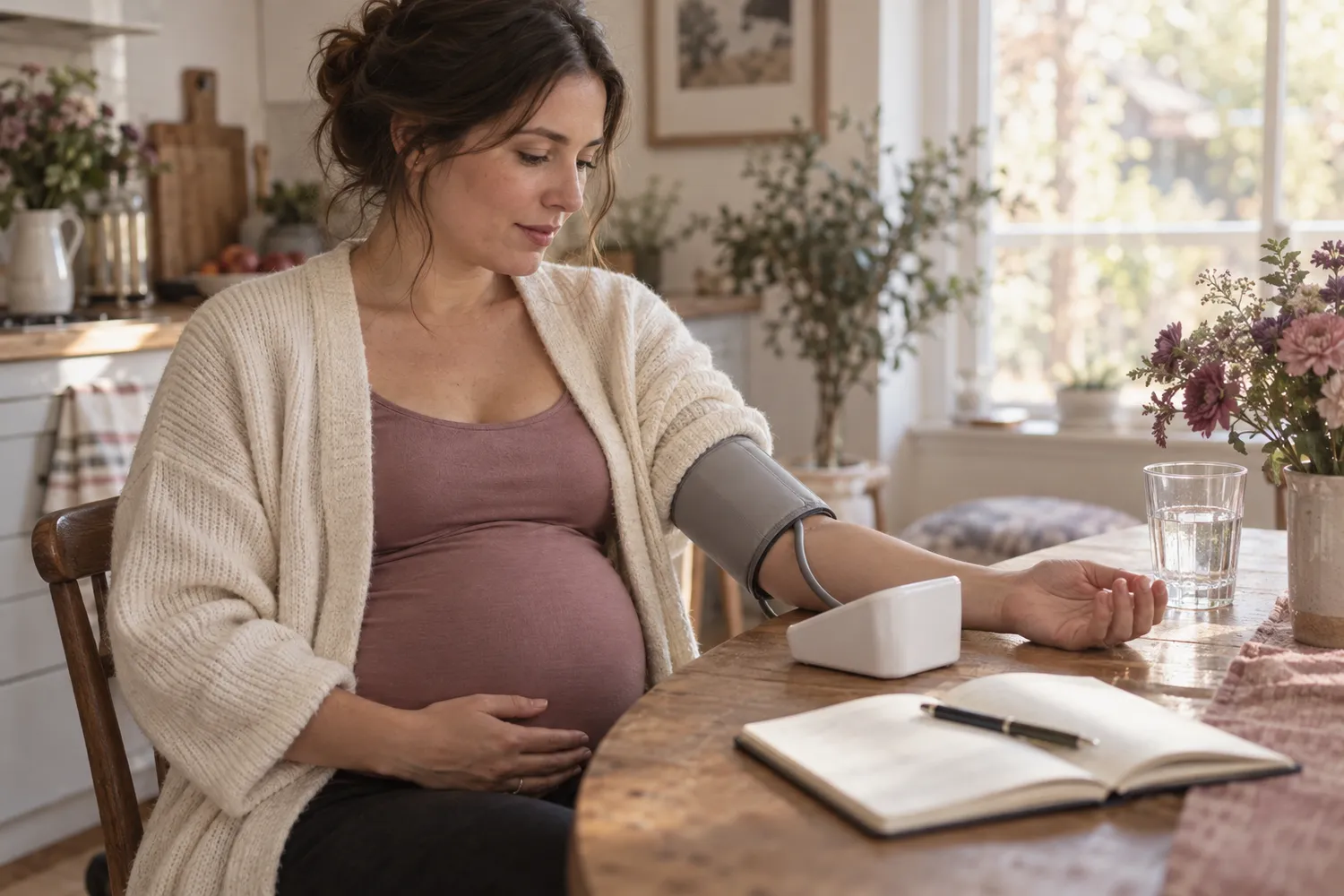
Pre-eclampsia usually starts quietly: your blood pressure rises, protein appears in your urine, and you notice nothing. That is why your blood pressure and urine are checked at every antenatal appointment. Here you can read about the signs of pre-eclampsia, which blood pressure readings are serious, who is at higher risk, how you can prevent it and what matters after the birth.
Go to hospital straight away or call 999 (UK) or your local emergency number if you are pregnant or gave birth a few weeks ago and have any of these: a severe headache that does not go away with simple painkillers, vision problems such as flickering or flashing lights, pain below the ribs, especially on the right, sudden swelling of your face, hands or feet, vomiting in the second half of pregnancy, shortness of breath or a seizure (NHS 2026).
What is pre-eclampsia?
Pre-eclampsia is a condition that only develops in pregnancy. After week 20, your blood pressure rises to 140/90 mmHg or higher, and there are also signs that an organ is affected (WHO 2026). The classic sign is protein in the urine (proteinuria). Under the 2024 German guideline, another sign can count instead of protein in the urine, for example changed liver or kidney values, a low platelet count, neurological symptoms, a baby that is growing too slowly or a raised result in the sFlt-1/PlGF blood test (DGGG 2024).
The old name toxaemia of pregnancy is misleading: nothing is poisoned. The term gestosis is also still used.
High blood pressure in pregnancy: the types
| Type | What it means |
|---|---|
| Chronic hypertension | was already present before pregnancy or before week 20 |
| Gestational hypertension | new high blood pressure from week 20, without organ involvement |
| Pre-eclampsia | new high blood pressure from week 20 with protein in the urine or other organ involvement |
| Superimposed pre-eclampsia | pre-eclampsia on top of existing high blood pressure |
| HELLP syndrome | severe form with breakdown of red blood cells, raised liver enzymes and a low platelet count |
| Eclampsia | seizures with pre-eclampsia, an emergency |
How common is pre-eclampsia?
Worldwide, pre-eclampsia affects 3 to 8 in 100 women who have a baby (WHO 2026). A large review estimated 4.6 in 100 births (Abalos 2013). High blood pressure disorders in pregnancy cause about 16 in 100 maternal deaths worldwide, around 42,000 women in 2023 (WHO 2026). In countries with good antenatal care, such as Germany, outcomes like this are very rare, because the condition is detected and treated early.
Pre-eclampsia most often starts in the third trimester. If it develops before week 34, it is called early-onset pre-eclampsia. It is usually more severe.
Pre-eclampsia symptoms: how do you recognise it?
You usually cannot feel the first signs, high blood pressure and protein in the urine. They are picked up at your antenatal checks. That is why these appointments are so important (NHS 2026).
Later, these symptoms can appear:
- a severe headache that does not get better with simple painkillers
- vision problems: blurred vision, flickering, flashing lights
- pain below the ribs, often on the right, or in the upper abdomen
- heartburn that does not go away with antacids
- sudden swelling of the face, hands or feet
- nausea and vomiting in the second half of pregnancy
- feeling very unwell, restlessness, shortness of breath
Swollen feet in the evening are common in pregnancy and on their own are not a sign of pre-eclampsia. Pay attention if the swelling comes on suddenly, affects your face or hands, or if you gain a lot of weight within a few days.
What blood pressure is dangerous in pregnancy?
Blood pressure in pregnancy: what the readings mean
- under 140/90 Normalkeep checking at antenatal appointments
- 140/90 to 159/109 High blood pressureif measured several times: contact your midwife or maternity unit the same day
- 160/110 or higher Severe high blood pressurego to hospital straight away, even without symptoms
If you measure at home, do it sitting down after five minutes of rest, on your upper arm, with your arm at heart level. If your reading is 140/90 mmHg or higher several times, call your midwife, your doctor or the maternity unit. At 160/110 mmHg or higher, go to hospital straight away.
Pre-eclampsia causes: how does it develop?
The exact cause is not known (NHS 2026). It starts in the placenta. In early pregnancy, the blood vessels of the womb normally remodel so that the placenta gets plenty of blood. If this does not work properly, the placenta has a poorer blood supply. It then releases substances into the mother's blood that damage the walls of blood vessels throughout the body. One of them is sFlt-1. The result is high blood pressure and damage to the kidneys, liver, brain and blood clotting.
Because the placenta is the cause, the condition only ends once the placenta has left the body after the birth.
Who is at higher risk of pre-eclampsia?
A large review of more than 25 million pregnancies measured how strongly individual risk factors act (Bartsch 2016):
How much risk factors raise the risk of pre-eclampsia
- Pre-eclampsia in a previous pregnancy 8.4 times
- High blood pressure before pregnancy 5.1 times
- Diabetes before pregnancy 3.7 times
- BMI over 30 before pregnancy 2.8 times
- Pregnancy after fertility treatment 1.8 times
Other risk factors are a first pregnancy, being 40 or older, pre-eclampsia in your mother or sister, a gap of ten years or more since your last pregnancy, kidney disease and autoimmune conditions such as lupus (NHS 2026). After fertility treatment, the risk is also slightly higher, as the chart shows.
Having a risk factor does not mean you will get pre-eclampsia. It means you will be monitored more closely and should talk to your midwife or doctor about aspirin.
First trimester screening for pre-eclampsia
Between weeks 11 and 14, the risk of early-onset pre-eclampsia can be calculated more precisely: from your blood pressure, the blood flow in the uterine arteries on ultrasound, the PlGF blood test and your risk factors. In Germany, this screening is not part of the services covered by the maternity guidelines (Mutterschafts-Richtlinien) and is usually paid for privately. The result is used to decide whether aspirin makes sense.
Can you prevent pre-eclampsia?
Low-dose aspirin is the most effective prevention if your risk is raised. In the ASPRE trial, women at high risk took 150 mg of aspirin every evening from weeks 11 to 14 until week 36. Pre-eclampsia before week 37 developed in 1.6 in 100 women on aspirin and in 4.3 in 100 on placebo (Rolnik 2017). A Cochrane review of 77 trials confirms that medicines such as aspirin lower the risk of pre-eclampsia by 18 percent, with no apparent harm to the baby (Duley 2019).
Only take aspirin in pregnancy if a doctor prescribes it. The dose and when to start are decided individually.
Calcium lowers the risk mainly in women who get little calcium from their diet (Hofmeyr 2018). The WHO therefore recommends it in regions with low calcium intake. If you eat dairy products regularly, you usually do not need a supplement. You can read more about diet in pregnancy in the guide What not to eat during pregnancy.
A healthy weight and exercise before and during pregnancy also lower the risk (NHS 2026). There is no evidence that vitamin C and E or cutting out salt prevent it.
Diagnosis: which tests are there?
- Blood pressure and urine: at every antenatal appointment, as set out in the German maternity guidelines (G-BA 2026).
- sFlt-1/PlGF blood test: if pre-eclampsia is suspected, the ratio of these two substances shows whether it is likely. With a ratio of 38 or below, 99.3 in 100 women in the PROGNOSIS study did not develop pre-eclampsia in the following week (Zeisler 2016). A high value does not mean pre-eclampsia for certain.
- Blood tests: liver, kidneys and platelets, to detect HELLP syndrome.
- Ultrasound and Doppler: the baby's growth, the amount of amniotic fluid and the blood flow in the umbilical cord.
- CTG: the baby's heartbeat.
Pre-eclampsia treatment

Pre-eclampsia can only be cured by the birth of the baby and the placenta (NHS 2026). Treatment has two aims: to protect you from complications and to give your baby as much time in the womb as is safely possible.
- Blood pressure medicines that have been tested in pregnancy, such as methyldopa, nifedipine or labetalol.
- Magnesium sulphate as a drip for severe pre-eclampsia: it halves the risk of seizures. In the Magpie trial with more than 10,000 women, 0.8 in 100 women on magnesium developed eclampsia, compared with 1.9 in 100 on placebo (Magpie 2002).
- Steroids to help the baby's lungs mature if birth before week 34 is likely (WHO 2026).
- Monitoring in hospital for severe pre-eclampsia, often in a perinatal centre with a neonatal intensive care unit.
When is the baby delivered?
| Week of pregnancy | Usual approach |
|---|---|
| from 37+0 | induce labour |
| 34+0 to 36+6 | monitor closely, deliver if things get worse |
| under 34+0 | steroids for lung maturity, monitoring, prolong the pregnancy as long as mother and baby are stable |
| at any time | immediate delivery with worsening HELLP, eclampsia, blood pressure that cannot be controlled, placental abruption or danger to the baby |
From week 37, induction is safer than waiting: in the HYPITAT trial, 31 in 100 women had a severe outcome after induction, compared with 44 in 100 after waiting (Koopmans 2009). Pre-eclampsia on its own is not a reason for a caesarean, and a vaginal birth is often possible.
HELLP syndrome and eclampsia
HELLP syndrome occurs in 0.5 to 0.9 in 100 pregnancies and in 10 to 20 in 100 women with severe pre-eclampsia (Haram 2009). The name stands for haemolysis (breakdown of red blood cells), elevated liver enzymes and low platelets. Typical signs are pain in the upper right abdomen, nausea and feeling very unwell. Blood pressure is not always very high. About 70 in 100 cases start before the birth and the rest in the first 48 hours afterwards (Haram 2009).
Eclampsia means seizures with pre-eclampsia. It is an emergency for mother and baby and is both prevented and treated with magnesium.
What does pre-eclampsia mean for the baby?
Because the placenta has a poorer blood supply, the baby gets less oxygen and fewer nutrients. It may grow too slowly. Many babies are born early, because birth is the only treatment (NHS 2026). Rarely, the placenta separates too early. That is why the baby is monitored with ultrasound, Doppler and CTG. The pages for each week of pregnancy show from which week a premature baby has a good chance.
Postpartum preeclampsia: after the birth
Pre-eclampsia can also start only in the days or weeks after the birth (NHS 2026). The warning signs are the same: a severe headache, vision problems, pain in the upper abdomen, shortness of breath. If you have these symptoms in the first six weeks after the birth, call your hospital straight away or call 999 (UK) or your local emergency number.
If you had pre-eclampsia in pregnancy, your blood pressure will continue to be checked after the birth. Some women need blood pressure medicine for a few more weeks (NHS 2026). Breastfeeding is possible with the usual medicines.
Long-term effects and your next pregnancy
Next pregnancy: about 14 in 100 women get pre-eclampsia again in their next pregnancy, and 18 to 21 in 100 develop some form of high blood pressure. The earlier the first pre-eclampsia was, the higher the risk. If it comes back, it is usually milder (van Oostwaard 2015). Aspirin from the first trimester can lower the risk.
Heart and circulation: after pre-eclampsia, the risk of high blood pressure later in life is about 3.7 times higher, the risk of heart attack and other heart conditions caused by poor blood flow 2.2 times higher and the risk of stroke 1.8 times higher (Bellamy 2007). So have your blood pressure, blood sugar and blood fats checked regularly, even years later. The review found no increased risk of cancer.
If you would like to get pregnant again after pre-eclampsia, it is best to talk to your doctor before you start trying. The ovulation calculator works out your fertile days, and the due date calculator your expected due date.
Frequently asked questions
In which week of pregnancy does pre-eclampsia start?
From week 20 at the earliest, most often in the third trimester. It can also start only in the days or weeks after the birth (WHO 2026, NHS 2026).
What is the difference between pre-eclampsia and eclampsia?
Pre-eclampsia is high blood pressure with organ involvement. Eclampsia means seizures that can occur with pre-eclampsia. Magnesium helps prevent them (Magpie 2002).
What causes pre-eclampsia?
A placenta with a poor blood supply that releases substances into the blood which damage the blood vessels. Why the placenta does not develop properly is not fully understood.
How long does postpartum preeclampsia last?
Blood pressure and symptoms usually improve in the days to weeks after the birth. Some women need blood pressure medicine for a few weeks (NHS 2026). If blood pressure is still high after three months, it counts as chronic hypertension.
Can I notice the signs of pre-eclampsia myself?
Usually not at the start, because high blood pressure and protein in the urine do not cause symptoms. Watch out for the warning signs above and go to all your antenatal appointments.
Is pre-eclampsia dangerous for the baby?
It can cause the baby to grow too slowly or to need to be born early. With good monitoring, most pregnancies with pre-eclampsia end well for mother and baby.
Does pre-eclampsia come back in the next pregnancy?
In about 14 in 100 women (van Oostwaard 2015). It is then usually milder, and aspirin from the first trimester can help prevent it.
Sources
Guidelines and fact sheets
- Hypertensive Erkrankungen in der Schwangerschaft (HES): Diagnostik und Therapie, S2k guideline 015-018, DGGG, OEGGG, SGGG, 2024
- Pre-eclampsia, Fact sheet, World Health Organization (WHO), 2026
- Pre-eclampsia, NHS, 2026
- Mutterschafts-Richtlinien (German maternity guidelines), Federal Joint Committee (G-BA), 2026
Studies
- Rolnik DL, Wright D, Poon LC et al.: Aspirin versus Placebo in Pregnancies at High Risk for Preterm Preeclampsia, N Engl J Med 2017;377:613-622
- Duley L, Meher S, Hunter KE et al.: Antiplatelet agents for preventing pre-eclampsia and its complications, Cochrane Database Syst Rev 2019;CD004659
- Zeisler H, Llurba E, Chantraine F et al.: Predictive Value of the sFlt-1:PlGF Ratio in Women with Suspected Preeclampsia, N Engl J Med 2016;374:13-22
- Bartsch E, Medcalf KE, Park AL, Ray JG: Clinical risk factors for pre-eclampsia determined in early pregnancy, BMJ 2016;353:i1753
- Magpie Trial Collaborative Group: Do women with pre-eclampsia, and their babies, benefit from magnesium sulphate?, Lancet 2002;359:1877-1890
- Koopmans CM, Bijlenga D, Groen H et al.: Induction of labour versus expectant monitoring for gestational hypertension or mild pre-eclampsia after 36 weeks' gestation (HYPITAT), Lancet 2009;374:979-988
- Hofmeyr GJ, Lawrie TA, Atallah ÁN, Torloni MR: Calcium supplementation during pregnancy for preventing hypertensive disorders and related problems, Cochrane Database Syst Rev 2018;CD001059
- van Oostwaard MF, Langenveld J, Schuit E et al.: Recurrence of hypertensive disorders of pregnancy, Am J Obstet Gynecol 2015;212:624.e1-17
- Bellamy L, Casas JP, Hingorani AD, Williams DJ: Pre-eclampsia and risk of cardiovascular disease and cancer in later life, BMJ 2007;335:974
- Haram K, Svendsen E, Abildgaard U: The HELLP syndrome: clinical issues and management, BMC Pregnancy Childbirth 2009;9:8
- Abalos E, Cuesta C, Grosso AL et al.: Global and regional estimates of preeclampsia and eclampsia, Eur J Obstet Gynecol Reprod Biol 2013;170:1-7