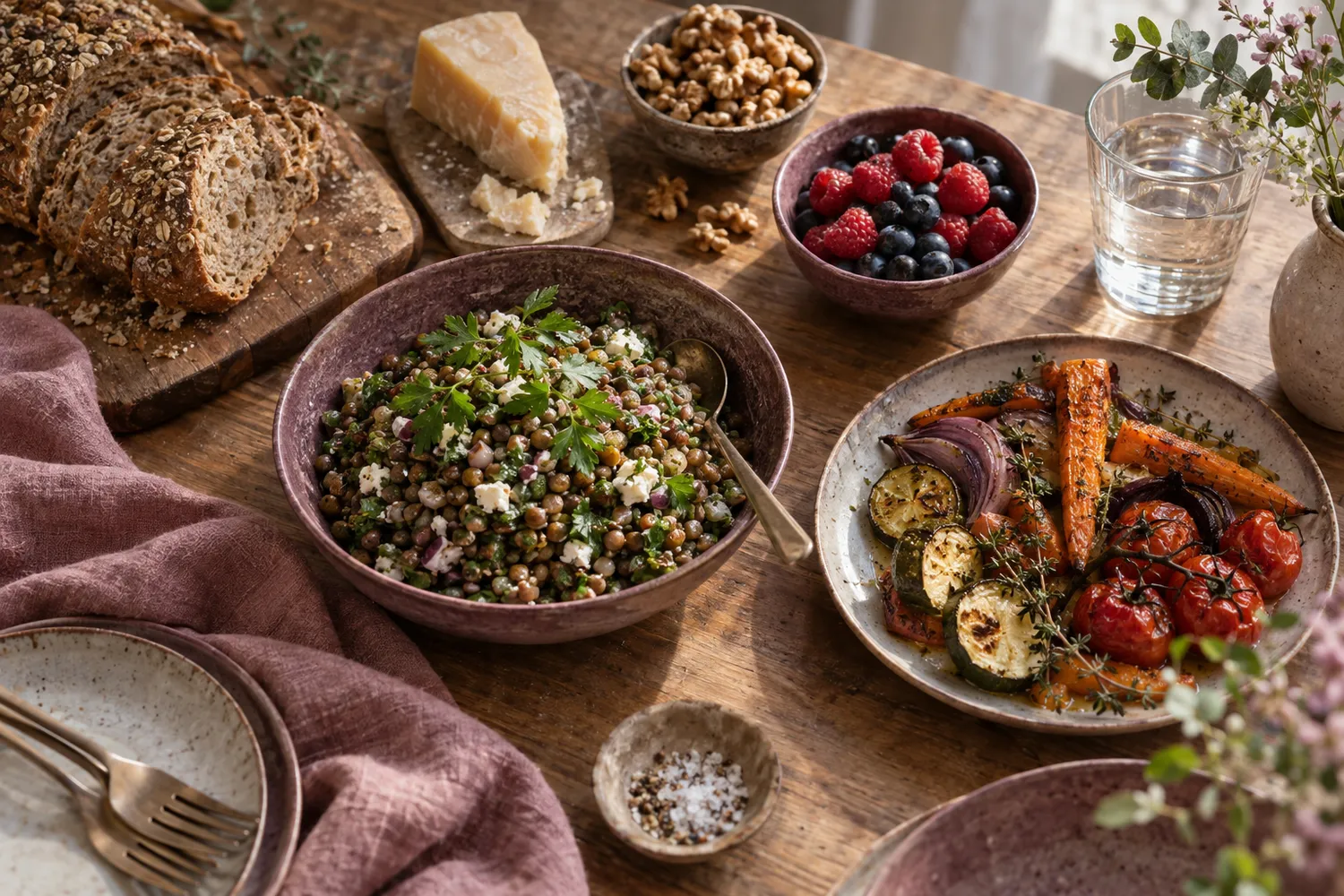
Can I eat mozzarella? And sushi, honey, tiramisu? Here you can look up over 60 foods, find the reason behind each rule, the nutrients you need in addition and how much more you really need to eat. The basis is the recommendations of the German Federal Institute for Risk Assessment (BfR) and the German network Gesund ins Leben (Healthy Start).
Data box: How common are food-borne infections?
In 2023, health authorities in Germany reported 26 cases of listeriosis in pregnant women, 25 in newborns and 15 children with congenital toxoplasmosis (RKI 2024). That is rare. But both infections can lead to miscarriage, premature birth or lasting harm to the baby, which is why the rules below apply throughout pregnancy.
Foods to avoid in pregnancy
You should avoid these foods or only eat them thoroughly cooked. Thoroughly cooked means at least 70 °C in the centre for at least two minutes (BfR).
- Raw meat: mett (raw minced pork), steak tartare, carpaccio, steak cooked pink
- Cured raw sausage: salami, Teewurst, fresh mettwurst, cervelat
- Cured raw ham: Parma ham, Serrano ham, lachsschinken (cured pork loin)
- Raw fish and seafood: sushi, sashimi, oysters, fish carpaccio
- Smoked fish and cured fish: smoked salmon, gravlax, smoked trout and mackerel
- Raw or soft eggs: tiramisu, chocolate mousse, fresh mayonnaise, eggs with a runny yolk
- Raw milk and raw milk cheese, except long-matured hard cheese
- Washed-rind soft cheese: Harzer, Limburger, Munster, Tilsiter, even if made from pasteurised milk
- Gorgonzola and other semi-soft blue cheeses
- Loose cheese: feta, mozzarella or herb quark from open containers and from the salad counter
- Raw sprouts and frozen berries, if they are not heated
- Liver from any animal
- Fish high in mercury: shark, swordfish, halibut, eel, and tuna only occasionally
- Alcohol, even in small amounts
- Drinks containing quinine: tonic water, bitter lemon
Why? Listeria, toxoplasma and salmonella
Listeria are bacteria that can multiply even in the fridge. Healthy adults often do not notice an infection or only have flu-like symptoms. In pregnancy, listeria can pass to the baby and cause miscarriage, premature birth or a serious infection in the newborn (BfR). They are found mainly in raw animal foods, smoked fish, washed-rind soft cheese, raw milk and ready-to-eat foods that were sliced or packed again after cooking.
Toxoplasma are parasites. They are found in raw meat, cured raw sausage and cured raw ham, and in soil, so on unwashed vegetables and in cat poo. If you have had toxoplasmosis before, you are usually protected. A first infection during pregnancy can harm the baby.
Salmonella can be found in raw eggs. They usually do not put the baby at direct risk, but a severe stomach bug with fever and a lot of fluid loss is hard on you in pregnancy.
Heat kills all three. So anything eaten piping hot is almost always fine: salami on a baked pizza, salmon from the oven, Camembert baked until hot.
Food list: can I eat this?
Type in a food and the list filters straight away: yes means safe, cooked only means only thoroughly cooked, limited means in small amounts, no means avoid in pregnancy.
62 of 62 foods
| Food | Allowed? | What to watch out for |
|---|---|---|
| Hard cheese (Parmesan, mature mountain cheese, aged Gouda) | yes | also from raw milk if long-matured; remove the rind |
| Semi-hard cheese from pasteurised milk (Gouda, Edam, Emmental) | yes | remove the rind |
| Mozzarella, pre-packed | yes | from pasteurised milk; not from open containers or the salad counter |
| Feta and sheep's cheese, pre-packed | yes | from pasteurised milk; not from open containers |
| Cream cheese and quark, pre-packed | yes | from pasteurised milk |
| Cottage cheese, ricotta, mascarpone, pre-packed | yes | from pasteurised milk |
| Camembert and Brie | cooked only | only baked or grilled until piping hot |
| Harzer, Limburger, Munster, Tilsiter | cooked only | washed-rind cheese, even if made from pasteurised milk |
| Gorgonzola and blue cheese | cooked only | only hot, for example in a cooked sauce |
| Raw milk cheese (soft or semi-soft) | cooked only | exception: long-matured hard cheese |
| Bagged grated cheese | cooked only | only for baking on top, not cold over a salad |
| Raw milk | cooked only | boil it first |
| Milk, yoghurt, butter (pasteurised) | yes | |
| Salami and cured raw sausage | cooked only | raw no; on a baked pizza yes |
| Teewurst, mettwurst, onion mett (spreadable raw pork sausages) | no | raw, spreadable, listeria and toxoplasma |
| Parma ham, Serrano ham, lachsschinken (cured pork loin) | cooked only | raw no; baked in the oven yes |
| Cooked ham | yes | freshly sliced; eat within 2 to 3 days of opening |
| Mett (raw minced pork), steak tartare, carpaccio | no | raw meat |
| Steak, burgers, roast beef | cooked only | cooked right through, no longer pink inside |
| Cooked sausages (frankfurters, Lyoner bologna-type sausage, bockwurst) | cooked only | safest piping hot; cold only fresh from a sealed pack |
| Liver sausage and pâté | no | liver; pâté only from a tin |
| Liver (beef, pork, poultry) | no | very high in vitamin A, risk of birth defects |
| Game | limited | not if shot with lead ammunition; no wild boar offal |
| Sushi and sashimi with raw fish | no | vegetarian sushi or sushi with cooked fish yes |
| Smoked salmon, hot-smoked salmon, smoked trout | cooked only | cold no; in the oven or in hot pasta yes |
| Gravlax, matjes, pickled herring (Bismarck herring) | no | cured or raw |
| Salmon, trout, cod, cooked | yes | oily fish 1 to 2 times a week for DHA and iodine |
| Tuna (tinned or fresh) | limited | high in mercury; only occasionally |
| Shark, swordfish, halibut, eel | no | high in mercury |
| Prawns and shrimps, pre-cooked | cooked only | heat them again before eating |
| Oysters and raw mussels | no | cooked mussels yes |
| Fish fingers | yes | cooked right through |
| Surimi (crab sticks) | cooked only | ready-to-eat fish product, safest piping hot |
| Eggs | cooked only | yolk and white firm; no soft-boiled egg with a runny yolk |
| Mayonnaise | yes | shop-bought from a jar; homemade with raw egg no |
| Tiramisu, chocolate mousse | no | usually made with raw egg; without egg or with a cooked cream yes |
| Homemade hollandaise, aioli, Caesar dressing | no | raw egg; shop-bought and pasteurised yes |
| Ice cream from an ice cream parlour | limited | avoid soft-serve and loose ice cream; pre-packed ice cream yes |
| Raw sprouts and shoots | cooked only | only heated thoroughly |
| Frozen berries | cooked only | heat thoroughly, for example as a compote; not raw in a smoothie |
| Fresh fruit and berries | yes | wash thoroughly |
| Vegetables and salad | yes | wash thoroughly, remove soil |
| Bagged ready-to-eat salad | no | pre-cut; better to cut your own |
| Pre-cut melon | no | if sold unchilled |
| Mushrooms | yes | cooked through; always cook enoki |
| Deli salads and antipasti from open containers | no | for example olives or coleslaw from the deli counter |
| Freshly squeezed juice and smoothies | limited | only homemade and drunk straight away |
| Honey | yes | allowed; only babies under 1 year should not have honey |
| Coffee | limited | up to 200 mg of caffeine a day, about 2 cups of filter coffee |
| Black and green tea | limited | contains caffeine, counts towards the 200 mg |
| Herbal tea | limited | vary the types; fennel tea not every day |
| Energy drinks | no | lots of caffeine, often with taurine and sugar |
| Cola | limited | about 35 mg of caffeine per glass (200 ml) |
| Tonic water, bitter lemon | no | contains quinine |
| Alcohol, including sparkling wine and alcohol-free beer with traces of alcohol | no | no safe limit |
| Liquorice | limited | no large amounts on a regular basis |
| Chocolate | yes | dark chocolate about 25 mg of caffeine per 50 g |
| Nuts and peanuts | yes | avoiding them does not prevent allergies |
| Linseed and chia seeds | yes | in normal amounts |
| Bread and rolls | yes | wholegrain provides fibre against constipation |
| Bakery cakes with cream or custard | limited | eat fillings that were not baked with the cake quickly |
| Plant-based alternatives (tofu, vegan sausages) | yes | treat like the animal product they replace, follow the manufacturer's instructions |
Nothing found. If in doubt: thoroughly cooked is almost always fine.
How much more should you eat in pregnancy?
Less than many people think. According to the German network Gesund ins Leben, most pregnant women do not need any extra energy (Gesund ins Leben 2026). The well-known guide values of 250 extra kilocalories in the second trimester and 500 in the third only apply to women of normal weight who are very active. Many women move less during pregnancy, which balances out the extra need. In Germany, 26 out of 100 women start pregnancy overweight and 19 out of 100 with obesity (Gesund ins Leben 2026).
So eating for two does not mean eating twice as much, but eating twice as well: more vegetables, wholegrains, pulses and dairy, less sugar and heavily processed food. Your need for vitamins and minerals rises much more than your need for calories.
| Weight before pregnancy | Recommended weight gain |
|---|---|
| Normal weight (BMI 18.5 to 24.9) | 10 to 16 kg |
| Overweight (BMI 25 to 29.9) | less than with normal weight |
| Obesity (BMI 30 or more) | 5 to 9 kg, or even less |
| Underweight (BMI under 18.5) | gain enough weight, discuss with your doctor |
In studies, weight gain within these ranges was linked to fewer complications for mother and baby. With obesity, a gain of less than 5 kg was not linked to growth problems in the baby, but to less pre-eclampsia and fewer caesarean sections (Gesund ins Leben 2026).
Which extra nutrients do you need?
In Germany, all pregnant women are advised to take two nutrients as tablets: folic acid and iodine. Others only in certain cases.
Which extra nutrients you need and when
- Folic acid400 µg a day from trying to conceive until the end of week 12
- Iodine100 to 150 µg a day throughout pregnancy and breastfeeding
- DHA (omega-3)200 mg a day throughout pregnancy
- Vitamin D20 µg (800 IU) a day especially in winter
- Vitamin B12supplement always, have your levels checked
- Ironbased on blood test if your antenatal check-ups show a deficiency
for all pregnant womenonly in certain cases
- Folic acid: 400 µg a day, ideally from the time you start trying for a baby and at least four weeks before pregnancy until the end of week 12. It lowers the risk of spina bifida. If you started later, Gesund ins Leben recommends 800 µg (Gesund ins Leben 2026). More on this in the guide Folic acid when trying to conceive.
- Iodine: 100 to 150 µg a day throughout pregnancy and breastfeeding. If you have a thyroid condition, talk to your doctor first (BfR).
- DHA (omega-3 fatty acid): 200 mg a day. You can get this from oily sea fish such as salmon, herring or mackerel once or twice a week. If you do not eat fish, take DHA as a supplement (Gesund ins Leben 2026).
- Vitamin D: 20 µg (800 IU) a day if you rarely get sun, especially in winter (Gesund ins Leben 2026).
- Iron: only if a blood test shows a deficiency. Your doctor or midwife checks this at your antenatal appointments (BfR).
- Vitamin B12: always as a supplement if you eat a vegan diet.
Which supplements contain which amounts is shown in the comparison of fertility supplements. An overview of all vitamins is in Vitamins when trying to conceive.
Coffee, tea and caffeine in pregnancy
According to EFSA, up to 200 mg of caffeine a day, spread over the day, is considered safe for the baby (Gesund ins Leben 2026). Coffee, tea, cola, energy drinks and chocolate all count together.
| Drink or food | Caffeine (approx.) |
|---|---|
| Filter coffee, 1 cup (200 ml) | 90 mg |
| Espresso, 1 cup (60 ml) | 80 mg |
| Energy drink, 1 can (250 ml) | 80 mg |
| Black tea, 1 cup (200 ml) | 45 mg |
| Cola, 1 glass (200 ml) | 35 mg |
| Green tea, 1 cup (200 ml) | 30 mg |
| Cocoa, 1 cup (200 ml) | 8 to 35 mg |
| Dark chocolate, 50 g | 25 mg |
| Milk chocolate, 50 g | 10 mg |
Values according to the BfR; the content varies a lot depending on the type and how it is made. So two cups of filter coffee or two espressos a day are within the limit.
Herbal tea is a good alternative, but vary the types and do not drink the same one every day. Some herbs contain pyrrolizidine alkaloids, and fennel tea contains estragole (Gesund ins Leben 2026). It is best to drink mainly water, about 1.5 litres a day.
Alcohol is off limits throughout pregnancy. There is no amount that is safe. Even small amounts can cause lasting damage to the baby's brain (BfR). This also applies while you are trying to get pregnant.
Vegetarian and vegan in pregnancy
A vegetarian diet with dairy and eggs can cover your need for most nutrients. On top of that come folic acid, iodine and DHA if you do not eat fish (BfR).
With a vegan diet, getting enough nutrients from food alone is not possible, says the BfR. If you want to stay vegan, you need advice from a qualified nutrition professional and, besides folic acid and iodine, further supplements, especially vitamin B12 and DHA. A lack of B12 can damage the baby's nervous system. Have your levels checked by a doctor, for example B12, iron, zinc and vitamin D.
Kitchen hygiene: how to protect yourself
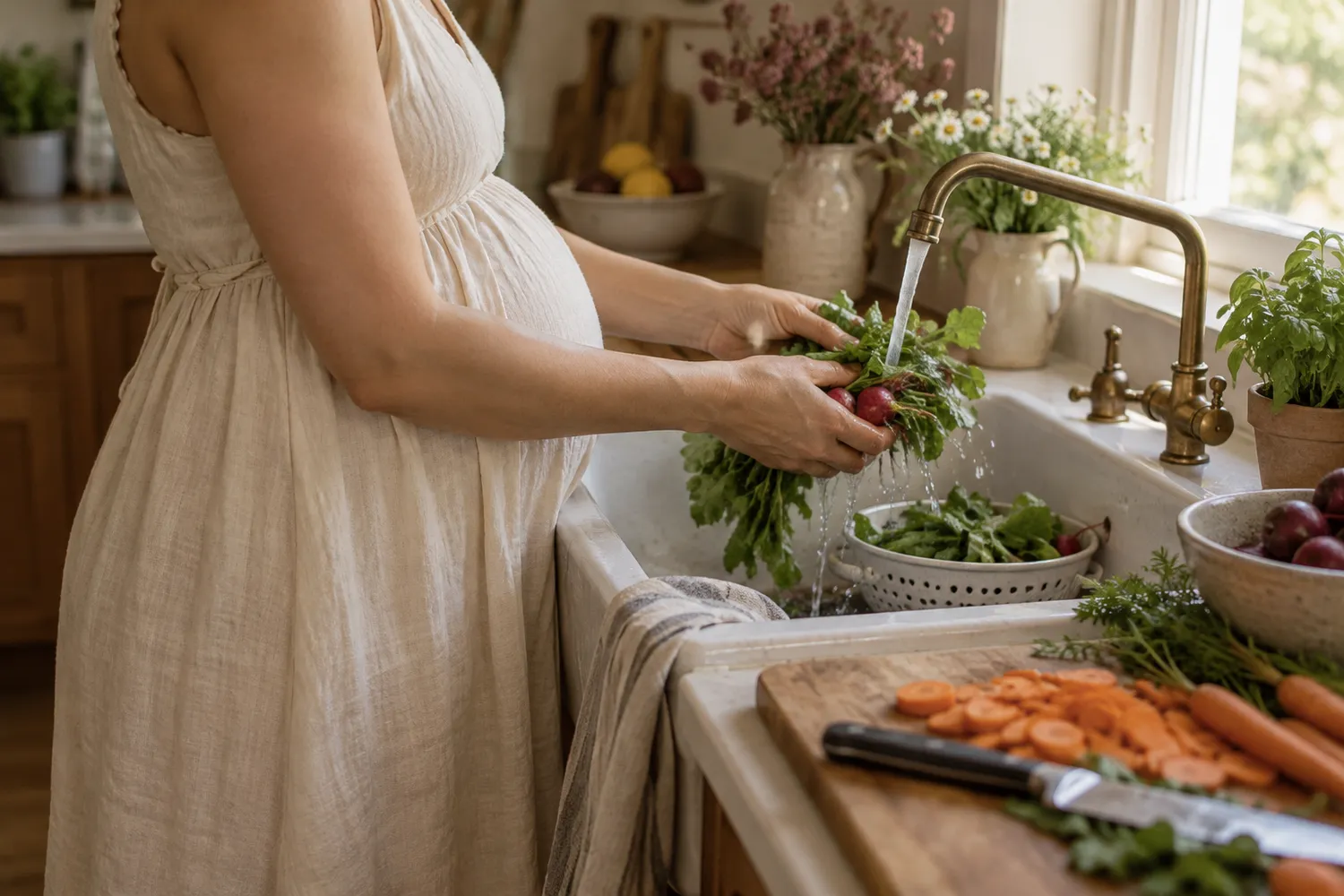
- Wash fruit, vegetables, salad and herbs thoroughly under running water.
- Store and cut raw meat and raw fish separately from other foods, and wash the board and knife in hot water afterwards.
- Set the fridge to no more than 7 °C, ideally below 5 °C.
- Eat leftovers and opened packs within two to three days.
- Reheat until everything is piping hot, and stir halfway through in the microwave.
- Wash your hands thoroughly after gardening and after cleaning the cat litter tray, and ideally leave the litter tray to someone else.
Diet in the first trimester
In the first twelve weeks, all the organs form. What matters most now is folic acid and iodine, and avoiding the foods above. Nausea makes eating hard for many women: small meals spread over the day, dry toast or crackers in the morning and enough fluids often help. If you can barely keep anything down for days, see your doctor.
How your baby develops week by week is shown in the overview Pregnancy week by week. The due date calculator works out your due date.
Frequently asked questions
Can you eat mozzarella when pregnant?
Yes, if it is pre-packed and made from pasteurised milk. Avoid mozzarella from open containers, for example from the salad counter or in a restaurant (BfR).
Can you eat honey when pregnant?
Yes. Honey is allowed in pregnancy. Only babies in their first year of life should not have honey.
Can you eat sushi when pregnant?
Not sushi with raw fish. Vegetarian sushi, for example with cucumber or avocado, and sushi with cooked fish or cooked prawns are allowed.
Can you eat salami when pregnant?
Not raw salami, because it can contain toxoplasma and listeria. On a baked pizza that is piping hot, salami is fine.
How much coffee can I drink when pregnant?
Up to 200 mg of caffeine a day, which is about two cups of filter coffee or two espressos. Tea, cola and chocolate count too (Gesund ins Leben 2026).
Can I eat smoked salmon when pregnant?
Not cold, because it can contain listeria. Thoroughly cooked, for example in the oven or in a hot pasta sauce, it is allowed (BfR).
What happens if I accidentally ate something I should avoid?
Usually nothing. Not every food contains germs. If you get a fever, muscle pain or flu-like symptoms in the weeks afterwards, tell your doctor what you ate. Listeriosis can be treated with antibiotics.
Do I have to eat for two in pregnancy?
No. Most pregnant women do not need any extra calories, but they do need a lot more vitamins and minerals (Gesund ins Leben 2026).
Sources
Guidelines and product information
- Healthy Start network (Gesund ins Leben): Diet and lifestyle before and during pregnancy, recommendations for action, 2026 update
- German Federal Institute for Risk Assessment (BfR): Pregnant women, recognising risks, protecting pregnant women
- BfR: Consumer tips, protection against food-borne listeria infections
- Robert Koch Institute: Infectious disease epidemiology yearbook of notifiable diseases for 2023
- EFSA: Scientific Opinion on the safety of caffeine, EFSA Journal 2015;13(5):4102