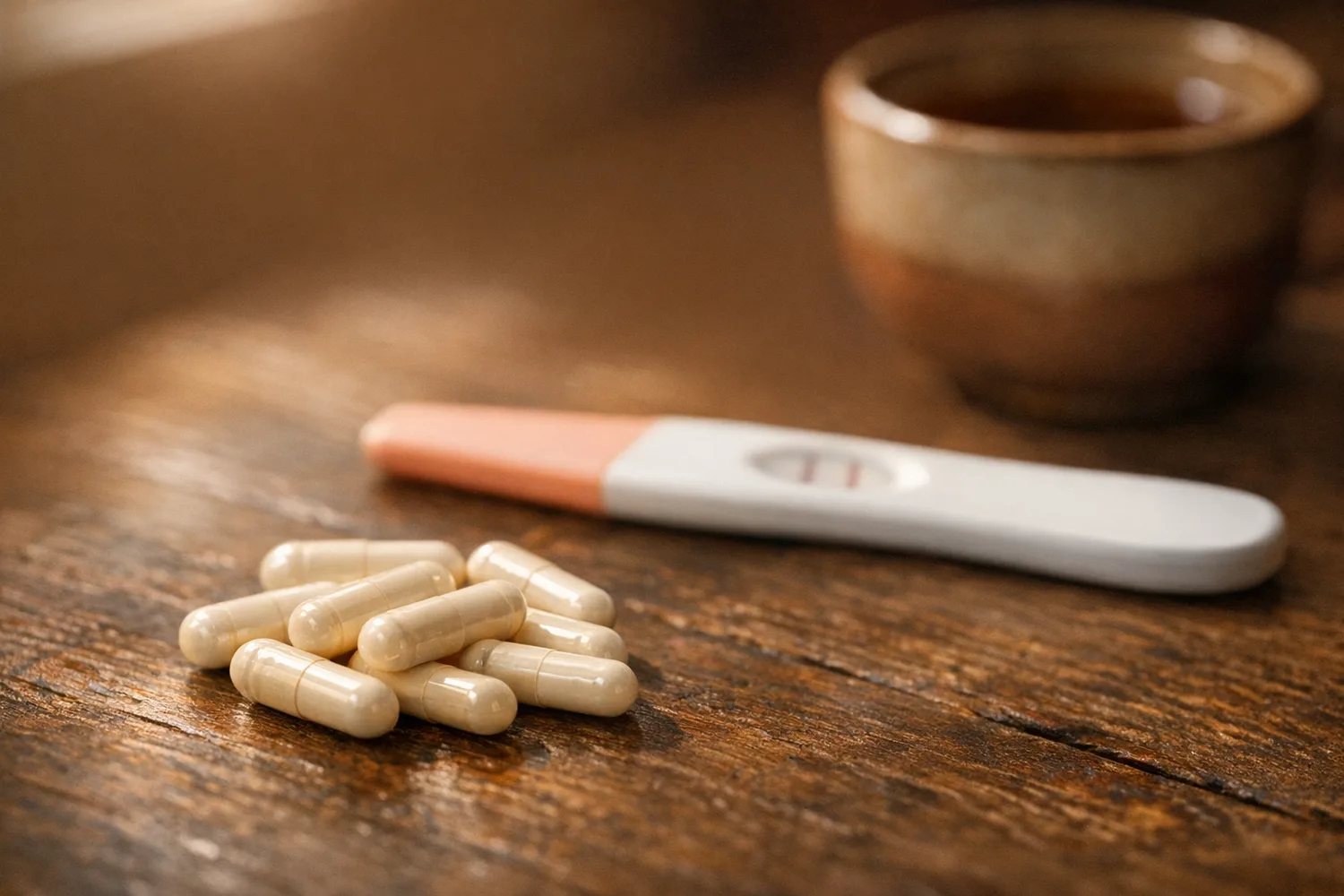
Folic acid is one of the few supplements for people trying to conceive that everyone truly agrees on. Gynecologists, reproductive medicine specialists, the WHO. 400 micrograms daily, ideally from the time you start trying to conceive, at least four weeks before conception and until the end of week 12 of pregnancy. So far, so familiar.
But then the questions come. Are the cheap tablets from the drugstore enough? Do I need active folate instead of folic acid? What about that MTHFR mutation everyone writes about in the forums? And how much folic acid when trying to conceive is actually too much?
Here you will find the answers you really need.
Why folic acid matters when you are trying to conceive
Folic acid (vitamin B9) controls cell division and DNA synthesis. Your body needs it for every cell that divides. In the first four weeks after fertilization, this is exactly what happens at a rapid pace: The neural tube forms, and the brain and spinal cord later develop from it.
Without enough folate, the risk of neural tube defects such as spina bifida rises many times over. Taking folic acid early enough lowers this risk by about 70%. That is not an estimate but the result of a Cochrane analysis of more than 6,000 pregnancies.
The catch: The neural tube already closes about four weeks after conception, which, counting from the last period as usual, is about week 6 of pregnancy. At that point, most women do not yet know they are pregnant. That is why your folate level has to be right before conception.
Whether a good folate level also promotes implantation or prevents miscarriage is not sufficiently proven. The recommendation rests on the well-established protection against neural tube defects.

How much folic acid when trying to conceive? The right dosage
400 µg per day, 800 µg if you start late
Women who are trying to conceive should take 400 µg of folic acid daily in addition to their diet, from when they start trying until the end of week 12 of pregnancy. This is recommended by the nationwide Healthy Start network (Gesund ins Leben) in its 2026 recommendations for action (as of July 2026, replacing the 2018 version), by the German Federal Institute for Risk Assessment (BfR), and by the German Nutrition Society (DGE).
800 µg daily is intended only if you did not start taking it at least four weeks before conception, for example if you only start after a positive test. With the higher dose, the protective folate level is reached faster. There is no general recommendation for 800 µg in Germany.
The same dose applies if you are overweight. For women with obesity, the Healthy Start network (2026) gives the same amounts as for everyone else: 400 µg, or 800 µg if you start late. The UK guideline NICE NG247 likewise provides for no more than 400 µg at a BMI of 25 or above, as long as there are no other risk factors for neural tube defects. The 2023 international PCOS guideline, by contrast, names a higher dose for women with PCOS and a BMI over 30, without giving a number. So the recommendations do not agree here. Whether more makes sense for you is something to clarify with a doctor.
When do you need more?
If your risk of neural tube defects is increased, a higher dose may make sense, and a doctor sets it. The UK guideline NICE NG247 names 5 mg daily for this, for example with a personal or family history, certain medical conditions, or certain medications. Examples:
- You have already had a pregnancy with a neural tube defect
- You, your partner, or someone in your family has a neural tube defect
- You take antiepileptic drugs (valproate, carbamazepine)
- You have type 1 or type 2 diabetes mellitus
According to current German and UK recommendations, a higher BMI alone is not a reason for more folic acid (see above).
These high doses belong in a doctor’s hands. You get 5 mg of folic acid at a pharmacy, not at a drugstore.
The right timing: when to start
At least four weeks before the planned pregnancy. It is best to start as soon as you want a baby, and at the latest when you start trying specifically on your fertile days. Our Ovulation Calculator shows you when those are.
Why so early? Your body needs time to build up the folate level in your red blood cells. The concentration in the blood serum does rise within a few days, but the decisive value, the red blood cell folate level, takes about 6 to 8 weeks at 400 µg to reach the protective range.
If you only start folic acid once you get a positive pregnancy test, you are late. The neural tube is then already closed or in the process of closing. Even so, the rule is: start right away, with 800 µg daily until the end of week 12 of pregnancy.
Rule of thumb: As soon as you stop birth control, start folic acid. There is no reason to wait.

Folic acid, folate, or 5-MTHF: which form is the right one?
This is the question that is debated most heatedly in fertility forums. And the answer is less dramatic than many think.
Synthetic folic acid
The classic form in most supplements. Your body has to convert it into the active form (5-methyltetrahydrofolate, or 5-MTHF for short) in several enzyme steps. For most people, this works without any problem.
Price: inexpensive. €3 to €5 for a three-month supply. Available at any drugstore, whether you buy folic acid at dm or Rossmann, or at a pharmacy.
Active folate (5-MTHF)
Already the active form, which your body can use directly. No conversion needed. In the EU, calcium L-methylfolate and two salts of 5-methyltetrahydrofolic acid (glucosamine salt and monosodium salt) are approved as folate compounds for dietary supplements (Healthy Start network 2026).
Price: more expensive. €10 to €20 for three months.
The MTHFR mutation
A portion of the population carries a homozygous variant of the MTHFR gene (C677T) that slows the conversion of folic acid to 5-MTHF. Heterozygous carriers are much more common and have a slightly reduced conversion rate.
In practice, this means: The recommendations do not differ by MTHFR variant. The Healthy Start network recommends 400 µg of folic acid or an equivalent amount of other folates, without prescribing a particular form (Healthy Start network 2026). The studies on protection against neural tube defects were done with folic acid.
The recommendations do not provide for an MTHFR test. If one is offered, it is usually a self-pay service. If you have questions about a known gene variant, discuss them with your doctor.
What you can look for when buying
Which folic acid is right for you when you are trying to conceive depends mainly on dose, form, and price. We deliberately do not name brands. These criteria help you compare products at the drugstore or pharmacy:
| Criterion | What you can look for |
|---|---|
| Dose | 400 µg of folic acid or an equivalent amount of other folates per day |
| Late start | 800 µg per day until the end of week 12 of pregnancy, if you did not start at least four weeks before conception |
| Form | Synthetic folic acid or one of the 5-MTHF compounds approved in the EU |
| Vitamin B12 | Some products also contain vitamin B12. That is not needed for the folic acid recommendation |
| Price per day | Package price divided by the number of daily servings |
| Supply | From the start until the end of week 12 of pregnancy, at least roughly three months pass, often considerably more |
| High-dose products | 5 mg only after talking to a doctor, not for self-treatment |
Dose and form
For prevention, the amount of folate is what counts. A product with 400 µg of folic acid meets the recommendation, and one with 800 µg does if you start late. Check whether the amount is given per tablet or per daily serving.
Synthetic folic acid and 5-MTHF are both approved as a folate source for dietary supplements.
Combination products and additives
Many products combine folate with vitamin B12 or other vitamins. For preventing neural tube defects, the amount of folate matters, not the additives. Whether you need extra vitamin B12 is something to clarify with a doctor. If you want to avoid certain additives or you are vegan, a look at the ingredient list helps. What is actually in common fertility supplements is shown in our fertility supplement comparison, with data on folate, iodine, vitamin D, and DHA.
Price and package size
Products with synthetic folic acid are usually cheaper than those with 5-MTHF (see above). Work out the price per day, not per package. Plan the package size so that it lasts for the time before pregnancy and the first twelve weeks of pregnancy, or so that you restock in time.
Our assessment
For prevention, a product with 400 µg of folic acid is enough, or with 800 µg if you start late. In the EU, 5-MTHF is approved as a folate compound for dietary supplements, and in a randomized trial it raised the folate level in red blood cells more than folic acid did (Healthy Start network 2026). That trial was funded by Merck, the maker of the methylfolate tested, and only the folate level was measured (Lamers 2006). Studies on protection against neural tube defects exist for folic acid. The recommendations do not provide for an MTHFR test.
High-dose 5 mg products from the pharmacy are intended only for women at increased risk, and the dose is set by a doctor, for example after a previous pregnancy with a neural tube defect, with certain medications, or with diabetes. Do not take this dose without talking to a doctor.

Folic acid for men: often underestimated
Folic acid when trying to conceive is not just a women’s issue. Men need folate too, because it is involved in cell division and therefore also in the formation of sperm. A balanced diet is therefore important for him as well.
Whether additional folic acid improves sperm quality, however, is not proven. There is no separate official recommendation for men. If a man wants to take a supplement anyway, 400 µg of folic acid daily is enough. Sperm maturation takes about 72 days, so changes show an effect after about three months at the earliest.
Be careful with zinc: The BfR recommends a maximum of 6.5 mg of zinc per day in dietary supplements. 25 mg is already the upper limit set by the European Food Safety Authority (EFSA) for total daily intake, including food. No expensive combination products are needed.
Many men do not take nutrition and lifestyle seriously, along the lines of: “My partner is already taking enough vitamins for both of us.” Unfortunately, it does not work that way. More on sperm quality in our separate guide.
Common mistakes and how to avoid them
By far the most common mistake is starting too late. Folic acid does not work immediately. If you wait until the pregnancy test is positive, you have missed the decisive moment. Ideally, you start from the time you start trying to conceive; four weeks before conception is the minimum.
The second classic: the cheap product with more filler than active ingredient. Not every two-euro product from the drugstore is bad, but read the ingredients. Some inexpensive tablets consist mainly of fillers and release agents.
Overdosing without a reason is also common. 5 milligrams daily without a medical indication bring no benefit and can mask a vitamin B12 deficiency. With folic acid, more is not better.
And perhaps the most frustrating classic: forgetting the man completely. Nutrition and lifestyle matter for him too if you want to get pregnant together.
Conclusion
Folic acid when trying to conceive is simple: 400 µg daily, start from the time you start trying to conceive and at the latest four weeks before the planned pregnancy, and take it every day. If you start later, you take 800 µg until the end of week 12 of pregnancy. If you are overweight, the same dose applies. Synthetic folic acid and 5-MTHF are both approved as a folate source, and the studies on protection against neural tube defects exist for folic acid. The recommendations do not provide for an MTHFR test.
Do not forget the man. A look at nutrition and lifestyle is worthwhile for him too.
The best product is the one you take every day. No supplement helps if it sits in a drawer. Put the package next to your toothbrush and make it a routine.
This article does not replace medical advice. If you have pre-existing conditions, take medication, or have had pregnancy complications before, discuss the dosage with your gynecologist.
Sources
- Folic acid supplement (recommendations for action for professionals), Healthy Start network (Gesund ins Leben), 2026
- Recommendations by the Healthy Start Network 2026, Geburtshilfe und Frauenheilkunde 2026;86(6):e60-e97 (Alaze-Hagemann et al.), Healthy Start network (Gesund ins Leben), 2026
- Maternal and child nutrition (NG247), recommendations 1.1.4 to 1.1.6, National Institute for Health and Care Excellence (NICE), January 15, 2025
- Recommendations from the 2023 international evidence-based guideline for the assessment and management of polycystic ovary syndrome, recommendation 5.1.2, Human Reproduction (Teede et al.), 2023
- Questions and answers on folate and folic acid, German Federal Institute for Risk Assessment (BfR), 2015
- Reference values for nutrient intake: folate, German Nutrition Society (DGE), 2019
- Effects and safety of periconceptional oral folate supplementation for preventing birth defects, Cochrane Database of Systematic Reviews (De-Regil et al.), 2015
- Folic acid when trying to conceive and during pregnancy: when and how much?, Healthy Start network (Gesund ins Leben), 2026
- Proposed maximum levels for zinc in foods including dietary supplements, German Federal Institute for Risk Assessment (BfR), 2021
- Overview on Tolerable Upper Intake Levels, European Food Safety Authority (EFSA), 2025
- Red blood cell folate concentrations increase more after supplementation with [6S]-5-methyltetrahydrofolate than with folic acid in women of childbearing age, American Journal of Clinical Nutrition 2006;84(1):156-161 (Lamers et al.), funded by Merck KGaA, 2006