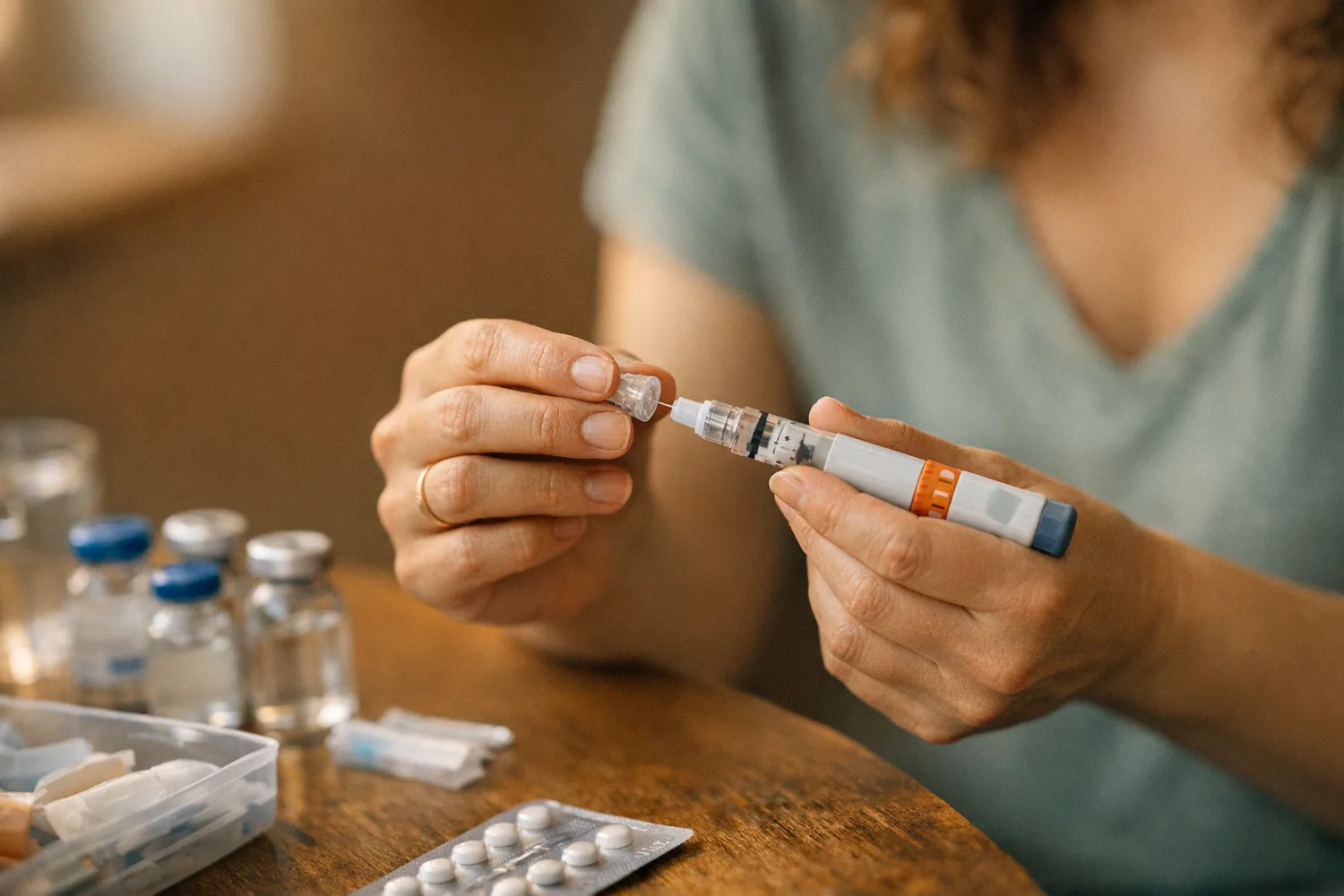
Many women worry about the possible long-term effects of their hormone treatment when trying to conceive. These concerns are completely justified and show how responsibly you treat your body.
One thing up front: Most of these fears are based on outdated studies or are greatly exaggerated. Still, you should know all the facts.
Modern hormone protocols are much gentler than they were 20 years ago. Today, lower doses are used, and risks can be assessed much better. Even so, there are definitely long-term effects you should know about.
Which long-term effects are backed by scientific evidence?
Research on the long-term effects of hormonal fertility treatment has made considerable progress in recent years. Large cohort studies from Scandinavia in particular give us a clearer picture today.
Ovarian hyperstimulation syndrome as an immediate risk

Although ovarian hyperstimulation syndrome (OHSS) does not occur as a late effect, it can have long-term consequences. In severe cases, impaired kidney or liver function can remain.
OHSS is much less common today than it used to be. Modern stimulation protocols with GnRH antagonists have reduced the risk considerably. According to the German IVF Registry (Deutsches IVF-Register, D.I.R.), severe OHSS occurred in only about 0.2% of stimulations in 2024. Milder forms are more common.
The good news: With timely treatment, OHSS usually heals without lasting effects. Long-term damage is a very rare exception.
Cancer risk from hormone treatment
This is probably the biggest worry for many women in fertility treatment. The evidence on it has become considerably more reassuring in recent years.
A large Dutch study of more than 19,000 women showed in 2016 that IVF treatment does not significantly increase the risk of breast cancer. Earlier studies that suggested a link had methodological weaknesses.
The picture is similar for ovarian cancer. The initial fears were not confirmed: In a large Dutch long-term study, women who were treated had no increased risk compared with women with infertility who did not receive treatment. The risk was even lower the more treatments had led to a birth.
Effect on menopause
A common worry is: Does stimulation use up the ovarian reserve faster and bring on menopause earlier?
So far, it has not been shown that fertility treatment brings on menopause earlier. However, how repeated stimulation affects the ovarian reserve in the long term has not been conclusively settled scientifically either.
For women whose ovarian reserve is already reduced, it is therefore worth raising the topic openly before treatment.
Thrombosis risk and cardiovascular disease
This is where it gets medically interesting. Hormone treatment has a major effect on your blood clotting system.
Acute risk of thrombosis during treatment
Estrogen increases the tendency of the blood to clot. This makes biological sense: During pregnancy, it protects against bleeding during childbirth.
During IVF cycles, your estrogen levels peak at more than 3,000 pg/ml. That is ten times the normal cycle maximum. The risk of thrombosis rises accordingly.
A large Swedish study found that in pregnancies after IVF, the risk of venous thromboembolism in the first trimester was about four times higher. In absolute terms, that means 1.5 instead of 0.3 cases per 1,000 women. So the risk is clearly increased, but small in absolute numbers.
Long-term cardiovascular effects
The long-term data are more reassuring here. A 2025 meta-analysis of about 500,000 treated women found no significantly increased long-term risk of major cardiovascular events, coronary heart disease, or stroke.
Interesting, though: In a Canadian study, women who did not have a child after fertility treatment later had somewhat more cardiovascular events than women who gave birth. Whether this is due to the treatment or to the underlying causes of infertility has not yet been determined. In any case, the risk did not rise with the number of treatment cycles.
Identifying special risk groups

Not all women have the same risk of thrombosis. That is why it is worth taking a close look at the most important risk factors before treatment:
| Risk factor | Risk increase | Consequence |
|---|---|---|
| Factor V Leiden mutation | 3 to 8 times | Consider thrombosis prophylaxis |
| BMI > 30 | 2 to 3 times | Weight loss before treatment |
| Age > 38 years | 2 times | Close monitoring |
| Smoking | 2 to 4 times | Smoking cessation before treatment |
| Previous thrombosis | 10 to 20 times | Usually a contraindication |
For high-risk patients, modified protocols are therefore often used. Lower doses, more frequent checks, and preventive blood thinning can reduce the risk considerably.
Differences between Germany, Austria, and Switzerland
In Germany, thrombosis prophylaxis in fertility treatment is not yet standardized. Many clinics handle it differently.
In Austria and Switzerland as well, clinics decide individually whether clotting values are checked beforehand and whether prophylaxis with low-molecular-weight heparin makes sense. So before treatment begins, ask specifically how your clinic assesses the risk of thrombosis.
Effects on bones and metabolism
This area is often overlooked, but it is highly relevant medically. Hormones control not only reproduction but the entire metabolism.
Bone density after GnRH agonists
GnRH agonists, which are used in many stimulation protocols, can temporarily reduce bone density. They create an artificial menopausal state.
With short-term use (a few weeks), this is usually reversible. It becomes problematic with longer treatment, for example for endometriosis before IVF.
Example: If a woman receives GnRH agonists for six months, a bone density scan afterward can show a measurable loss in the lumbar spine. With targeted therapy, such a loss can often be largely compensated for.
Changes in glucose metabolism

The evidence here is reassuring. The 2025 meta-analysis mentioned earlier found no significantly increased long-term risk of diabetes or high blood pressure after fertility treatment.
Still, it is worth taking a look at your own lifestyle: Weight gain during treatment can become a problem in the long run.
Thyroid function under hormone stimulation
The thyroid reacts very sensitively to hormone fluctuations. In some women, thyroid function changes during treatment.
This usually returns to normal after the cycle. Occasionally, though, a subclinical underactive thyroid (hypothyroidism) remains. That is why it makes sense to check your thyroid levels regularly.
Metabolic syndrome as a long-term effect?
The evidence is thin. Whether fertility treatment increases the risk of metabolic syndrome has not been settled. For diabetes and high blood pressure, two central components, the large 2025 meta-analysis found no increased risk.
A healthy lifestyle after treatment still makes sense, regardless of how the treatment turns out.
Psychological long-term effects after hormone therapy
A point that often gets too little attention: The psychological effects are greatly underestimated. Hormones affect not only the body but also the mind.
The hormonal roller coaster and its effects
During IVF, your hormone levels change a lot. After egg retrieval, you receive progesterone to support the luteal phase. It is given at least until the pregnancy test and, if you are pregnant, depending on the product, until weeks 7 to 12 of pregnancy.
The treatment period can put considerable strain on your emotional balance. Especially after unsuccessful treatment, some women report depressive moods long afterward. Whether the hormone fluctuations themselves contribute to this is not established by the evidence we found.
If you already have a mental health condition, bring it up before treatment. Then your treatment team can support you in a targeted way.
Post-traumatic stress after unsuccessful treatment

Unsuccessful treatment often leaves deeper marks than expected. The combination of physical strain, hormonal fluctuations, and emotional stress can take on traumatic features.
Psychological support therefore makes particular sense after unsuccessful cycles. Many fertility clinics offer it, and it is never too late to take it up.
Effects on relationships and sexuality
The hormonal changes also affect libido. Many women report a lasting lack of sexual desire after treatment.
This is not due only to the psychological strain. While they are being used, GnRH agonists suppress hormone production in the ovaries, and that can dampen desire further.
Psychological support in Germany, Austria, and Switzerland
This section applies to Germany, Austria, and Switzerland.
How psychological support is regulated differs between the countries:
In Germany, psychosocial fertility counseling is a voluntary service offered by independent counseling centers and many fertility clinics. Often it is only mentioned once strain arises during treatment.
In Austria, under the Reproductive Medicine Act (Fortpflanzungsmedizingesetz), the doctor must suggest psychological counseling or psychotherapeutic care. The rates of the IVF Fund (IVF-Fonds) also include psychological care.
In Switzerland, the Federal Act on Medically Assisted Reproduction (Fortpflanzungsmedizingesetz, FMedG) requires that psychological support be offered.
Preventive measures for mental health
What can you do to minimize psychological long-term effects?
Look for support early. Whether it is a support group, a psychologist, or a trusted friend, you do not have to go through this alone.
Limit the number of attempts from the start. Endless treatment cycles only wear you down.
Deliberately plan breaks between cycles. Your body and mind need time to recover.
Frequently asked questions
Does my cancer risk go up with multiple IVF cycles?
The current data are reassuring. Large long-term studies show no increased risk of breast cancer from IVF treatment. For ovarian cancer as well, no increased risk was found compared with women with infertility who were not treated, and the more treatments led to a birth, the lower it was.
There is one caveat: Women with BRCA mutations should discuss their individual risk with a geneticist. In this case, the high estrogen levels during stimulation can become problematic.
The article on the fertility test for women also covers genetic risk factors that you should know about before treatment.
Can I go through menopause earlier after IVF treatment?
This worry is common. So far, it has not been shown that fertility treatment brings on menopause earlier. However, how repeated stimulation affects the ovarian reserve in the long term has not been conclusively settled.
If your ovarian reserve is already reduced, bring up the topic before treatment.
For most women, another question matters more anyway: how good the chances of successful treatment are.
How do GnRH agonists affect my bones?
GnRH agonists can reduce bone density with prolonged use. They create an artificial estrogen deficiency, similar to menopause.
With short-term use (a few weeks), this is usually reversible. It becomes problematic with long-term treatment lasting several months, for example for severe endometriosis.
If you have to take GnRH agonists for longer than three months, talk to your doctor about a bone density scan and, if appropriate, “add-back” therapy with low-dose hormones.
How do I recognize psychological long-term effects after treatment?
Watch for persistent symptoms such as sleep problems, lack of drive, or anxiety that are still present months after treatment.
Depressive moods can develop, especially after several unsuccessful cycles. Relationship problems or a lack of sexual desire can also be consequences.
Do not hesitate to seek professional help. Many fertility clinics now offer psychological counseling. When looking at ICSI cost, you should also factor in psychological aftercare.
Are the costs of treating long-term effects reimbursable?
That depends on the country and on your insurance. Fertility treatment itself is only partly reimbursed or not at all, whereas treating a condition such as thrombosis is, as a rule, part of normal medical care.
In Germany, the statutory health insurance fund pays 50% of the approved costs of fertility treatment for married couples. The article AOK fertility treatment: benefits and reimbursement 2026 gives you an overview of the German rules.
In Austria, the IVF Fund covers 70% of the costs of IVF and ICSI under certain conditions. In Switzerland, mandatory basic health insurance (Grundversicherung) does not pay for IVF. For the treatment of illnesses in Switzerland, as with any treatment, a deductible (Franchise) and co-insurance (Selbstbehalt) apply. If in doubt, check in advance with your insurer which services it covers.
Are you planning fertility treatment, or are you worried about possible long-term effects? Fertilio’s Fertility Clinic Finder helps you find a suitable clinic that also specializes in long-term care. That way, you can make sure you are well looked after even after treatment.
Sources
- Long-Term Risk of Ovarian Cancer and Borderline Tumors After Assisted Reproductive Technology, Journal of the National Cancer Institute, 2021
- Incidence of pulmonary and venous thromboembolism in pregnancies after in vitro fertilisation, BMJ, 2013
- Failure of fertility therapy and subsequent adverse cardiovascular events, CMAJ, 2017
- Gonadotrophin-releasing hormone analogues for endometriosis: bone mineral density, Cochrane Database of Systematic Reviews, 2003
- Yearbook 2024, German IVF Registry (D.I.R.), 2025
- Routine psychosocial care in infertility and medically assisted reproduction, ESHRE, 2015
- ESHRE guideline: ovarian stimulation for IVF/ICSI, Update 2025, Human Reproduction 2026;41(4):498-514, ESHRE, 2026
- Prescribing information, vaginal micronized progesterone 200 mg, section 4.2, as of 02/2026
- Prescribing information, progesterone solution for injection 25 mg, section 4.2, as of 11/2023