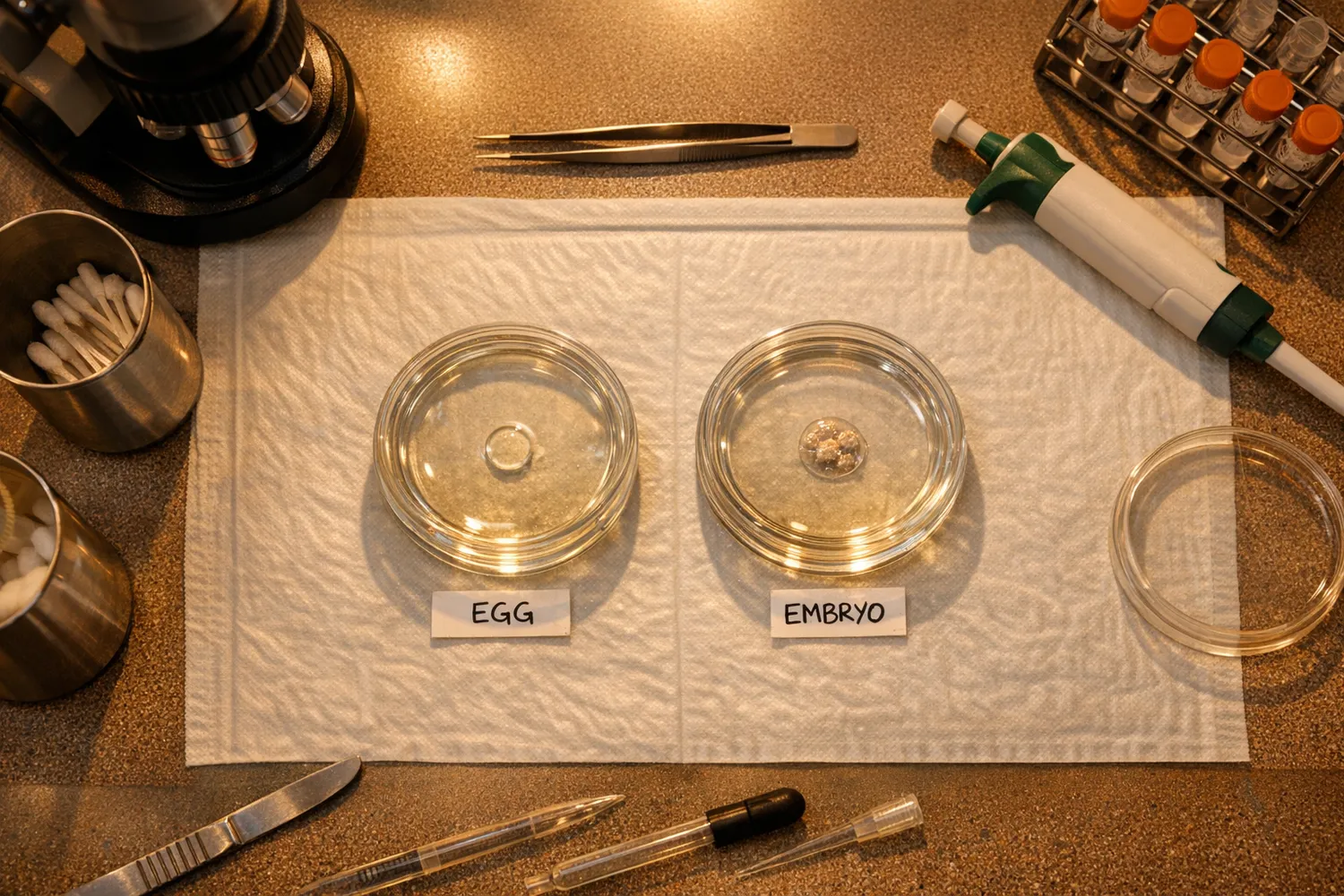
IVF or ICSI, which is better? Many couples ask themselves this question before their first fertility treatment. The short answer: There is no better or worse. There is only the method that fits your findings.
IVF and ICSI are the two most common procedures of assisted reproduction. The German IVF Registry (Deutsches IVF-Register, D.I.R.) recorded around 131,800 treatment cycles in 2024. Among fresh cycles with fertilization in the lab, ICSI was used in about two thirds (66.5%). Even so, many couples are unclear about what the difference actually is and why their clinic suggests one method or the other.
The difference lies in a single lab step. Several large randomized trials have by now examined whether this step adds anything, and professional societies have adjusted their recommendations accordingly. We summarize both here, along with the rules of health insurance funds in Germany, Austria, and Switzerland.
IVF and ICSI compared
| Conventional IVF | ICSI | |
|---|---|---|
| What happens in the lab | Eggs and prepared sperm are brought together in a culture dish, and one sperm penetrates the egg on its own | A single sperm is injected into the egg with a fine glass needle |
| Stimulation, egg retrieval, transfer | identical | identical |
| Average lab time (Bhattacharya 2001) | 22.9 minutes | 74.0 minutes |
| Fertilized per treated egg (D.I.R. 2024) | 56.2% | 66.4% |
| Fertilized per retrieved egg (D.I.R. 2024) | 55.3% | 52.5% |
| Cycles with no fertilization at all (D.I.R. 2024, calculated) | 8.1% | 6.1% |
| Live births per embryo transfer, all indications (D.I.R. 2023) | 23.4% | 22.0% |
| Live birth from the first treatment cycle including frozen embryo transfers, without severe male factor (INVICSI 2025, 824 women) | 47.3% | 43.2% |
| Live birth after the first transfer, normal sperm count and motility (Dang 2021, 1,064 couples) | 31% | 35% |
| Share of fresh cycles with fertilization in the lab (D.I.R. 2024) | 30.9% | 66.5% |
| Additional cost | Baseline | according to ESHRE about 8.3% more expensive (cost data from the Netherlands) |
| When guidelines provide for them | Standard when there is no male factor | impaired semen analysis, surgically retrieved sperm, previous fertilization failure, thawed eggs, PGT |
| Covered by statutory health insurance in Germany | when indicated under No. 11.3 of the guideline of the Federal Joint Committee (Gemeinsamer Bundesausschuss, G-BA) | for severe male fertility disorder, after cryopreservation under Section 27a, paragraph 4 of Book V of the German Social Code (Sozialgesetzbuch V, SGB V), or after total fertilization failure in the first IVF attempt |
In both randomized trials, the difference in live births was not statistically significant. The registry figures do not compare equal groups: ICSI is used mainly for an impaired semen analysis, IVF more for female causes. Only randomized trials, in which chance assigns the method, show whether one method is more effective.
What is IVF?
In conventional in vitro fertilization, eggs and sperm are brought together in a culture dish. Fertilization takes place in a quasi-natural way: The sperm has to penetrate the egg on its own. In principle, the same thing happens as in the body, just under controlled lab conditions.
The process in detail: After hormonal stimulation with daily injections, the mature eggs are retrieved by puncture under light sedation. In the lab, they are placed in a culture medium with prepared sperm. According to the 2026 lab recommendations of the European professional society ESHRE, usual concentrations are about 100,000 to 500,000 progressively motile sperm per milliliter. The dish goes into the incubator, and 16 to 17 hours later the embryology team checks whether fertilization has taken place. How the treatment works overall is described in our article on the IVF process.
Conventional IVF requires enough motile sperm. There is, however, no generally valid minimum value. The Vienna Consensus, an expert consensus on quality indicators in the IVF lab (2017), found the minimum values cited in practice so different that no reliable recommendation could be derived. Clinics therefore work with their own cutoffs. In the Danish INVICSI trial, a sample counted as suitable for IVF if at least 2 million progressively motile sperm were available after preparation (until 2020, the trial cutoff was 5 million). In another clinic study (Batha 2023), IVF was performed with more than 4 million motile sperm in total after preparation. According to ESHRE, a trial sperm preparation in advance may be advisable to determine the appropriate method.
What is ICSI?
ICSI stands for intracytoplasmic sperm injection. It sounds complicated but is simple at its core: A single, carefully selected sperm is injected directly into the egg with an extremely thin glass needle. The sperm therefore does not have to penetrate on its own, it is placed inside deliberately. Palermo and colleagues described the first pregnancies after ICSI in 1992 in the journal Lancet.
That makes ICSI the method of choice when sperm quality is severely impaired. Even with extremely low sperm counts or after a TESE procedure (surgical sperm retrieval directly from testicular tissue), a single functional sperm per egg is theoretically enough. The laboratory manual of the World Health Organization (WHO) therefore considers it worthwhile to freeze every sample that contains live sperm if ICSI may be considered later.
The process up to the egg retrieval is identical to IVF. The difference lies in the lab: Instead of adding the sperm to the egg and waiting, the embryologist actively performs the fertilization under the microscope. Only mature eggs are injected. You can find more about the method and the clinics that offer it on our page on ICSI treatment.

The key difference
In one sentence:
- IVF = Sperm and eggs meet in the lab, and fertilization happens on its own
- ICSI = A single sperm is injected directly into the egg
Everything else (stimulation, egg retrieval, embryo culture, transfer) is identical in both procedures. The process and the burden are the same for you as a patient, and ICSI costs somewhat more. The difference takes place in the embryology lab, but it takes more time there than often assumed: In a randomized trial from four British centers (Bhattacharya 2001), the lab work took 22.9 minutes on average with IVF and 74.0 minutes with ICSI.
From the transfer on, there is no difference anymore. The week of pregnancy and the due date depend on the transfer date and the age of the embryo, not on the fertilization method. Our IVF Due Date Calculator shows you the usual time window for the blood test, the week of pregnancy, and the due date, and your clinic sets the exact test day.
When is which method recommended?
This is where it gets more concrete. The choice of method does not follow gut feeling but medical criteria. Fixed numerical cutoffs are not part of them, however. More on this in the section on the G-BA guideline.
IVF is the usual method for:
- A normal semen analysis: when enough progressively motile sperm are available after preparation. There is no generally valid minimum count.
- Fallopian tube problems: blocked or non-functioning fallopian tubes that cannot be treated any other way
- Endometriosis: The G-BA guideline mentions it in connection with a “tubal loss of function that cannot be treated otherwise,” meaning when the tubes no longer function because of it
- Unexplained infertility: when all tests are normal and other treatments have been exhausted. The G-BA guideline explicitly requires a psychological assessment for this as well. The British NICE guideline (2026) advises trying for 2 years in total and then offering up to 4 inseminations with hormonal stimulation or IVF. ESHRE (2023) words it cautiously, saying IVF is “probably not” recommended before an insemination with stimulation.
- After unsuccessful IUI treatment: as the next step in fertility treatment
ICSI is the usual method for:
- Severely impaired sperm quality: for example with OAT syndrome (oligoasthenoteratozoospermia, meaning too few, too poorly motile, and abnormally shaped sperm). For statutory health insurance in Germany, a “severe male fertility disorder” must be documented by two semen analyses according to the WHO manual, after an andrological examination.
- A very low sperm count: Since 2017, there has been no numerical cutoff anymore. The value of 5 million often cited in the past resembles a value from an old G-BA table (concentration below 5 million/ml after preparation) that was deleted in 2017.
- A high share of abnormally shaped sperm: The frequently cited 4% normal forms is the lower WHO reference limit, not an ICSI criterion. With normal count and motility, morphology did not help identify couples who benefit from ICSI in an analysis of a large randomized trial. Half of the men there had 3% normal forms or fewer (Pham 2025).
- After unsuccessful IVF: when conventional IVF achieved no fertilization or very low fertilization
- Surgically retrieved sperm: after TESE, micro-TESE, or MESA
- Thawed eggs: for example after elective egg freezing or after cryopreservation before a therapy that damages germ cells
- Planned preimplantation genetic testing (PGT): especially when testing for a known hereditary disease (PGT-M)
- Frozen sperm: Cryopreserved samples lose motility. According to the WHO, the share of motile sperm can drop from 50.6% to 30.3%, depending on the study. Freezing alone is not an indication, however. What matters is how many motile sperm are available after thawing. If there are very few, for example after a TESE, ICSI is used.
In practice, the line is not always black and white. With borderline semen analyses, both options are usually discussed with the couple. Sometimes treatment starts with IVF and switches to ICSI in the next cycle if fertilization is poor.
Decision guide: IVF or ICSI?
The table summarizes what professional societies and large trials say about typical situations. It does not classify individual findings and does not replace the conversation with your clinic. How to read a semen analysis is explained in our article Semen analysis: normal values.
| Situation | What guidelines and trials say | Source |
|---|---|---|
| Semen analysis normal (values in the WHO reference range), cause in the woman | Conventional IVF is the standard. ICSI is not recommended without a male factor. Large randomized trials found no advantage in the live birth rate. | ESHRE 2023, ASRM 2026, NICE NG257 (1.50.3), Dang 2021, INVICSI 2025, Kayimu 2026 |
| Semen analysis slightly impaired (in the Wang 2024 trial: 5 to 15 million/ml or 10 to 32% progressively motile) | In a large trial from China, no higher live birth rate with ICSI. NICE: consider ICSI, depending on severity. ICSI fertilizes more eggs here. What matters is how many motile sperm remain after preparation. | Wang 2024, NICE NG257 (1.50.2), Tournaye 2002, ESHRE 2026 |
| Semen analysis severely impaired (evaluated in the German IVF Registry: below 1 million/ml in the ejaculate) | ICSI is the established method. An andrological work-up comes first. With secondary hypogonadism (hormone deficiency caused by a disorder of the brain's control), treatment of the cause should be tried first. In the German registry 2020 to 2023: clinical pregnancy per transfer 31.5%, live births per transfer 23.6%. | NICE NG257 (1.50.2), AWMF S2k 015/085, D.I.R. 2024 p. 37 |
| Surgically retrieved sperm (TESE, micro-TESE, MESA) | Offer ICSI. In the German registry after TESE: clinical pregnancy per transfer 30.2%, live births per transfer 23.2%. | NICE NG257 (1.50.1), D.I.R. 2024 p. 37 |
| Previous fertilization failure with IVF | Consider ICSI. In the following cycle, ICSI improves fertilization, and the figures are in the section Fertilization failure. There is no fixed cutoff for “too low” fertilization. | NICE NG257 (1.50.2), ASRM 2026 |
| Few eggs, low ovarian reserve, older age | ICSI is not recommended without a male factor. No advantage in fertilization or live birth, including within the individual groups by egg number. | ASRM 2026, Drakopoulos 2019, Supramaniam 2020 |
| Eggs from elective egg freezing (thawed eggs) | ICSI is the best-established method, but the data are limited. NICE: offer ICSI. | ASRM 2026, NICE NG257 (1.50.1), ESHRE 2026 |
| PGT planned | ICSI is preferred so that no maternal cells (cumulus cells) and no paternal genetic material outside the embryo distort the test result. For PGT-A without a male factor, ASRM sees no advantage in euploidy or live birth; for PGT-M, ICSI can be appropriate. | ESHRE PGT Consortium 2020, ESHRE 2026, ASRM 2026 |
| Unexplained cause | ICSI is not recommended instead of IVF (ESHRE: strong recommendation). IVF itself, according to ESHRE, probably not before an insemination with stimulation. NICE: after 2 years, up to 4 inseminations with stimulation or IVF. A split procedure lowers total failure in trials; a benefit for births has not been shown. | ESHRE 2023, NICE NG257 (1.38), Johnson 2013, Bungum 2004 |
| Frozen sperm | No evidence that frozen sperm alone require ICSI. Motility after thawing counts. | INVICSI 2025, WHO 2021 |
What the health insurance fund in Germany says
For people with statutory health insurance, it is not only medicine that decides but also the G-BA guideline. ICSI is covered by statutory health insurance in cases of severe male fertility disorder (No. 11.5 a), after cryopreservation because of a therapy that damages germ cells with a proven fertility disorder in the woman (No. 11.5 b), and in up to two cycles after a total fertilization failure in the first IVF attempt (No. 8). Elective egg freezing without a medical reason, donor sperm, and preimplantation genetic testing are not covered by statutory health insurance. If you have frozen eggs as a precaution, you will find the background in our guide to elective egg freezing.
You make the decision together with your clinic
You decide together with your fertility clinic which method fits you. The doctor knows your findings, your history, and the result of the trial sperm preparation. These questions help in the conversation:
- How many progressively motile sperm were available after preparation, and is that enough for conventional IVF?
- For what reason do you suggest ICSI or IVF in our case?
- How often is no egg fertilized at all in your lab with IVF and with ICSI?
- Do you offer a split procedure, and how is it billed?
- What happens if no egg is fertilized in an IVF?
- Does our health insurance fund or the IVF Fund (IVF-Fonds) pay for the suggested method?
Semen analysis cutoffs: what the G-BA guideline says
This section applies to Germany only.
Many couples look for a number above which ICSI is necessary. In Germany, there has been no such cutoff since 2017. Anyone who still comes across fixed values online often finds remnants of the old guideline or the WHO reference values.
The old cutoff table (2002 to 2017)
With an amendment of the guideline on assisted reproduction of February 26, 2002, the Federal Committee at the time set fixed semen analysis values for ICSI. They applied unchanged until 2017, most recently in the 2014 version. ICSI was covered by insurance if two semen analyses at least 12 weeks apart fell below these values:
| Parameter | in unprocessed semen | after preparation (swim-up) |
|---|---|---|
| Concentration | below 10 million/ml | below 5 million/ml |
| Total motility | below 30% | below 50% |
| Progressive motility (WHO A) | below 25% | below 40% |
| Normal forms | below 20% | below 20% |
If not all criteria were met at the same time, progressive motility was decisive according to the guideline. If it was below 15% in unprocessed semen or below 30% after swim-up, there was an indication for ICSI.
Why the G-BA deleted the values in 2017
In 2017, the Federal Joint Committee (G-BA) deleted the table and the 12-week interval. The reasoning is in the Supporting Reasons for the decision: “Since scientifically validated cutoffs for semen analysis parameters that justify ICSI cannot be derived, the values previously specified under No. 11.5 of the guideline were deleted.” The Institute for Quality and Efficiency in Health Care (IQWiG) had found four randomized trials, all only with men with a normal semen analysis. The G-BA's conclusion: “A clear dividing line based on semen analysis parameters regarding the methods (IVF and ICSI) is not possible with the available data.” The 12-week interval was dropped because the current WHO guideline does not provide for such an interval.
What the guideline says today
The current version of the guideline has been in effect since February 9, 2022. For ICSI, it names two indications in No. 11.5:
a) “Severe male fertility disorder, documented by two current semen analyses that were prepared on the basis of the WHO manual ‘Examination and processing of human semen.’ The examination of the man ... by physicians with the additional designation ‘Andrology’ must precede the indication.”
b) “ICSI after cryopreservation under Section 27a, paragraph 4 SGB V in the case of a proven fertility disorder in the female insured person, regardless of a male fertility disorder”
Section 27a, paragraph 4 SGB V concerns cryopreservations that appear “medically necessary because of a disease and its treatment with a therapy that damages germ cells,” for example before chemotherapy. Elective egg freezing without a medical reason does not fall under it. Before an ICSI because of a male fertility disorder, physicians must also provide information “about the special risks, including genetic ones, and possible malformations of the child” and point out the entitlement to human genetic counseling (No. 16). The andrological examination is carried out by specialized andrology practices.
For IVF, No. 11.3 lists these indications, quoted here in translation:
- “Condition after removal of the fallopian tubes”
- “Tubal blockage that cannot be treated otherwise (including by microsurgery)”
- “Tubal loss of function that cannot be treated otherwise, including in endometriosis”
- “Idiopathic (unexplainable) infertility, provided that ... including a psychological assessment ... all diagnostic and other therapeutic options for the treatment of infertility have been exhausted”
- “Subfertility of the man, provided that treatment attempts under No. 10.2 do not promise success or have been unsuccessful” (No. 10.2 is insemination after hormonal stimulation)
- “Infertility caused by immunological factors,” under further conditions
No. 8 regulates the relationship between the two methods. IVF and ICSI are paid for only as alternatives. “The only exception is the case constellation of a total fertilization failure after the first attempt at in vitro fertilization. In this case, intracytoplasmic sperm injection ... can be used in a maximum of two subsequent cycles, even if the requirements under No. 11.5 are not met.” And further: “A change of method within an IVF cycle (so-called rescue ICSI) is excluded. The change of method must be applied for on a follow-up treatment plan.”

The WHO reference values are not an ICSI cutoff
The WHO laboratory manual (6th edition, 2021) gives reference values from data on about 3,500 men from 12 countries whose partners became pregnant naturally within a year. Each is given as the 5th percentile, that is, the value that 95% of these men reached or exceeded. The lower reference limit there is, for example, 16 million/ml for concentration, 30% for progressive motility, and 4% normal forms. All values are explained in our article Semen analysis: normal values.
The WHO explicitly states that the 5th percentile does not represent a boundary between fertile and infertile men. A value just below it therefore does not automatically mean ICSI, and a value above it does not rule out problems. According to the lab recommendations of ESHRE (2026), which refer to a WHO guideline of 2025, a single semen analysis is enough if all values are within the reference range. Otherwise a second one should follow after at least 11 weeks. For ICSI, the G-BA guideline requires two current semen analyses but no longer names an interval.
In Austria, the following applies to the IVF Fund: The diagnosis “male infertility” must be made by a specialist physician, for example a urologist. For idiopathic pathospermia, meaning abnormal values without a recognizable cause, two pathological semen analyses at least four weeks apart are needed.
What the studies show
Whether ICSI adds anything without a severe male factor has by now been well studied. The most important randomized trials and meta-analyses at a glance:
| Study | Who took part | Size | Result |
|---|---|---|---|
| Bhattacharya, Lancet 2001 | no male factor, 4 centers in the United Kingdom | 415 couples, 435 cycles | Implantation per embryo IVF 30%, ICSI 22%; pregnancy per cycle 33% versus 26% (not significant) |
| Dang, Lancet 2021 | normal sperm count and motility, 2 centers in Vietnam | 1,064 couples | Live birth after the first transfer ICSI 35%, IVF 31% (not significant) |
| Wang, Lancet 2024 | slightly impaired semen analysis, 10 centers in China | 2,387 randomized, 2,329 analyzed | Live birth after the first transfer ICSI 33.8%, IVF 36.6% (not significant) |
| Berntsen (INVICSI), Nat Med 2025 | first IVF cycle, no severe male factor, 6 public clinics in Denmark | 824 women | Live birth from the first cycle including frozen embryo transfers ICSI 43.2%, IVF 47.3% (not significant) |
| Cutting, Cochrane 2023 | normal sperm count and motility | 3 trials, 1,539 couples | neither method superior, low-certainty evidence |
| Kayimu, Hum Reprod 2026 | no severe male factor | 6 randomized trials | Live birth ICSI 32.8%, IVF 34.5%; cumulative 43.2% versus 47.4%; in each case no advantage for ICSI, high-quality evidence |
INVICSI: the latest large trial
The Danish INVICSI trial (2025) is particularly informative for couples in their first cycle. A total of 824 women in their first IVF cycle at six public clinics took part, without a severe male factor. The outcome counted was whether the first treatment cycle, including all frozen embryo transfers from that cycle, led to at least one live birth. The result is in the table above. After the first transfer alone, 31.6% of women with IVF and 26.6% with ICSI had a child.
Per retrieved egg, 58.1% were fertilized with IVF and 53.5% with ICSI. A complete fertilization failure occurred in 3.7% (IVF) and 4.8% (ICSI) of women. 26.8% of the women in the ICSI group and 28.9% in the IVF group used donor sperm. In an exploratory analysis of women up to 32 years, ICSI performed worse: Mathematically, there was one live birth fewer for every nine women treated with ICSI instead of IVF (number needed to harm 9). Such subgroup analyses are only an indication, not proof. The authors conclude that ICSI should be reserved for severe male factor.
Other randomized trials
In the trial from Vietnam (Dang 2021) with normal sperm count and motility, ICSI was slightly ahead after the first embryo transfer (values in the table above). The difference was not significant, and the authors write that ICSI did not improve the live birth rate.
The largest of the trials mentioned here comes from China (Wang 2024). It studied couples with a slightly impaired semen analysis: concentration 5 to 15 million/ml or 10 to 32% progressively motile sperm. Only couples in their first or second cycle could take part. Excluded were, among others, poor fertilization in the previous cycle, donor sperm, frozen sperm, and PGT. Here the live birth rate after the first transfer was somewhat higher with IVF, again without a significant difference. The authors advise against routine use in this group.
The oldest of the trials mentioned (Bhattacharya 2001) even found a higher implantation rate per embryo with IVF in couples without a male factor. Its conclusion: ICSI offers no advantage in clinical outcome in non-male infertility. A small randomized trial with 60 women aged 39 and older without a male factor, in which the method was assigned by lot for each ovary, also found no advantage from ICSI (Haas 2021).
The 2023 Cochrane review still rated the evidence as low certainty. The latest meta-analysis (Kayimu 2026) rates it as high quality: no advantage of ICSI for live birth or cumulative live birth. In 3 trials, there were somewhat fewer preterm births with ICSI (4.6% versus 6.0%), close to the threshold of statistical significance.
Large observational studies
Large observational studies show the same picture. In the United States, the ICSI share of all fresh cycles rose from 36.4% in 1996 to 76.2% in 2012, and among couples without a male factor from 15.4% to 66.9% (Boulet 2015). In these couples, the live birth rate was 36.5% with ICSI and 39.2% with IVF. An analysis of the British registry with about 570,000 cycles with a normal semen analysis (Supramaniam 2020) found no advantage, not even in women with few eggs. A European analysis from 15 centers with 4,891 patients (Drakopoulos 2019) saw no difference in any group, whether 1 to 3, 4 to 9, 10 to 15, or more than 15 eggs were retrieved.
The US professional society ASRM also cites an analysis of the US registry with over 400,000 fresh cycles from 2024. There, ICSI without an indication was even associated with lower chances of reaching a blastocyst transfer and a live birth.
What the professional societies make of this
The guidelines largely agree:
- ESHRE (2023): In its recommendations on add-ons, the European professional society writes that ICSI is not recommended for infertility without a male factor. ESHRE names PGT cycles as a possible exception. For unexplained infertility, the 2023 ESHRE guideline makes a strong recommendation against ICSI instead of IVF, even though the evidence for it is rated as very low. The 2026 lab recommendations state that there is no evidence of benefits of ICSI without a male factor for pregnancy and live birth.
- ASRM (2026): The US professional society has updated its 2020 statement. Routine ICSI without a male factor is not recommended, nor is it recommended for unexplained cause, few eggs, low ovarian reserve, older age of the woman, or PGT-A. According to ASRM, ICSI may be beneficial in PGT-M, after previous poor or absent fertilization, and with previously frozen eggs.
- NICE NG257 (2026): Offer ICSI for surgically retrieved sperm and thawed eggs; consider it for an abnormal semen analysis (depending on severity) and after absent or very low fertilization with IVF; do not use it for a normal semen analysis without a male factor.
- German-language S2k guideline (AWMF 015/085, 2019): If secondary hypogonadism is present, treatment of the cause should be tried first before a TESE with ICSI (when sperm are absent) or an ICSI (when sperm are very few).
Success rates compared
This is the question that interests everyone most. The honest answer: The success rates of both methods are close together. The German IVF Registry (D.I.R.) shows these values per embryo transfer for 2019 to 2023:
| Age of the woman | IVF: clinical pregnancy | ICSI: clinical pregnancy | IVF: live birth | ICSI: live birth |
|---|---|---|---|---|
| up to 29 | 43.1% | 40.4% | 34.8% | 32.7% |
| 30 to 34 | 39.0% | 38.2% | 30.9% | 30.4% |
| 35 to 39 | 31.9% | 30.2% | 22.8% | 21.5% |
| 40 | 24.1% | 21.8% | 14.5% | 13.0% |
| 41 | 22.0% | 19.3% | 11.9% | 10.8% |
| 42 | 16.3% | 14.7% | 7.7% | 7.3% |
| 43 | 12.0% | 11.3% | 5.9% | 4.7% |
| 44 | 11.0% | 8.1% | 3.4% | 2.9% |
| 45 and older | 3.8% | 3.8% | 0.9% | 1.1% |
| all age groups | 33.0% | 31.4% | 24.3% | 23.3% |
Source: D.I.R. Yearbook 2024, pp. 26 and 27, prospectively recorded treatments 2019 to 2023. Mixed IVF/ICSI cycles are counted with ICSI. The live birth rates are in each case clearly below the pregnancy rates because some of the pregnancies end in a miscarriage. You can follow how the chances develop by age in the registry in the IVF Calculator.
The decisive factor is not the method but your age, more precisely the quality of your eggs. The somewhat lower ICSI values in the registry do not prove a disadvantage of the method, because ICSI is used more often in couples with a male factor. For the chance of a birth, randomized trials show no difference.
What does differ is the fertilization rate, and the reference base matters here. According to the German IVF Registry, in 2024 66.4% of the treated eggs were fertilized with ICSI and 56.2% with conventional IVF. With IVF, however, nearly all retrieved eggs are set up for fertilization (98.4%), while with ICSI only the mature ones are (79.0%). Per retrieved egg, IVF is therefore slightly ahead: 55.3% versus 52.5% (D.I.R. 2024, p. 37). In a study with sibling eggs and a borderline semen analysis, usable day 5 blastocysts also developed more often from IVF eggs (Yu 2022, figures in the section Split ICSI). How often no egg at all is fertilized in a cycle is shown in the section Fertilization failure.
The number of eggs also plays a role. In ICSI cycles from 2020 to 2024, the clinical pregnancy rate per fresh transfer was 21.6% when fewer than 5 eggs were retrieved, 34.0% with 5 to 15 eggs, and 36.6% with more than 15. In 26.8% of ICSI cycles, fewer than 5 eggs were retrieved (D.I.R. 2024, p. 35).
With a severely impaired semen analysis, the registry shows what ICSI makes possible. In ICSI cycles 2020 to 2023 with fewer than 1 million sperm per milliliter in the ejaculate, the live birth rate per transfer was 23.6%, and after TESE 23.2%. Of the treated eggs, 57.7% and 49.4%, respectively, were fertilized. The registry does not distinguish between fresh and thawed sperm here (D.I.R. 2024, p. 37).
In Austria, the IVF registry records only attempts co-financed by the IVF Fund. In 2024, 78.5% of fresh attempts there were ICSI. The pregnancy rate per transfer was 36.4% (IVF) and 30.1% (ICSI), per egg retrieval 23.9% and 19.8%. The baby take-home rate per transfer in 2023 was 30.6% with IVF and 28.3% with ICSI (IVF Registry Annual Report 2024).

Fertilization failure: how often is no egg fertilized?
The biggest worry with IVF is that on the morning after the egg retrieval, not a single egg is fertilized. That does happen, but in randomized trials without a severe male factor it is similarly rare with both methods, around 2 to 6%. In women with few eggs it is more common, but then also with ICSI:
| Source | Who, reference base | IVF | ICSI |
|---|---|---|---|
| Dang 2021 (randomized) | normal sperm count and motility, per couple | 6% | 5% |
| Bhattacharya 2001 (randomized, values according to ASRM) | no male factor, per couple | 5% | 2% |
| INVICSI 2025 (randomized) | no severe male factor, per woman | 3.7% | 4.8% |
| Supramaniam 2020 (British registry) | normal semen analysis, per cycle | 4.8% | 3.2% |
| Supramaniam 2020 (British registry) | few eggs (poor responders), per cycle | 17.3% | 17.0% |
| D.I.R. 2024, p. 22 | all indications, cycles without fertilization (calculated from the short statistics) | 8.1% | 6.1% |
| Bungum 2004 (split with sibling eggs) | unexplained cause after 3 inseminations, per cycle | 25% | 4.4% |
Even ICSI does not protect completely. The Vienna Consensus cites complete or near-complete fertilization failure in 1 to 5% of cycles for ICSI, and a review (Vanden Meerschaut 2014) in 1 to 3% of couples. For IVF, the Vienna Consensus sets a quality target of below 5% in stimulated cycles. If a lab is above that, this should be reported and investigated.
The clearest difference is shown by studies with sibling eggs in unexplained infertility. A meta-analysis with 901 couples (Johnson 2013) found a clearly more frequent total failure with IVF. Mathematically, five couples had to be treated with ICSI to prevent one total failure. ASRM points out, however, that the total failure rate in the IVF group of these studies was unusually high at 21.5% and that a higher live birth rate was not shown.
With a moderately impaired semen analysis, ICSI fertilized about 1.9 times as many eggs as IVF in an older meta-analysis. To prevent one complete fertilization failure, 3.1 ICSI cycles were mathematically needed. With a higher sperm concentration in IVF, the difference in fertilization was no longer significant (Tournaye 2002).
After a total failure with IVF, ICSI improves fertilization in the following cycle. In an analysis with sibling eggs cited by ASRM, none of 89 eggs were fertilized with IVF, but 90 of 143 (62.9%) were with ICSI. When IVF was repeated after a total failure, fertilization results ranged from 30 to 97%, depending on the study. According to ASRM, there is no fixed cutoff for when fertilization is “too low.”
Split ICSI and rescue ICSI
Split ICSI: half IVF, half ICSI
In the split procedure, the eggs of a cycle are divided: One part is fertilized with conventional IVF, the other with ICSI. This lowers the risk that no egg is fertilized at all, and it shows how the eggs respond to both methods.
In a study of 248 couples with unexplained infertility after three unsuccessful inseminations (Bungum 2004), 68% of eggs were fertilized with ICSI and 46% with IVF. A total failure occurred in the IVF portion in 25% and in the ICSI portion in 4.4% of cycles. In a study of 190 couples with a borderline semen analysis in the first cycle (Yu 2022), the IVF portion was left without fertilization in 16.8% of couples; overall, with the ICSI portion included, it was only one couple (0.53%). Women with at least 8 eggs had been selected there. With ICSI, 74.2% of eggs were fertilized, and with IVF 51.7%. Usable day 5 blastocysts, however, developed more often from IVF eggs (31.3% versus 22.8%).
Whether split increases the chance of a child has not been shown. Not every clinic offers the procedure. Statutory health insurance funds in Germany pay for IVF and ICSI only as alternatives. Clarify in advance with your clinic and your insurance fund how a split cycle is billed.
Rescue ICSI: re-injection the day after IVF
In rescue ICSI, eggs that did not fertilize after IVF are injected after all on the next day. A review of 38 studies with 1,863 patients (Beck-Fruchter 2014) found a pooled pregnancy rate of 14.4%, and the authors describe the rates as low. In a more recent clinic series (Batha 2023), rescue ICSI was performed 18 to 24 hours after insemination in 377 patients, which was 2.3% of all cases. 49.5% of the re-injected eggs were fertilized normally. After the transfer of frozen blastocysts, the live birth rate was 46.7% (64 of 137). A total failure now occurred in only 0.15% of cases overall in this clinic.
In Germany, rescue ICSI is expressly excluded as a service covered by statutory health insurance (G-BA guideline No. 8). Clarify in advance whether your clinic offers it and how it is billed.
Cost comparison: Germany, Austria, Switzerland
This section applies to Germany, Austria, and Switzerland.
ICSI is somewhat more expensive than IVF because the lab effort is higher. The embryologist works under the microscope and injects each egg individually. That takes time and requires special equipment. For the Netherlands, ESHRE (2023) cites additional costs of about 8.3% for ICSI. Fixed rates per attempt exist only in Austria:
| Austria, IVF Fund rate from July 1, 2025, excluding taxes | IVF | ICSI |
|---|---|---|
| Public contract hospital, woman under 35 | €3,238.47 | €3,594.54 |
| of which out-of-pocket share (30%) | €971.54 | €1,078.36 |
| Public contract hospital, woman 35 to 40 | €3,456.28 | €3,812.35 |
| of which out-of-pocket share (30%) | €1,036.88 | €1,143.71 |
| Private contract hospital, woman under 35 | €3,322.82 | €3,678.89 |
| of which out-of-pocket share (30%) | €996.85 | €1,103.67 |
Source: Austrian Ministry of Social Affairs, brochure “We would like a baby,” as of July 25, 2025. The fund rates include the medication. At the public rate for women under 35, ICSI costs about €356 more than IVF, and the out-of-pocket share is about €107 higher (calculated from the rates). According to the brochure, the amounts are stated excluding taxes and may increase further depending on the center's tax rules. For private contract centers, our cost calculator uses clinic figures including VAT and therefore shows higher out-of-pocket shares than this table.
In Germany, clinics with an approved treatment plan bill at statutory insurance rates, and self-pay patients are billed under the German fee schedule for physicians. There is no fixed price per attempt like the Austrian fund rate, and invoices differ from clinic to clinic. In Switzerland, you pay for IVF and ICSI yourself, and there too prices differ by clinic. The medication is identical with both methods because the stimulation is the same. Our cost calculator calculates your out-of-pocket cost for Germany, Austria, and Switzerland. You will find example calculations under ICSI cost and IVF cost, and the overview of all countries in the guide Fertility treatment cost.
Coverage by the health insurance fund
Germany: Statutory health insurance covers 50% of the costs approved with the treatment plan if you are married, both of you are at least 25 years old, you are under 40, and your partner is under 50 (Section 27a SGB V). IVF and ICSI are each possible up to three times, but they are paid for only as alternatives, not three attempts per method. The insurance fund approves the third attempt only if fertilization took place in one of the first two cycles. Only eggs and sperm of the spouses may be used. When ICSI is covered is stated above in the section on the G-BA guideline. Some health insurance funds pay more as a bylaw benefit, and the details are on our page on coverage.
In addition, the federal government supports fertility treatments together with individual states through the federal initiative “Help and Support for Involuntary Childlessness.” According to the Fertility Information Portal of the Federal Family Ministry, there are cooperation agreements with nine states: Bremen, Hesse, Mecklenburg-Western Pomerania, Lower Saxony, Rhineland-Palatinate, Saarland, Saxony, Saxony-Anhalt, and Thuringia. Lower Saxony is currently not approving new applications, and the current conditions by state are on our page on coverage. Only IVF and ICSI are funded. The rules for IVF cost and ICSI cost are largely identical.
Austria: The IVF Fund covers 70% of the costs (Section 2, paragraph 2 of the IVF Fund Act), for at most four attempts (Section 4, paragraph 2). Age limit: woman under 40, man under 50. A prerequisite is one of the statutory indications (Section 4, paragraph 1): female infertility due to fallopian tube damage, endometriosis, or polycystic ovary syndrome (PCOS), or male infertility. There are separate rates for IVF and ICSI. Before a fund-financed ICSI attempt, the fund also pays proportionally for a MESA or TESE. On July 18, 2026, the family minister announced a reduction of the out-of-pocket share from 30% to 25%. The law (RIS, as of October 4, 2026) still states the fund share of 70%. When the reduction takes effect has not yet been published.
Switzerland: Mandatory basic health insurance (Grundversicherung) pays for neither IVF nor ICSI. In Annex 1 of the Health Care Benefits Ordinance (Krankenpflege-Leistungsverordnung, KLV, edition of July 1, 2026), the entry “in vitro fertilization and embryo transfer” says No, and ICSI is not listed separately. Only artificial insemination is paid for, at most three treatment cycles per pregnancy. Whether supplemental insurance contributes anything depends on the individual contract. Because you pay for IVF and ICSI yourself, comparing prices between clinics is especially worthwhile.
Risks and side effects
The risks of both procedures are almost identical because the burdensome part (hormonal stimulation and egg retrieval) is the same.
Common side effects (with both):
- Bloating and mild abdominal pain during stimulation
- Mood swings caused by the hormones
- Light bleeding after the egg retrieval
Rare risks according to the German IVF Registry 2024:
- Severe ovarian hyperstimulation syndrome (OHSS grade III) in 0.2% of started stimulations (148 of 73,784)
- Complications during egg retrieval in 0.6% (433 of 69,556). Of these, 58.4% were vaginal bleeding, 17.8% were bleeding in the abdominal cavity, and 6.2% were peritonitis.
What studies show about the health of the children is in the next section.
Child health: how safe is ICSI for the child?
The vast majority of children born after ICSI are healthy. After assisted reproduction overall, however, congenital birth defects are somewhat more common than after natural conception. The G-BA guideline notes: “The causes can lie in the procedures used as well as in the infertility itself.”
Birth defects
A network meta-analysis from 2026 evaluated 24 studies published between 1990 and 2016, with 105,152 IVF, 254,538 ICSI, and 4,048,050 spontaneous pregnancies. In singletons, the risk of birth defects was about 1.3 times higher (HR 1.32) after IVF and about 1.5 times higher (HR 1.47) after ICSI than after natural conception. Overall, no significant difference appeared between IVF and ICSI. One exception: Cardiovascular defects were more common in singletons after ICSI than after IVF (HR 1.41).
A large registry study from Denmark, Norway, and Sweden (Henningsen 2023) compared 32,484 singletons after fresh ICSI, 47,178 after fresh IVF, and about 4.8 million naturally conceived singletons. A major birth defect occurred in 6.0% after ICSI, 5.3% after IVF, and 4.2% after natural conception. The difference between ICSI and IVF was small but significant (aOR 1.07). The authors recommend taking this into account when choosing the method for couples without a male factor. Hypospadias, an abnormal opening of the urethra, was more common with ICSI for a purely male factor than with ICSI for other reasons (aOR 1.85). That fits with the cause of infertility possibly also playing a role.
A study from South Australia with 308,974 births (Davies 2012) found, after accounting for other factors, no significantly increased risk after IVF (OR 1.07) but an increased one after ICSI (OR 1.57). The authors cannot rule out, however, that unrecorded differences between the parents contribute. In the INVICSI trial, birth defects were similarly common after ICSI (3.4%) and IVF (4.2%), but the trial was not designed for this question.
ASRM summarizes that ICSI is associated with a small additional risk of birth defects. It is unclear whether this also applies to ICSI without a male factor.
Chromosomes, imprinting, and development
One clinic examined children after ICSI treatments from 2004 to 2012 (Belva 2020). In 3.7% of the prenatally examined fetuses (41 of 1,114), the chromosome set showed an abnormality. 36 of these 41 abnormalities had arisen anew, which is 3.2% of all fetuses examined. After birth, it was 1.0% (14 of 1,391). Newly arisen abnormalities were more common when the father's sperm concentration was below 15 million/ml (aOR 2.10). The authors see the rate as above that of the general population and a connection with the father's sperm values. In line with this, the G-BA guideline provides for information about genetic risks and the entitlement to human genetic counseling before an ICSI because of a male fertility disorder.
For imprinting disorders, which result from disturbances of gene imprinting, a meta-analysis (Lazaraviciute 2014) found an increased relative risk after assisted reproduction (OR 3.67). Another meta-analysis (Cortessis 2018) saw associations with four such disorders: Angelman, Beckwith-Wiedemann, Prader-Willi, and Silver-Russell syndromes. These are relative values that say nothing about absolute frequency on their own. According to ESHRE (2023), epigenetic differences after assisted reproduction including ICSI are small at birth and largely even out by adulthood. Neurological development, growth, vision, and hearing appear to be similar in ICSI children as in naturally conceived children.
A first small study (Belva 2016) examined 54 young men aged 18 to 22 who had been conceived by ICSI because of male factor. They had a lower sperm concentration than 57 men in the comparison group (median 17.7 versus 37.0 million/ml). The authors themselves emphasize the small sample.
How does the clinic decide?
In most cases, the semen analysis sets the direction: If enough motile sperm are available after preparation, IVF is the standard. With severely impaired quality, it is ICSI.
But there are gray areas in which clinic and couple weigh things together:
Split ICSI is one option when the prognosis is uncertain: One part of the retrieved eggs is treated by IVF, the other by ICSI. What studies show about this and what you should clarify beforehand with the clinic and the insurance fund is in the section Split ICSI and rescue ICSI.
Our advice: Don't let the method unsettle you. Whether IVF or ICSI, the difference lies in the lab, not in your experience. The stimulation, the egg retrieval, the transfer, and the wait afterward are identical. But do ask why your clinic suggests a particular method. A good clinic explains this based on your findings.
If you are still unsure which treatment is right for you, our Fertility Clinic Finder helps you sort out your options in a few minutes.
Frequently asked questions
When ICSI and when IVF?
ESHRE (2023), ASRM (2026), and NICE (2026) provide for IVF when there is no male factor. ICSI comes into question with an impaired semen analysis (depending on severity), surgically retrieved sperm, after a fertilization failure with IVF, and with thawed eggs; with PGT it is preferred. With unexplained cause, few eggs, or older age, ICSI without a male factor brings no advantage according to ASRM. Our decision guide shows the individual situations.
Is IVF better than ICSI?
Without a male factor, IVF is at least not worse. In the INVICSI trial (2025), slightly more women had a child with IVF, but the difference was not significant. Per retrieved egg, slightly more are fertilized with IVF because only mature eggs are injected with ICSI (D.I.R. 2024: 55.3% versus 52.5%). With a severely impaired semen analysis, on the other hand, ICSI is the established method, and for surgically retrieved sperm the NICE guideline provides for ICSI.
Is ICSI better than IVF?
No, not in general. ICSI is the established method for severely impaired sperm quality. With a normal or only slightly impaired semen analysis, ICSI has no proven advantage over conventional IVF: Large randomized trials from Vietnam (2021, normal sperm count and motility), China (2024, slightly impaired semen analysis), and Denmark (2025, no severe male factor) found no higher live birth rate. Nevertheless, ICSI is performed clearly more often in Germany, including with normal sperm quality. The European professional society ESHRE, however, does not recommend ICSI when there is no male factor, and neither do the US professional society ASRM (2026) and the British NICE guideline (2026).
Can we choose the method ourselves?
You can certainly have a say, but free choice is limited. The clinic suggests the method based on your findings. For people with statutory health insurance in Germany, the insurance fund pays for ICSI only if there is an indication under the G-BA guideline or if no egg was fertilized in the first IVF attempt. In Austria, the contract center bills via the fund rates for IVF and ICSI. Ask for the specific reason behind the suggestion. Without a male factor, ESHRE, ASRM, and NICE advise against ICSI.
What is split ICSI?
In the split procedure, one part of the eggs is fertilized with conventional IVF and the other with ICSI. This lowers the risk that no egg is fertilized at all. In a study of 190 couples with a borderline semen analysis (Yu 2022), the IVF portion was left without fertilization in 16.8% of couples, but overall only one couple (0.53%). Whether split increases the chance of a child has not been shown. Statutory health insurance funds pay for IVF and ICSI only as alternatives, so clarify the billing beforehand.
Can you switch from IVF to ICSI?
Yes. If conventional IVF leads to no or only very little fertilization, the NICE guideline, for example, provides for considering ICSI in the next cycle. Nothing changes in the process for you, because the switch takes place in the lab. Sometimes clinics also offer a split procedure: One part of the eggs is treated by IVF, the other by ICSI. For people with statutory health insurance in Germany, the following applies: After a total fertilization failure in the first IVF attempt, the insurance fund still pays for up to two ICSI cycles. A switch during an ongoing cycle (rescue ICSI) is excluded as a covered service, and the change of method must be applied for on a follow-up treatment plan.
Why does the clinic recommend ICSI despite a normal semen analysis?
Guidelines name a few situations for this: thawed eggs, a planned PGT (especially PGT-M), and a previous fertilization failure. Often, though, the concern behind it is that no egg will be fertilized with IVF. In randomized trials without a severe male factor, this was similarly rare with both methods, around 2 to 6%. In the German IVF Registry in 2024, the male finding was listed as normal in 33.4% of ICSI entries. That includes, however, treatments of single women and lesbian couples, PGT, and elective egg freezing. Ask for the specific reason, for example whether the trial sperm preparation yielded too few motile sperm.
Why is ICSI done so much more often than IVF?
According to the German IVF Registry, about two thirds of fresh fertilization cycles in 2024 were ICSI (66.5%, or 69.1% with mixed IVF/ICSI cycles). In the United States, the share rose from 36.4% to 76.2% between 1996 and 2012. One reason is the worry about a complete fertilization failure, and many clinics opt for ICSI to be safe, even with borderline normal semen analyses. From a medical perspective, this is often not necessary: In randomized trials without a male factor, total failure was similarly rare with both methods, and there were no more births with ICSI. ASRM even cites a US registry analysis in which ICSI without an indication was associated with lower chances of a live birth.
How often does IVF work on the first try?
That depends mainly on age. In the INVICSI trial with women in their first IVF cycle, the first treatment cycle including all frozen embryo transfers led to a live birth in 47.3% of women with IVF and in 43.2% with ICSI. After the first transfer alone, it was 31.6% and 26.6%. Trial participants are, however, selected. In the German IVF Registry, 19.5% of fresh IVF treatments and 18.5% of ICSI treatments in 2023 led to a birth, across all attempts and age groups. Values by age are shown by the IVF Calculator.
How common are twins with ICSI?
The German IVF Registry reports a multiple birth rate of 8.0% for 2023 across all IVF, ICSI, and frozen-cycle treatments together (D.I.R. Yearbook 2024, p. 33). In women with a good prognosis who had only one embryo transferred (up to age 35, first fresh cycle, at least 8 eggs and at least 5 fertilized eggs), it was 1.6% of live births. A difference between ICSI and IVF cannot be read from these figures. How many embryos are transferred is something you discuss with the clinic before the transfer.
Are ICSI children different from IVF children?
The vast majority of ICSI children are born healthy. After assisted reproduction overall, however, the risk of congenital birth defects is slightly increased: A 2026 meta-analysis found about 1.5 times the risk after ICSI and about 1.3 times after IVF in singletons compared with naturally conceived children. Overall, there was no significant difference between ICSI and IVF, but there was a higher risk of cardiovascular defects after ICSI (HR 1.41). A Nordic registry study found major birth defects somewhat more often after ICSI than after IVF (6.0% versus 5.3%). ICSI was first successfully described in 1992, and since then a great many children worldwide have been conceived this way.
Does health insurance cover ICSI?
In Germany, yes, if there is an indication: severe male fertility disorder, documented by two semen analyses according to the WHO manual and an andrological examination, a cryopreservation because of a therapy that damages germ cells with a proven fertility disorder in the woman, or a total fertilization failure in the first IVF attempt. The insurance fund then pays 50% of the approved costs for up to three attempts, only for married couples and within the age limits. In Austria, the IVF Fund covers 70% when one of the statutory indications is present, and male infertility is one of them. In Switzerland, mandatory basic health insurance pays for neither IVF nor ICSI.
How much more does a cycle cost with ICSI compared with IVF?
Official figures come from Austria: Under the IVF Fund rate of public contract hospitals, ICSI costs €3,594.54 for women under 35 and IVF €3,238.47 (excluding taxes, as of July 1, 2025). That is a difference of about €356, and about €107 in the out-of-pocket share (calculated). ESHRE cites about 8.3% additional cost for the Netherlands. In Germany, clinic prices differ. The difference arises from the higher lab effort, and the medication costs are identical. When covered by insurance, statutory health insurance also pays 50% of the approved costs for ICSI, provided there is an ICSI indication under the G-BA guideline or no fertilization took place in the first IVF attempt. The cost calculator calculates your out-of-pocket cost.
Conclusion
IVF and ICSI differ only in the fertilization step in the lab. Stimulation, egg retrieval, and transfer are identical. The live birth rates per transfer are close together for both methods, and what matters most is the woman's age. ICSI is the established method for severely impaired sperm quality and for surgically retrieved sperm. After a fertilization failure with IVF, guidelines recommend considering ICSI in the next cycle. With a normal semen analysis, according to several large randomized trials it brings no advantage, and ESHRE, ASRM, and NICE then advise against it. Germany has had no fixed semen analysis cutoffs since 2017. Which method fits is decided by you and your clinic based on the semen analysis, the trial sperm preparation, and your history.
Sources
Law and guidelines
- Guideline on assisted reproduction, Nos. 2, 8, 9.2, 11.3, 11.5, 14, and 16, Federal Joint Committee (Gemeinsamer Bundesausschuss, G-BA), in effect since February 9, 2022
- Supporting Reasons and final report on the decision to delete the semen analysis parameters, Federal Joint Committee (G-BA), 2017
- Announcement: Amendment of the guideline on assisted reproduction of February 26, 2002, German Medical Journal, 2002
- Section 27a SGB V: Assisted reproduction, Federal Ministry of Justice, 2026
- German fee schedule for physicians, Federal Ministry of Justice, as of 2026
- Preimplantation genetic testing: health insurance funds do not have to cover the costs (Federal Social Court, B 1 KR 19/13 R), German Medical Journal, 2014
- Support from the federal government and the states, Fertility Information Portal of the Federal Ministry of Education, Family Affairs, Senior Citizens, Women and Youth (BMBFSFJ), 2026
- IVF Fund Act, Sections 1, 2, and 4, Legal Information System of the Federal Government (RIS), version of October 4, 2026
- We would like a baby: Information on the IVF Fund, Austrian Ministry of Social Affairs, as of July 25, 2025
- Out-of-pocket share for IVF treatments drops from 30 to 25 percent, ORF, July 18, 2026
- Health Care Benefits Ordinance (Krankenpflege-Leistungsverordnung, KLV), Annex 1, edition of July 1, 2026, Federal Office of Public Health (BAG), 2026
Guidelines and professional societies
- Good practice recommendations on add-ons in reproductive medicine, ESHRE Add-ons Working Group, Human Reproduction 38(11):2062, 2023
- Evidence-based guideline: unexplained infertility, ESHRE Guideline Group, Human Reproduction 38(10):1881-1890, 2023
- ESHRE recommendations on Good Practice in the IVF laboratory, ESHRE, Human Reproduction 41(8):1245-1269, 2026
- ESHRE PGT Consortium and SIG Embryology good practice recommendations for polar body and embryo biopsy for PGT, Kokkali G et al., Human Reproduction Open, 2020
- The Vienna consensus: report of an expert meeting on the development of ART laboratory performance indicators, ESHRE Special Interest Group of Embryology and Alpha Scientists in Reproductive Medicine, Human Reproduction Open, 2017
- Intracytoplasmic sperm injection for nonmale factor indications: a committee opinion, Practice Committees of ASRM and SART, Fertility and Sterility 126:49-56, 2026
- Intracytoplasmic sperm injection (ICSI) for non-male factor indications: a committee opinion, Practice Committees of ASRM and SART, Fertility and Sterility 114(2):239-245, 2020
- NICE guideline NG257: Fertility problems, assessment and treatment, recommendations 1.50.1 to 1.50.3 (ICSI), National Institute for Health and Care Excellence, March 31, 2026
- NICE NG257: Unexplained fertility problems, recommendation 1.38, National Institute for Health and Care Excellence, March 31, 2026
- Diagnostics and therapy before assisted reproductive treatment, part 2, S2k guideline AWMF 015-085 of DGGG, OEGGG, and SGGG, Geburtshilfe und Frauenheilkunde, 2019
- WHO laboratory manual for the examination and processing of human semen, 6th edition, World Health Organization (WHO), 2021
Registries
- D.I.R. Yearbook 2024 (pp. 19, 22, 23, 26, 27, 33, 35, 37, 41, and 44), German IVF Registry, 2025
- IVF Registry Annual Report 2024, Austrian National Public Health Institute on behalf of the IVF Fund, reporting year 2024
Randomized trials and meta-analyses on IVF and ICSI
- Conventional in-vitro fertilisation versus intracytoplasmic sperm injection for the treatment of non-male-factor infertility: a randomised controlled trial, Bhattacharya S et al., The Lancet 357:2075-2079, 2001
- Intracytoplasmic sperm injection versus in vitro fertilization: a randomized controlled trial and a meta-analysis of the literature, Tournaye H et al., Fertility and Sterility 78(5):1030-1037, 2002
- Intracytoplasmic sperm injection versus conventional in-vitro fertilisation in couples with infertility in whom the male partner has normal total sperm count and motility: an open-label, randomised controlled trial, Dang VQ et al., The Lancet 397:1554-1563, 2021
- The role of ICSI vs. conventional IVF for patients with advanced maternal age: a randomized controlled trial, Haas J et al., Journal of Assisted Reproduction and Genetics 38(1):95-100, 2021
- Intracytoplasmic sperm injection versus conventional in vitro fertilisation in couples with males presenting with normal total sperm count and motility, Cutting E et al., Cochrane Database of Systematic Reviews, 2023
- Intracytoplasmic sperm injection versus conventional in-vitro fertilisation for couples with infertility with non-severe male factor: a multicentre, open-label, randomised controlled trial, Wang Y et al., The Lancet 403:924-934, 2024
- Study registry entry NCT03298633 with inclusion and exclusion criteria of the study by Wang et al., ClinicalTrials.gov, accessed 2026
- Intracytoplasmic sperm injection versus conventional in vitro fertilization in infertile couples with normal total sperm count and motility: does sperm morphology matter?, Pham TD et al., Human Reproduction 40(1):23-29, 2025
- IVF versus ICSI in patients without severe male factor infertility: a randomized clinical trial (INVICSI), Berntsen S et al., Nature Medicine 31:1939-1948, 2025
- Does intracytoplasmic sperm injection outperform conventional in vitro fertilization in couples without severe male factor infertility? A systematic review and meta-analysis of randomized controlled trials, Kayimu K et al., Human Reproduction 41(7):1173-1182, 2026
Observational studies, fertilization failure, split and rescue ICSI
- Pregnancies after intracytoplasmic injection of single spermatozoon into an oocyte, Palermo G et al., The Lancet 340:17-18, 1992
- A strategy for treatment of couples with unexplained infertility who failed to conceive after intrauterine insemination, Bungum L et al., Reproductive BioMedicine Online 8(5):584-589, 2004
- Does intracytoplasmic sperm injection improve the fertilization rate and decrease the total fertilization failure rate in couples with well-defined unexplained infertility? A systematic review and meta-analysis, Johnson LN et al., Fertility and Sterility 100(3):704-711, 2013
- Rescue intracytoplasmic sperm injection: a systematic review, Beck-Fruchter R et al., Fertility and Sterility 101(3):690-698, 2014
- Assisted oocyte activation following ICSI fertilization failure, Vanden Meerschaut F et al., Reproductive BioMedicine Online 28(5):560-571, 2014
- Trends in use of and reproductive outcomes associated with intracytoplasmic sperm injection, Boulet SL et al., JAMA 313(3):255-263, 2015
- ICSI does not offer any benefit over conventional IVF across different ovarian response categories in non-male factor infertility: a European multicenter analysis, Drakopoulos P et al., Journal of Assisted Reproduction and Genetics 36(10):2067-2076, 2019
- ICSI does not improve reproductive outcomes in autologous ovarian response cycles with non-male factor subfertility, Supramaniam PR et al., Human Reproduction 35(3):583-594, 2020
- Analysis of the split insemination (IVF+ICSI) treatment in patients with borderline semen in first cycle, Yu CM et al., Journal of Gynecology Obstetrics and Human Reproduction 51(10):102491, 2022
- Day after rescue ICSI: eliminating total fertilization failure after conventional IVF with high live birth rates following cryopreserved blastocyst transfer, Batha S et al., Human Reproduction 38(7):1277-1283, 2023
Child health
- Reproductive technologies and the risk of birth defects, Davies MJ et al., New England Journal of Medicine 366(19):1803-1813, 2012
- A systematic review and meta-analysis of DNA methylation levels and imprinting disorders in children conceived by IVF/ICSI compared with children conceived spontaneously, Lazaraviciute G et al., Human Reproduction Update 20(6):840-852, 2014
- Semen quality of young adult ICSI offspring: the first results, Belva F et al., Human Reproduction 31(12):2811-2820, 2016
- Comprehensive meta-analysis reveals association between multiple imprinting disorders and conception by assisted reproductive technology, Cortessis VK et al., Journal of Assisted Reproduction and Genetics 35(6):943-952, 2018
- Chromosomal abnormalities after ICSI in relation to semen parameters: results in 1114 fetuses and 1391 neonates from a single center, Belva F et al., Human Reproduction 35(9):2149-2162, 2020
- Risk of congenital malformations in live-born singletons conceived after intracytoplasmic sperm injection: a Nordic study from the CoNARTaS group, Henningsen AA et al., Fertility and Sterility 120(5):1033-1041, 2023
- The risk of congenital malformations and neonatal outcomes among singletons and twins born after IVF/ICSI: a systematic review and Bayesian network meta-regression analysis, BMC Pregnancy and Childbirth 26:919, 2026